
Dr. Paul Borosky, DBA, MBA
Business Plan Writer · Business Consultant
How to Write a Retail Store Business Plan Built on Traffic, Average Sale, and Rent
A retail store lives on a simple chain: people walk in, some of them buy, and each sale keeps a slice of margin. Rent and inventory eat that slice first. Build the plan around transactions, average sale, gross margin, and the traffic you need to break even. Imported goods add one more cost to count. See port fees in your landed cost.
Last Updated: 10/30/2026 · Written by Dr. Paul Borosky, DBA, MBA
Watch First
Watch: How to Write a Retail Store Business Plan
Retail Store Business Plan Template
Editable Word plan plus an Excel financial model built for a retail store. Plug in your traffic, average sale, and margin, and the projections follow.
- Word business plan plus a video tutorial that walks you through every section
- Excel financial model plus a video tutorial that shows you how to enter your numbers
An AI template hands you a blank file and walks away. This one comes with Dr. Paul showing you how to fill in the plan and the model, on video.
The Problem
Why Do Retail Store Business Plans Get Turned Down?
Most retail plans guess at a yearly sales number and work backward. Lenders want transactions a day, average sale, gross margin, rent as a share of sales, and the cash tied up in inventory. Show those and the plan holds up. When you compare sites, price full occupancy cost, not base rent.
Here is the trap. A great location with heavy foot traffic feels safe. But walkers are not buyers, and premium rent gets paid whether they buy or not. Inventory sits on shelves as cash you cannot spend. Dr. Paul has written 1,000+ business plans over 14+ years, and the retail plans that struggle all skip the same step: tying rent and inventory back to the traffic that actually buys.
A strong retail store business plan turns the idea into transactions, average sale, margin, and inventory turns. That is the language bankers read.
Planning a Retail Store? Start Here
Five Fixes
How Do You Make a Retail Store Business Plan Work?
1. Build sales from transactions and average sale
Do not start with a sales goal. Start with how many people buy each day and what they spend. Transactions times average sale times open days is your monthly revenue. Every line after that follows.
2. Test rent against sales
Base rent plus common area charges is your occupancy cost. Divide it by projected sales. If that share is high, the location has to deliver far more buyers to work. Run it before you sign the lease.
3. Plan inventory by turns
Turns tell you how often you sell through your stock in a year. Fewer turns means more cash sitting on shelves. Show opening inventory, your reorder plan, and the cash it ties up.
4. Price for real margin, then subtract shrink
Know your markup on every product line. Then take out theft, damage, markdowns, and card fees. The margin you keep is smaller than the tag suggests. Put it in the plan.
5. Show break even traffic
In the example below, the store breaks even at about 34 transactions a day. That is the number to test against your location. Can the site deliver it on a slow Tuesday?
Section by Section
What Goes in a Retail Store Business Plan?
Every retail plan follows the same sections as any business plan. Here is what each one needs for a store. Each heading links to the full guide for that section.
- 1
Executive summary
The store, what you sell, the location, sales target, funding needed, and break even. Write it last.
- 2
Company description
Legal structure, ownership, product lines, store size, hours, and whether you also sell online.
- 3
Target market
Who buys what you sell, where they live and work, and why they would come to your door.
- 4
Market analysis
Nearby stores, big box and online competitors, their prices, and the gap you fill.
- 5
Marketing plan
Storefront and signage, grand opening, social media, email list, and a Google Business Profile.
- 6
Management and staffing
Who buys inventory, who runs the floor, staffing by day, and how you count stock and cash.
- 7
Financial projections
Transactions, average sale, gross margin, inventory turns, rent, payroll, and break even traffic.
- 8
Funding request
Build out, fixtures, POS, opening inventory, deposits, and working capital.
Example Numbers
How Much Does a Retail Store Make per Month?
These are example numbers only, built to show how the math works. Assumptions: a 1,800 square foot store at $26 a square foot a year, open 26 days a month, 55 transactions a day at an average sale of $42, 5% gross margin, shrink at 1.5% and card fees at 2.7% of sales, 2 staff on the floor 10 hours a day at $15 an hour plus 1% payroll taxes. Sales tax and business licenses vary by state and city, so check yours.
| Line | How it is figured | Monthly |
|---|---|---|
| Sales | 55 transactions × $42 × 26 days | $60,060 |
| Gross profit | Sales × 5% | $30,030 |
| Shrink and card fees | 1.5% + 2.7% of sales | $2,522.52 |
| Floor payroll | 2 staff × 10 hours × 26 days × $15 × 1.10 | $8,580 |
| Rent and common area | 1,800 sq ft × $26 ÷ 12 + $750 common area | $4,650 |
| Other fixed costs | Utilities $650 + insurance $300 + marketing $1,500 + POS and other $1,000 | $3,450 |
| Monthly profit before owner pay and taxes | Gross profit minus all costs | $10,827.48 |
| Check | How it is figured | Result |
|---|---|---|
| Occupancy cost share | Rent and common area ÷ sales | 7.7% |
| Sales per square foot | Yearly sales ÷ 1,800 sq ft | $400.40 |
| Average inventory at cost | Yearly cost of goods ÷ 4 turns | $90,090 |
| Break even traffic | Transactions a day where profit reaches zero | 34 |
Look at the inventory line. At 4 turns a year, about $90,090 sits on the shelves at any time. That is cash you need before the first sale. Then look at break even: 34 buyers a day against a plan of 55. Both numbers belong in the plan.
Avoid These
What Are the Biggest Retail Store Business Plan Mistakes?
- Counting walkers as buyers. Foot traffic is not sales. Project transactions and average sale.
- Signing the lease before running the numbers. Test occupancy cost against realistic sales first.
- Underfunding inventory. Opening stock and reorders take cash every month. Size it from your turns.
- Using the markup as the margin. Shrink, markdowns, and card fees come out before you keep anything.
- Projecting holiday sales every month. Retail is seasonal. Show the slow months and the cash to get through them.
Real World Use
How a Retail Store Owner Uses This Plan
A pricey strip center lease and two traffic levels
Say a leasing agent offers you a strip center space at $6,500 a month, all in. The agent says the center brings you 60 buyers a day. Your other costs match the example above, so your monthly costs come to $18,530.
At 60 transactions a day, sales hit $65,520 a month and the store earns $11,478.16 before owner pay. Now run it at 35 transactions a day. Sales drop to $38,220, rent eats 17% of every dollar, and the store loses $1,025.24 a month.
The rent is fixed for years. The traffic is not. Ask for the center's real counts, test the lease at the low number, and show the bank both cases. These figures are an example only.
Agriculture, dairy, and food and beverage makers are core parts of the Vermont economy, which gives local shops plenty of homegrown products to stock. Dr. Paul works that angle into Vermont business plan help.
Keep Going
More Videos in This Series
How to Use a Retail Store Business Plan Template
Dr. Paul shows how to customize the retail store template section by section. (10:51)
Retail Store Pro Forma Financial Projections in 30 Minutes
He builds retail store pro forma projections and a profit and loss statement in Excel. (14:27)
Questions
Retail Store Business Plan Questions
How do I write a business plan for a retail store?
How much does it cost to open a retail store?
How much inventory do I need to open a retail store?
How much rent can a retail store afford?
Do I need a business plan for a retail store loan?
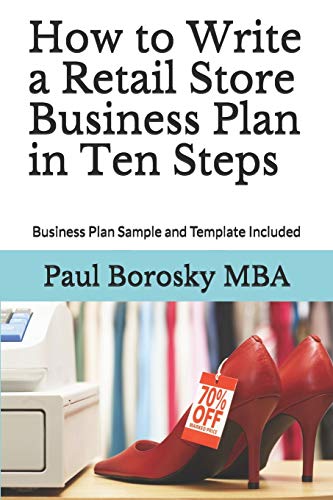
Your retail store plan follows the same ten steps.
Dr. Paul's How to Write a Retail Store Business Plan in Ten Steps walks you through every section with a full retail sample plan. For the general method, his How to Write a Business Plan in Ten Steps, Fifth Edition covers each section in order. Pair either with the retail store template and you have the structure and the numbers.
Written by Dr. Paul Borosky, DBA, MBA, current college professor, business consultant, and author with 14+ years and 1,000+ businesses served.
This page is for general educational purposes only. It is not financial, investment, legal, or tax advice.