Strategy · Glossary
Small Business Strategy Glossary: Strategy Terms in Plain English
Gap analysis. SWOT. Strategic drift. Strategy talk can sound like it belongs in a boardroom. This strategy glossary puts 80 terms from the book in plain English, each one linked to the foundation that shows a small business how to use it.
Last Updated: 11/02/2026 · Written by Dr. Paul Borosky, DBA, MBA
Prefer to Watch? Start Here
Dr. Paul walks through his strategic plan process for small businesses, the same path from vision to action that the terms below describe.
The Quality Strategic Plan Process for Small Businesses
Dr. Paul Borosky, DBA, MBA. (10:10)
The Terms
Strategy Terms Every Owner and Student Should Know
Each term below is taught by name in Strategy for Small Businesses, Book 6 of Dr. Paul's Fabled Forest Business School Series. The tag under each definition shows the chapter that teaches it. Click it to see the full foundation, or start with the small business strategy guide.
Story words from the forest are left off this list: coins (the forest's money), fire or foundation (Doctor Owl's first question), the Talon Way (the tempting shortcut in several chapters), and the ladder. In the story, the ladder is how the owl pictures a plan: the vision sits on top, and each step below it covers a shorter stretch of time, ending with today. When a term below says rung, it means one of those steps.
- Action Plan
- The list of tasks that turns your strategy into this month's work, with a person, a deadline, and a cost on each line, plus a set day to review it.
- Chapter 17: Action Plan →
- Align
- The second strategy job in the book: setting objectives at every level so each one supports the level above, and making sure every person knows their part.
- Introduction: Small Business Strategy Guide →
- Assess
- The third strategy job in the book: taking an honest look at your business and its surroundings, and revising higher objectives when that look shows one is wrong.
- Introduction: Small Business Strategy Guide →
- Busy Is Not Direction
- A packed calendar can mask the fact that the business is not moving toward any particular goal.
- Chapter 1: Strategic Thinking →
- The Check Date
- A fixed day, usually weekly, when you go through each line of the action plan and ask whether it got done, and if not, what stopped it.
- Chapter 17: Action Plan →
- Choosing a Few Things to Do Well
- The core of strategic focus: doing less, on purpose, so you can do it better.
- Chapter 8: Strategic Focus →
- Coins, Creatures, Customers, and Months
- The forest's four plain ways to measure a gap. In everyday business terms: money, people, customers, and time.
- Chapter 4: Gap Analysis →
- Competing for the Same Coin, Not the Same Product
- Your competition is anyone your customer might spend that same money on instead of you, even if they sell something completely different.
- Chapter 14: Competitive Analysis →
- Competitive Analysis
- An honest comparison between your business and everyone chasing the same customer's money, judged on the things that customer cares about most.
- Chapter 14: Competitive Analysis →
- Current State
- Where your business stands right now in revenue, people, and customers.
- Chapter 4: Gap Analysis →
- Deciding What Success Looks Like First
- Writing down, before a test starts, which result counts as a win and what you will do if you miss it.
- Chapter 18: Pilot Testing →
- Each Objective Climbs a Long-Term Rung
- Every short-term objective should move you measurably closer to a three-year or five-year objective. If it does not, it is routine upkeep, not an objective.
- Chapter 6: Short-Term Objectives →
- Each One Serving an Objective
- Every functional strategy states which objective it exists to reach.
- Chapter 15: Functional Strategy →
- The Economy
- Whether people in general are borrowing, spending, or holding back. It is one of the areas an environmental scan checks.
- Chapter 12: Environmental Scanning →
- Environmental Scanning
- A regular, scheduled check on what is changing outside your business, so you see it coming before it shows up at your door.
- Chapter 12: Environmental Scanning →
- Envision
- The first strategy job in the book: describing your five-year picture, then writing the vision and mission from it.
- Introduction: Small Business Strategy Guide →
- Every Rung Points at the One Above It
- Each level of the plan serves the next one up: today's work feeds this month's target, the month feeds the six-month goal, and so on all the way to the five-year picture.
- Chapter 9: Strategic Alignment →
- Everyone Knowing Their Rung
- Every person can tell you what they are responsible for this month and today.
- Chapter 9: Strategic Alignment →
- Execute
- The fourth strategy job in the book: picking strategies for operations, sales, and finance, breaking them into a list of tasks, running small tests, checking results, and fitting the whole plan on one page.
- Introduction: Small Business Strategy Guide →
- Fewer Is Stronger
- Keep each level to about three objectives. Set more than that and often none of them get finished.
- Chapter 6: Short-Term Objectives →
- Finance Strategy
- The plan for how the business will fund what its objectives require, and how much it will hold on to.
- Chapter 15: Functional Strategy →
- Five-Year and Three-Year Objectives
- The top two levels beneath the vision: a small number of results that turn the five-year picture into reality.
- Chapter 5: Long-Term Objectives →
- The Five-Year Picture
- A description of your business five years from now in four parts: where it operates, how many people it has, what it sells, and how much revenue it brings in.
- Chapter 1: Strategic Thinking →
- Functional Strategy
- A separate plan for each main area of the business, such as operations, sales, and finance, built to serve the objectives above it.
- Chapter 15: Functional Strategy →
- Gap Analysis
- Measuring how far your business is today from where your vision says it will be.
- Chapter 4: Gap Analysis →
- A Growing One Next Door
- A neighboring market, often sharing some of your customers or skills, that is expanding while your own market shrinks.
- Chapter 13: Industry Life Cycle →
- An Honest Look
- The real purpose of a SWOT analysis. It is only as useful as the truth you put into it.
- Chapter 11: SWOT Analysis →
- Industry Life Cycle
- The path most markets travel over time: an introduction with few buyers, fast growth, a leveling off at maturity, and decline as the whole market shrinks.
- Chapter 13: Industry Life Cycle →
- Keep, Change, or Drop
- The three choices a strategy review makes about each piece of the plan.
- Chapter 19: Strategy Review →
- The Ladder as the Test
- Holding each new opportunity up to your objectives and asking one question: does this help you climb, or does it pull you off course?
- Chapter 16: Opportunity Cost →
- Long-Term Objectives
- A few clear results, set five and three years out, that turn the vision into reality. Strong ones are measurable, limited in number, and flow down from the vision.
- Chapter 5: Long-Term Objectives →
- Looking Outside the Job Site
- Checking, on a set schedule, the places where change tends to appear first: rules, materials and prices, customers, competitors, and the economy.
- Chapter 12: Environmental Scanning →
- Measurable
- An objective that includes a number, so you can clearly say whether you hit it or not.
- Chapter 5: Long-Term Objectives →
- The Mission as a Filter
- Testing every product, service, and request against your mission before agreeing to it, then asking whether it is worth the time and money it will take.
- Chapter 3: Mission Statement →
- Mission Statement
- A single plain sentence that says what your business does today, who it serves, and why.
- Chapter 3: Mission Statement →
- Monthly and Daily Objectives
- This month's targets and today's short task list, suggested by the team and agreed with the owner, all serving the six-month objective.
- Chapter 7: Operational Planning →
- The Next Best Use of What You Give Up
- How you measure opportunity cost: what those hours, vehicles, rooms, or money could have produced somewhere else.
- Chapter 16: Opportunity Cost →
- No Is a Strategy
- Declining work that does not fit is part of your plan working, not a sign the plan failed.
- Chapter 16: Opportunity Cost →
- The One-Page Plan
- A strategic plan short enough for anyone to read in a few minutes, with the detailed records and projections filed behind it.
- Chapter 20: The Strategic Plan →
- One-Year and Six-Month Objectives
- The two levels of objectives that sit right under the long-term ones.
- Chapter 6: Short-Term Objectives →
- Operational Planning
- Breaking six-month objectives down into goals for each month and each day.
- Chapter 7: Operational Planning →
- Operations Strategy
- The plan for how the business will produce or deliver the work its objectives call for.
- Chapter 15: Functional Strategy →
- Opportunities and Threats
- The external half of a SWOT analysis: what the market could offer you and what it could take away.
- Chapter 11: SWOT Analysis →
- Opportunity Cost
- The value of whatever you pass up when you pick one option over another.
- Chapter 16: Opportunity Cost →
- An Owner and a Date for Every Step
- Each line of an action plan carries one person's name and a specific day, never a vague promise that someone will get to it soon.
- Chapter 17: Action Plan →
- The Owner Owns the Top
- The owner or leadership team is responsible for every objective from six months out to five years, and checks that each month lines up with the year.
- Chapter 7: Operational Planning →
- The Picture as the Filter
- Using your five-year picture, and the vision behind it, to sort which offerings and requests stay and which go.
- Chapter 8: Strategic Focus →
- A Picture That Was Never Redrawn
- A vision the business reached years ago and then stopped revisiting while the world kept changing. It is a frequent cause of strategic drift.
- Chapter 10: Strategic Drift →
- Pilot Testing
- Running a small, low-cost trial of an idea before you commit to the full rollout.
- Chapter 18: Pilot Testing →
- A Plan Others Can Use
- A plan written for the people who will act on it or pay for it, including your team, lenders, partners, and you on a hectic Monday.
- Chapter 20: The Strategic Plan →
- The Question the Test Must Answer
- The specific thing a pilot is supposed to reveal, stated as a result you can count.
- Chapter 18: Pilot Testing →
- The Review Date
- The day of your next strategy review, chosen ahead of time and written right on the plan.
- Chapter 19: Strategy Review →
- Sales Strategy
- The plan for where and how you will sell enough to meet your objectives.
- Chapter 15: Functional Strategy →
- Saying It Back
- A simple alignment test: each person explains their piece of the plan in their own words.
- Chapter 9: Strategic Alignment →
- Saying No on Purpose
- Deliberately deciding, with your five-year picture in hand, which activities the business will quit and which it will never take on.
- Chapter 8: Strategic Focus →
- Short-Term Objectives
- The few results you aim to hit over the coming year and the coming six months.
- Chapter 6: Short-Term Objectives →
- A Shrinking Market
- A market in decline, where even great service cannot restore the old sales numbers.
- Chapter 13: Industry Life Cycle →
- A Small Test Before a Big Bet
- Running an idea at a size where a failure would not hurt much, before betting on the full-size version.
- Chapter 18: Pilot Testing →
- Strategic Alignment
- When all levels of the business, and all the people in it, are aimed at one shared vision.
- Chapter 9: Strategic Alignment →
- Strategic Drift
- The slowly widening gap between what your business does and what the market needs today.
- Chapter 10: Strategic Drift →
- Strategic Focus
- Picking a few things to do well and deliberately turning down the rest.
- Chapter 8: Strategic Focus →
- Strategic Plan
- One document that pulls together your vision, mission, objectives, outside scan, strategies, and near-term actions.
- Chapter 20: The Strategic Plan →
- Strategic Thinking
- Stepping away from daily tasks to ask where the business is headed and why.
- Chapter 1: Strategic Thinking →
- Strategy
- Deciding where your business is headed, why it is going there, and what it will refuse to do along the way.
- Introduction: Small Business Strategy Guide →
- Strategy Review
- A regular, scheduled check of your plan that compares what really happened with what you intended.
- Chapter 19: Strategy Review →
- Strengths and Weaknesses
- The internal half of a SWOT analysis: what your business does well and what it does poorly.
- Chapter 11: SWOT Analysis →
- SWOT Analysis
- A four-box review of a business: strengths and weaknesses on the inside, opportunities and threats on the outside.
- Chapter 11: SWOT Analysis →
- The Team Owns the Bottom Rungs
- Front-line managers and staff are responsible for this month's and today's objectives, and they decide how to reach them.
- Chapter 7: Operational Planning →
- Testing an Objective Against the Truth
- Using an honest look at the business to confirm an objective, or to send you back to change it.
- Chapter 11: SWOT Analysis →
- A Vision as a Filter
- Using your vision to sort ideas, projects, and offers into those that move you toward the picture and those that can wait.
- Chapter 2: Vision Statement →
- Vision Statement
- One or two sentences describing where the business is headed, based on your five-year picture.
- Chapter 2: Vision Statement →
- Vision versus Mission
- Your vision is the destination. Your mission is what the business does every day on the way there.
- Chapter 3: Mission Statement →
- Walking the Ladder
- Reviewing a plan from the highest objective downward, since an error near the top affects every level below it.
- Chapter 19: Strategy Review →
- What Customers Compare
- The factors customers really choose on, like speed, price, comfort, convenience, and quality, rather than the things you are proudest of.
- Chapter 14: Competitive Analysis →
- What Each Step Costs
- The money each line of an action plan requires, settled before the work begins.
- Chapter 17: Action Plan →
- What the Business Does, for Whom, and Why
- The three building blocks of a mission statement.
- Chapter 3: Mission Statement →
- The Whole Ladder on One Page
- All your objectives on a single sheet, top to bottom, from five years out to the current month, with the supporting strategies under them and the next review date at the foot.
- Chapter 20: The Strategic Plan →
- Working in the Business
- Doing the daily jobs yourself: serving customers, solving problems, covering shifts.
- Chapter 1: Strategic Thinking →
- Working on the Business
- Stepping outside the daily work to view the business as a whole and decide where it is going.
- Chapter 1: Strategic Thinking →
Knowing the word does not set the direction. Deciding does.
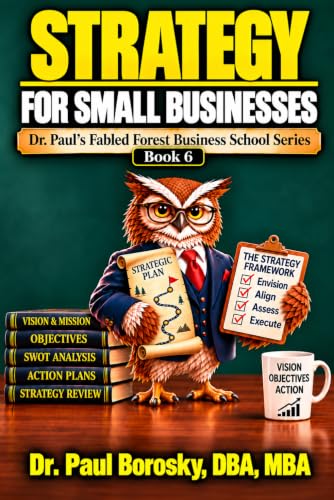
Every term here shows up in the book inside a real problem: a mayor who said yes to every tour anyone asked for, five resorts sketched in the dirt, a market with ten competitors on every branch. 20 foundations, a Nutshell for each, and the Owner's Scorecard. Book 6 of Dr. Paul's Fabled Forest Business School Series.
Put the Terms to Work
Start With the Foundation You Need
A definition helps you follow the conversation. A foundation helps you decide where the business is going. These are the ones owners ask about most.
All 20 are on the small business strategy guide, with a quick self-check and a free sample chapter. More subjects are in the Small Business Education Center.
Related glossaries: Small Business Sales Glossary, Small Business Marketing Glossary, and Small Business Management Glossary.
Written by Dr. Paul Borosky, DBA, MBA, business consultant and author who helps owners decide where the business is going and build every step between that picture and Monday morning. Want a second set of eyes on your plan? Dr. Paul works with owners one-on-one.
This page is for general educational purposes only. It is not legal, financial, or other professional advice. The Fabled Forest and its characters are fictional. For decisions about your own business, consult a qualified professional.