
Dr. Paul Borosky, DBA, MBA
College Professor · Business Consultant
How to Calculate WACC Weighted Average Cost of Capital
Your money is not free. Lenders want interest and owners want a return. WACC blends both into one rate that every project has to beat. Watch Dr. Paul run the formula, then follow the worked example below.
Last Updated: 10/30/2026 · Written by Dr. Paul Borosky, DBA, MBA
Watch First
Watch: Calculating WACC Using a Formula
The Short Answer
What Is the WACC Formula?
WACC is the average rate a company pays for its money, weighted by how much comes from equity and how much comes from debt. Debt gets a tax discount because interest is deductible. The result is the minimum return a new project must earn to create value.
WACC = (E/V × Re) + (D/V × Rd × (1 − T))
- E
- Market value of equity
- D
- Market value of debt
- V
- Total capital: E + D
- Re
- Cost of equity: the return owners require
- Rd
- Cost of debt: the interest rate on borrowing
- T
- Corporate tax rate, as a decimal
What Does Your Money Really Cost?
Step by Step
How Do You Calculate WACC?
Say a company is funded with $600,000 of equity and $400,000 of debt. Owners require 12%. The loan costs 7%. The tax rate is 25%.
- 1
Add up total capital
V = $600,000 + $400,000 = $1,000,000.
- 2
Find the weights
E/V = $600,000 ÷ $1,000,000 = 60%. D/V = $400,000 ÷ $1,000,000 = 40%. The weights must add to 100%.
- 3
Weight the cost of equity
0.60 × 12% = 7.20%.
- 4
Find the after-tax cost of debt
7% × (1 − 0.25) = 5.25%. Interest is tax deductible, so the real cost of the loan is lower than the sticker rate.
- 5
Weight the cost of debt
0.40 × 5.25% = 2.10%.
- 6
Add the pieces
7.20% + 2.10% = 9.30%. Any project this company takes on needs to earn more than 9.30% to add value.
Where does the 12% cost of equity come from? A common method is CAPM: Re = risk-free rate + beta × market risk premium. With an example risk-free rate of 4%, a beta of 1.2, and a 6% premium, Re = 4% + 1.2 × 6% = 11.20%.
Owners often think debt is "cheap" and equity is "free." Neither is true. Equity is the most expensive money in the business, because owners take the most risk. WACC puts a real price on that risk, so decisions stop being based on gut feel.
In Excel
How Do You Calculate WACC in Excel?
Lay the inputs out in cells and let one formula do the rest. With the example above:
| Cell | Input or formula | Result |
|---|---|---|
| B1: Equity | 600000 | $600,000 |
| B2: Debt | 400000 | $400,000 |
| B3: Cost of equity | 12% | 12.00% |
| B4: Cost of debt | 7% | 7.00% |
| B5: Tax rate | 25% | 25.00% |
| B6: Total capital | =B1+B2 | $1,000,000 |
| B7: After-tax cost of debt | =B4*(1-B5) | 5.25% |
| B8: WACC | =B1/B6*B3+B2/B6*B4*(1-B5) | 9.30% |
Format B8 as a percentage with two decimals. Change the debt in B2 and you can see right away how a new loan shifts the hurdle rate.
Avoid These
What Are the Most Common WACC Mistakes?
- Skipping the tax shield. Use Rd × (1 − T), not the raw interest rate. Leaving it out overstates WACC.
- Using book values when market values exist. For a public company, equity should be market value. For a small private company, a reasonable estimate is fine, but say so.
- Weights that do not add to 100%. Check E/V + D/V = 1 every time.
- Applying the tax rate to equity. Dividends and owner returns are not tax deductible. Only debt gets the (1 − T).
- Using one WACC for every project. A risky new venture deserves a higher hurdle than a routine equipment upgrade.
Real World Use
How a Manager Uses WACC
Setting the hurdle rate for next year's project requests
A finance manager is asked to set the hurdle rate leadership will use to approve projects. The company has $3,500,000 of equity and $1,500,000 of debt. Owners expect 14%. The bank loan costs 8%. The tax rate is 21%.
Total capital is $5,000,000, so the weights are 70% equity and 30% debt. Equity piece: 0.70 × 14% = 9.80%. After-tax debt: 8% × (1 − 0.21) = 6.32%, and 0.30 × 6.32% = 1.90%. WACC = 11.70%.
The slide is simple: "Projects must clear 11.70%." A proposal returning 10.5% gets sent back. One returning 13% moves forward. Showing the inputs on the slide, not just the answer, is what earns leadership's trust in the number.
Keep Going
More Videos in This Series
Capital Budgeting Example Solved With NPV, IRR, and Payback
Dr. Paul uses a discount rate like WACC to accept or reject a project. (42:43)
Calculate Beta of a Portfolio in Excel
Dr. Paul calculates beta, the risk input behind the cost of equity. (6:47)
Expected Rate of Return
Dr. Paul explains how investors set the return they expect to earn. (3:03)
Questions
WACC Questions People Ask
What is the WACC formula?
Why is the cost of debt multiplied by one minus the tax rate?
What is a good WACC?
How do you calculate WACC in Excel?
=B1/(B1+B2)*B3+B2/(B1+B2)*B4*(1-B5). With $600,000 equity, $400,000 debt, 12%, 7%, and 25%, the result is 9.30%.Is WACC the same as the hurdle rate?
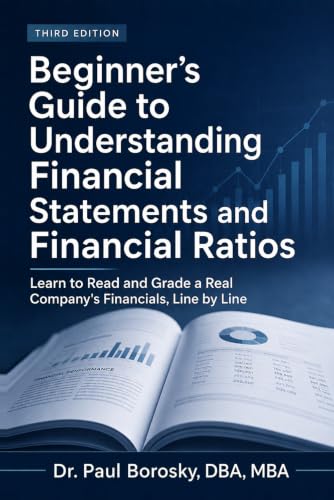
Cost of capital starts on the balance sheet.
Dr. Paul's Beginner's Guide to Understanding Financial Statements and Financial Ratios shows where debt and equity sit on Apple's actual 10-K and how ratios like debt to equity connect to the cost of money, in plain English.
Written by Dr. Paul Borosky, DBA, MBA, current college professor, business consultant, and author with 14+ years and 1,000+ businesses served.
This page is for general educational purposes only. It is not financial, investment, legal, or tax advice.