
Dr. Paul Borosky, DBA, MBA
College Professor · Business Consultant
How to Calculate Dividend Yield Current and Expected, With Excel Steps
Dividend yield tells you how much cash a stock pays you each year for every dollar of price. Current yield uses the dividend just paid. Expected yield uses next year's dividend. Watch Dr. Paul solve it both ways, then follow the steps below.
Last Updated: 10/30/2026 · Written by Dr. Paul Borosky, DBA, MBA
Watch First
Watch: Dividend Yield Problem Solved in Excel and by Hand
The Short Answer
What Is the Dividend Yield Formula?
Dividend yield equals the annual dividend divided by the current stock price. Current yield uses the dividend paid over the past year (D0). Expected yield uses the dividend forecast for next year (D1), which is D0 grown by the expected growth rate.
Current = D0 ÷ P0 | Expected = D1 ÷ P0
- D0
- Annual dividend just paid (add up all quarterly payments)
- D1
- Next year's expected dividend: D0 × (1 + g)
- P0
- Current stock price
- g
- Expected dividend growth rate, as a decimal
Want to Compare Returns the Right Way?
Step by Step
How Do You Calculate Current and Expected Dividend Yield?
Say a stock trades at $50.00. It paid $2.00 in dividends over the past year, and dividends are expected to grow 5% a year.
- 1
Write down what you know
D0 = $2.00. P0 = $50.00. g = 5%, or 0.05.
- 2
Find the current yield
$2.00 ÷ $50.00 = 0.04, or 4.00%.
- 3
Grow the dividend one year
D1 = $2.00 × 1.05 = $2.10.
- 4
Find the expected yield
$2.10 ÷ $50.00 = 0.042, or 4.20%.
- 5
Add growth for total expected return
Under the constant growth model, expected return = D1 ÷ P0 + g = 4.20% + 5.00% = 9.20%. Yield is only the cash part of the return.
A yield can rise for a bad reason. If this $50 stock falls to $40 and the $2.00 dividend stays put, the yield jumps to 5.00%. Nothing got better. The price dropped. Before you chase a high yield, ask why the price is low and whether the dividend is safe.
In Excel
How Do You Calculate Dividend Yield in Excel?
Put the dividend in B1, the price in B2, and the growth rate in B3. Then divide.
| Problem | Excel formula | Answer |
|---|---|---|
| Current yield: $2.00 dividend, $50.00 price | =2/50 | 4.00% |
| Expected yield: same stock, 5% growth | =2*(1+5%)/50 | 4.20% |
| Quarterly $0.48 dividend, $64.00 price | =(0.48*4)/64 | 3.00% |
| Same $2.00 dividend after price falls to $40.00 | =2/40 | 5.00% |
With cell references the formulas become =B1/B2 for current yield and =B1*(1+B3)/B2 for expected yield. Format the result as a percentage with two decimals.
Avoid These
What Are the Most Common Dividend Yield Mistakes?
- Using one quarterly payment. A $0.48 quarterly dividend is $1.92 a year. Annualize before you divide.
- Mixing up D0 and D1. Current yield uses the dividend already paid. Expected yield uses next year's. Read the question carefully.
- Treating yield as total return. Yield ignores price growth. Total expected return adds the growth rate.
- Chasing the highest yield. A falling price raises the yield. Check why before buying.
- Comparing to preferred stock without adjusting. A preferred dividend is fixed. A common dividend can grow or be cut. The yields carry different risk.
Real World Use
How a Student Uses Dividend Yield
Two stocks, two yields, one right comparison
The question: "Stock A pays $1.80 a year and trades at $48.00, with 3% expected growth. Stock B pays $3.10 and trades at $95.00, with 7% expected growth. Which has the higher yield, and which has the higher expected return?"
Current yields: A = $1.80 ÷ $48.00 = 3.75%. B = $3.10 ÷ $95.00 = 3.26%. A wins on yield. Expected yields: A = $1.854 ÷ $48.00 = 3.86%. B = $3.317 ÷ $95.00 = 3.49%.
Now add growth. A: 3.86% + 3% = 6.86%. B: 3.49% + 7% = 10.49%. B wins on total expected return. That is the full answer: the higher yield is not always the better investment.
Keep Going
More Videos in This Series
Constant Growth Formula for Stocks
Dr. Paul values a stock whose dividend grows every year. (7:56)
Preferred Stock Price and Required Rate of Return
Dr. Paul prices a fixed dividend and solves for its required return. (12:41)
Holding Period Return Calculations
Dr. Paul combines dividends and price change into one total return. (3:51)
Questions
Dividend Yield Questions Students Ask
What is the dividend yield formula?
What is the difference between current and expected dividend yield?
How do you calculate dividend yield with quarterly dividends?
Is a higher dividend yield always better?
How do you calculate dividend yield in Excel?
=B1/B2. For expected yield, add the growth rate in B3 and use =B1*(1+B3)/B2. Format the cell as a percentage.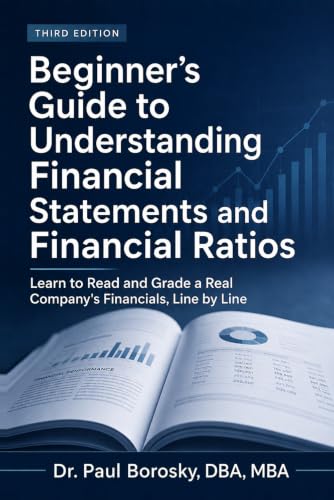
Dividends make more sense when you can find them on the statements.
Dr. Paul's Beginner's Guide to Understanding Financial Statements and Financial Ratios shows where dividends paid show up on Apple's actual 10-K and how they connect to equity and cash flow, in the same plain English he uses in class.
Written by Dr. Paul Borosky, DBA, MBA, current college professor, business consultant, and author with 14+ years and 1,000+ businesses served.
This page is for general educational purposes only. It is not financial, investment, legal, or tax advice.