
Dr. Paul Borosky, DBA, MBA
College Professor · Business Consultant
How to Calculate the Expected Rate of Return For a Stock and a Portfolio
Expected return is a probability weighted average: multiply each possible return by its chance of happening, then add. Watch Dr. Paul explain it, then work the same kind of problem below and check it in Excel.
Last Updated: 10/30/2026 · Written by Dr. Paul Borosky, DBA, MBA
Watch First
Watch: Expected Rate of Return
The Short Answer
What Is the Expected Rate of Return?
The expected rate of return is the average return you would earn if the same bet played out many times. Multiply each possible return by its probability, then add the results. It is not a guarantee. It is the center of gravity of all the outcomes.
E(R) = (p1 × R1) + (p2 × R2) + … + (pn × Rn)
- E(R)
- Expected rate of return
- p
- Probability of each outcome, as a decimal. All of them must add to 1.00
- R
- Return in that outcome, as a decimal (20% = 0.20)
Ready to Weigh Your Next Investment?
Step by Step
How Do You Calculate Expected Return With Probabilities?
A stock has three possible outcomes next year. A strong economy has a 25% chance and the stock returns 20%. A normal economy has a 50% chance and it returns 10%. A recession has a 25% chance and it loses 5%.
- 1
Check that the probabilities add to 100%
0.25 + 0.50 + 0.25 = 1.00. If they do not, stop. The problem is set up wrong.
- 2
Multiply each return by its probability
Strong: 0.25 × 0.20 = 0.0500. Normal: 0.50 × 0.10 = 0.0500. Recession: 0.25 × (−0.05) = −0.0125.
- 3
Add the results
0.0500 + 0.0500 − 0.0125 = 0.0875, or 8.75%. That is the expected return on the stock.
- 4
Move up to a portfolio
Say a bond fund has an expected return of 5.00%. Put 60% of your money in the stock and 40% in the bond fund. Portfolio expected return is the weighted average: (0.60 × 8.75%) + (0.40 × 5.00%) = 5.25% + 2.00% = 7.25%.
- 5
Read what it means
No single year will likely return exactly 8.75%. The stock returns 20%, 10%, or −5%. Expected return is the long run average you plan around.
Students lose points on the negative return more than anything else. A loss of 5% times a 25% chance is −0.0125, and it pulls the average down. Drop the minus sign and you get 11.25%, a wrong answer that looks perfectly reasonable.
In Excel
How Do You Calculate Expected Return in Excel?
Put the probabilities in B2:B4 and the returns in C2:C4. One function does the whole calculation: =SUMPRODUCT(B2:B4,C2:C4). It multiplies each pair and adds the results.
| Problem | Excel formula | Answer |
|---|---|---|
| Check the probabilities | =SUM(B2:B4) | 100.00% |
| Stock expected return (25/50/25 at 20%, 10%, −5%) | =SUMPRODUCT(B2:B4,C2:C4) | 8.75% |
| Bond fund (25/50/25 at 8%, 5%, 2%) | =SUMPRODUCT(B2:B4,D2:D4) | 5.00% |
| Portfolio, 60% stock and 40% bond fund | =0.6*8.75%+0.4*5% | 7.25% |
| Three stocks: 50%, 30%, 20% weights at 9%, 12%, 4% | =SUMPRODUCT({0.5,0.3,0.2},{0.09,0.12,0.04}) | 8.90% |
Same function, two jobs. For a single stock, the first range is probabilities. For a portfolio, the first range is weights. Either way, format the result cell as a percentage.
Avoid These
What Are the Most Common Expected Return Mistakes?
- Dropping the negative sign. A loss is a negative return. Leave it negative in the formula.
- Probabilities that do not add to 100%. Check with
=SUM()before you trust the answer. - Taking a simple average. Averaging 20%, 10%, and −5% gives 8.33%. That ignores that the normal case is twice as likely.
- Mixing percents and decimals. Use 0.20 with 0.25, or 20% with 25%. Never 20 with 0.25.
- Treating expected return as a promise. It is an average. Risk is how far real results can land from it.
Real World Use
How a Student Uses Expected Return
Picking between scenarios on a finance final
The question: "A tech stock has a 30% chance of returning 25%, a 40% chance of returning 12%, and a 30% chance of losing 10%. What is its expected return?"
Set it up: (0.30 × 0.25) + (0.40 × 0.12) + (0.30 × −0.10) = 0.075 + 0.048 − 0.030 = 0.093, or 9.30%. In Excel, =SUMPRODUCT({0.3,0.4,0.3},{0.25,0.12,-0.1}) returns the same 9.30%.
Then add the line that earns the last points: the expected return is 9.30%, but there is a 30% chance of losing money. A higher expected return does not mean a safer stock.
Keep Going
More Videos in This Series
How to Build an Expected Rate of Return Template in Excel
Dr. Paul builds a reusable sheet that solves expected return problems in seconds. (5:30)
Using Excel to Calculate Gain or Loss and Weight of Stocks in a Portfolio
Dr. Paul shows how to find the portfolio weights you need for a weighted average. (13:41)
How to Calculate the Beta of a Portfolio in Excel
Dr. Paul uses the same weighted average idea to measure portfolio risk. (6:47)
Questions
Expected Return Questions Students Ask
What is the formula for expected rate of return?
How do you calculate expected return in Excel?
=SUMPRODUCT(B2:B4,C2:C4). For a 25/50/25 split at 20%, 10%, and −5%, Excel returns 8.75%.How do you calculate the expected return of a portfolio?
Is expected return the same as average return?
Can expected return be negative?
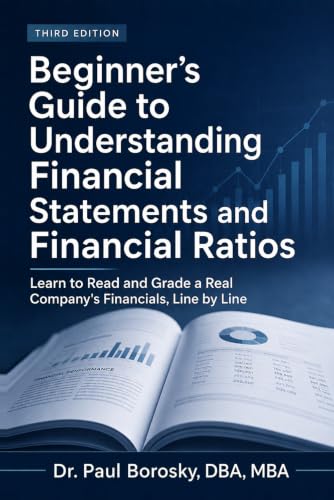
Expected return is only as good as the numbers behind it.
Dr. Paul's Beginner's Guide to Understanding Financial Statements and Financial Ratios teaches you to read the real statements behind a stock, using Apple's actual 10-K, so your return assumptions start from facts.
Written by Dr. Paul Borosky, DBA, MBA, current college professor, business consultant, and author with 14+ years and 1,000+ businesses served.
This page is for general educational purposes only. It is not financial, investment, legal, or tax advice.