
Dr. Paul Borosky, DBA, MBA
Business Plan Writer · Business Consultant
Restaurant SWOT Analysis: What Goes in Each Box? Specific Beats Impressive
Almost every restaurant SWOT lists “great food” as a strength and “competition” as a threat. That tells a lender nothing.
Written by Dr. Paul Borosky, DBA, MBA
The Definition
What Is a Restaurant SWOT Analysis?
A restaurant SWOT analysis is a strategic planning tool that identifies the restaurant’s internal Strengths and Weaknesses and its external Opportunities and Threats. It appears in the industry analysis section of a business plan and is used to shape strategy, marketing, and risk planning.
“Two boxes are about you: what you do well and what you do poorly. Two boxes are about the world outside: what could help you and what could hurt you. Fill all four honestly and specifically, and the plan writes half of itself.”
Need the answer fast? Read the gold Short Answer boxes and the numbered steps. Want the full picture? Follow Startup Steve the monkey, who is opening a noodle bar, from Dr. Paul’s Fabled Forest, as his SWOT analysis fits on a single banana peel. The story shows up in a few short gold notes along the way. The sample SWOT sits in one section, clearly marked.
Get Your Restaurant Plan Written, or Build It Yourself
Lenders want covers, prime cost, and break even before they read the menu. Pick how you want to get there.
Business Consulting
Packed dining room and a thin bank balance? Dr. Paul helps restaurant owners sort out prime cost, cash, staffing, and menu pricing.
See consulting options →Business Plan Writing
FeaturedCovers by shift, prime cost, and break even, built into one plan your lender and landlord can follow. Dr. Paul writes it with you.
Start your plan →Restaurant Business Plan Template
A Word plan and an Excel model built around covers, check size, and food cost, with video tutorials for both.
See the template →Small Business Education
Free guides on funding, financial statements, and running the business, plus Dr. Paul’s plan-writing videos.
Start learning →From Dr. Paul’s Fabled Forest
Meet Steve: The Banana Peel SWOT
Some lessons stick better as a story. Dr. Paul’s Fabled Forest is his business school told through a forest full of small business owners. Doctor Owl, a dry-witted consultant who lives in the Lone Oak, helps them fix the same problems real owners face. Today he finds Startup Steve the monkey back at the Lone Oak, proudly holding up the SWOT analysis for his noodle bar. It fits on one banana peel.
STEVE: (reading from the peel) Strengths: great noodles. Weaknesses: none. Opportunities: everybody loves noodles. Threats: competition. Done!
DOCTOR OWL: Which competition?
STEVE: You know. Other restaurants.
DOCTOR OWL: Fast Frankie’s is two doors down. He sells late-night food until the moon sets. Is that a threat?
STEVE: (writing on the peel) Oh. Yes. That’s a big one.
DOCTOR OWL: And weaknesses. None at all?
STEVE: (quieter) Well. I’ve never run a kitchen. And I’ve never opened anything that lasted past the first winter.
DOCTOR OWL: Now you are writing a SWOT.
An original Fabled Forest moment. Similar stories about Doctor Owl and the forest’s owners are in Strategy for Small Businesses, Book 6 of Dr. Paul’s Fabled Forest Business School.
Steve has a decision to make. Keep reading. You’ll see what he does, and why it works for your restaurant too.
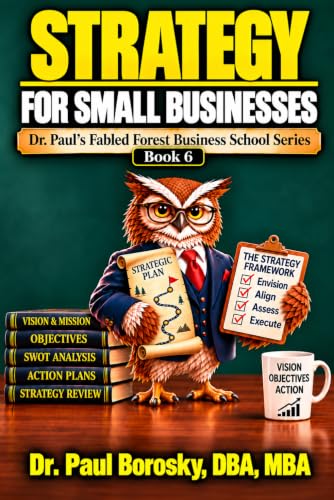 Similar stories in Strategy for Small Businesses
Dr. Paul’s Fabled Forest Business School, Book 6 See the Books →
The Problem
Why Do Most Restaurant SWOTs Say Nothing?
A vague SWOT is a wasted page. “Great food” is a claim every restaurant makes. “Competition” is true for every business. Neither helps a lender judge your restaurant, and neither helps you plan.
Dr. Paul’s How to Write a Restaurant Business Plan in Ten Steps puts the SWOT inside the industry analysis, right before the competitive analysis. Its job is to turn research into strategy.
Steve’s first SWOT had no weaknesses and one generic threat. His real weaknesses were the most useful thing on the page.
Show the Example
What Does a Good Restaurant SWOT Look Like?
Here is a sample for a new neighborhood noodle bar. Illustration only. Notice how specific each line is.
Strengths
- Hand-pulled noodles no one else nearby makes
- Former restaurant space with a working hood
- Owner savings in the deal
Weaknesses
- Owner has never run a kitchen: hiring an experienced kitchen manager
- New name with no following
- Small dining room limits weekend sales
Opportunities
- Lunch crowd from nearby offices
- Takeout and delivery for the late-shift hospital staff
- No noodle concept within the neighborhood
Threats
- Late-night competitor two doors down
- Rising ingredient costs
- Slow winter months on the walking street
Fill Each Box
How Do You Fill In Each Box of a Restaurant SWOT?
- 1
Strengths: specific, provable, hard to copy
A signature dish, a location, a skill, a lease term. Not “great service.”
- 2
Weaknesses: the ones a lender will spot anyway
Name them, then name the fix. It builds trust.
Steve’s FixSteve added his two real weaknesses, and next to each one, how he would handle it. The first fix: hire a kitchen manager who has done this before.
- 3
Opportunities: slow nights, catering, private events
Outside openings you can actually reach in year one.
- 4
Threats: costs, competitors, and the calendar
Named competitors, cost trends, and seasonal slowdowns.
- 5
Turn it into strategy
Use strengths to grab opportunities. Fix weaknesses before threats find them.
From Dr. Paul’s Work as a Business Plan Writer
What a Business Plan Writer Looks for in a SWOT
When Dr. Paul reviews a restaurant SWOT, the weaknesses box is the first place he looks. An empty one is a red flag. A specific one, with a fix next to each item, is one of the most convincing parts of a plan.
Lenders know every restaurant has weaknesses. They want to see that the owner knows them too.
A SWOT is not a brag sheet. It is an honest map of where you stand, and the strategy writes itself from there.
From Dr. Paul’s Fabled Forest
What Steve Did Next
Steve came back with a full sheet of paper this time. No banana peel.
STEVE: Strengths: hand-pulled noodles, a space with a hood already in it. Weakness: never ran a kitchen. Fix: hiring someone who has.
DOCTOR OWL: And Frankie two doors down?
STEVE: He owns late night. So I’m going after lunch. The office crowd has nowhere to go.
DOCTOR OWL: That is not a SWOT anymore, Steve. That is a strategy.
STEVE: (grinning) Is that good?
DOCTOR OWL: It is the point.
The lesson for your restaurant: Make every line of your SWOT specific, name your real weaknesses with a fix beside each, and turn the four boxes into a strategy.
In Your Business Plan
How Does the SWOT Fit Your Restaurant Business Plan?
The SWOT is a bridge between your research and your plan. Related guides: What Do Restaurant Customers Really Want?.
- 1
It follows your industry research
Threats and opportunities come from what you found.
- 2
It feeds your competitive analysis
Named competitors and how you will be different.
- 3
It shapes your marketing plan
Your strengths become your message.
- 4
It shows up in your risk planning
Each weakness and threat gets a response.
This is one piece of the full plan. See How to Write a Restaurant Business Plan for every section, start to finish.
Want a SWOT and strategy a lender can trust?Dr. Paul writes restaurant business plans with honest, specific analysis that turns into strategy.
Questions
Restaurant SWOT Analysis Questions
What is a SWOT analysis for a restaurant?
A summary of the restaurant’s internal strengths and weaknesses and the external opportunities and threats it faces, used to shape strategy in the business plan.
What are common restaurant weaknesses?
Limited owner experience, a new name with no following, a small dining room, thin cash reserves, or reliance on one meal period. Name them and pair each with a fix.
Where does the SWOT go in a restaurant business plan?
In the industry analysis, alongside industry research and the competitive analysis.
How to Write a Restaurant Business Plan in Ten Steps
All ten steps of a restaurant business plan, with a full sample plan to model.