
Dr. Paul Borosky, DBA, MBA
Business Consultant & Author
Why Did Milton Hershey Give Away His Fortune?
Milton Hershey had no children, and he knew what his money was for. Dr. Paul Borosky tells the 1918 trust accurately, including the parts that are less polished, and shows what an owner can learn about defining enough.
Last Updated: 10/28/2026 · Written by Dr. Paul Borosky, DBA, MBA
The Short Answer
Why Did Milton Hershey Give Away His Fortune?
Milton and Catherine Hershey had no children. In 1918, three years after Catherine died, Hershey placed almost his entire fortune in a perpetual trust for the school they founded for orphans. In effect he made orphan children his heirs, because he had defined what his wealth was for.
This is a case study from Chapter 6 of Become Your Version of Rich by Dr. Paul Borosky, DBA, MBA. It shows what happens after you have calculated your number and reached it. The opposite case is how MC Hammer went broke. All of it sits inside the Become Your Version of Rich guide.
The Timeline
From a School for Orphans to a Perpetual Trust
Dr. Paul begins with dates, because the honest version is stronger than the polished one.
- November 15, 1909Milton and Catherine Hershey sign the Deed of Trust that establishes the Hershey Industrial School.
- March 25, 1915Catherine Hershey dies. The couple had no children.
- November 13, 1918Milton Hershey places almost his entire fortune in a perpetual trust for the school. The gift is not made public until 1923.
- August 1968The school is integrated.
- 1976 and 1977The Deed of Trust is modified in 1976, and the first girls enroll in March 1977.
Sources: Hershey Community Archives, History of Milton Hershey School.
The archive gives no dollar value for the 1918 gift, so this page does not either. Some retellings give a figure near $60 million, but treat any single number with care.
The Honest History
In Its Early Years the School Served Orphan Boys
Originally the school admitted only healthy orphan boys whose fathers had died, aged four to eight. In 1933 the age range widened to four through fourteen, and admission required that either the mother or father be deceased. It integrated in 1968 and admitted girls from 1977. That is the real history, and it does not diminish the core of the choice. Hershey took a fortune that could have kept growing and pointed it at children who had nothing, through an institution built to outlast him.
He also did not walk away from the company. He kept running it for decades. Dr. Paul adds that the transfer cost something real in control and legacy. Giving that much involved tradeoffs, and it is fair to say so.
The Sequence
Arrive, Protect, Live It, Then Choose
Arriving is not the end, and it is not the launch pad for chasing something bigger. The book describes a slower sequence.
- Recognize that you arrived. Measure against a line you drew in advance. The person who never drew one can never know.
- Protect what you built. Reserves, insurance, and sound structure come before generosity or expansion.
- Live the life for a real stretch of time. Long enough to feel it, and to learn whether it is the life you wanted.
- Then choose what comes next from freedom. Bank it, give it, or set a new goal if a real reason appears. It does not have to be bigger.
Dr. Paul sums up Hershey this way in Become Your Version of Rich.
From Chapter 6 of Become Your Version of Rich
Hershey is remembered not as the man who died with the most, but as the man who knew what his fortune was for and aimed it well. That is not the absence of ambition. It is ambition that finally knew where it was going.
The Surplus
What to Do With What Spills Over the Top
Not everyone who defines enough becomes a philanthropist, and nobody has to. But spending on others is one of the better uses of surplus, and it is available at any scale. Hershey’s case is the extreme version of a choice a small owner can make: decide in advance where the surplus goes, so “more” never quietly becomes the new goal. See the enough line and the stop line in the glossary.
Compare Franklin, who retired at 42 and spent decades on science and public life, with Napoleon, who never defined enough.
What the Research Says
Spending on Others Can Add to Your Own Well-Being
Elizabeth Dunn, Lara Aknin, and Michael Norton reported in 2008 that spending money on others predicted higher happiness than spending it on oneself. Aknin and colleagues later found a similar pattern in a survey of people in 136 countries. The effects are modest, and giving is not a guarantee of happiness. It is a reasonable use of what you do not need.
Sources: Dunn, E. W., Aknin, L. B., & Norton, M. I. (2008), Spending money on others promotes happiness, Science, 319(5870), 1687-1688. Aknin, L. B., Barrington-Leigh, C. P., Dunn, E. W., et al. (2013), Prosocial spending and well-being: Cross-cultural evidence for a psychological universal, Journal of Personality and Social Psychology, 104(4), 635-652.
How This Helps a Business Owner
Decide What Your Business Is For While You Still Run It
Hershey kept running his company for decades and decided early what his wealth would do. Owners can do the same in three steps.
Write the Purpose
Say what the business pays for
Describe the life, the people, and the cause your business should fund. If you cannot say it, growth will keep chasing a bigger number.
Protect the Owner
Do not give from an empty tank
Generosity needs reserves and rest. Read how to avoid burnout as an owner before you add a new commitment.
Name the Surplus Rule
Decide what happens past your number
Write what share of profit above your target goes to savings, family, or a cause. Use the financial independence number to know when you are past it.
One Honest Caution
Giving Away Wealth Is a Legal and Family Decision
Giving away wealth is not required to define enough, and it is not right for every owner or family. Trusts, estates, and taxes are complex and vary by place. This page is general education, not legal, tax, or financial advice. Ask a qualified attorney and adviser before you create a trust or make a large gift.
Do This Tomorrow
Three Steps for This Month
- Write the first draft of what your business is for, in two sentences.
- Write your surplus rule: what you will do with money past your number.
- Name one person you trust and tell them the rule, so it holds when you are tempted.
This is the destination the other five rungs were built for. If you have not drawn your line, start with how to calculate your financial independence number. For the other half of the chapter, see Franklin vs. Napoleon.
The Book
The Full Story Is in Chapter 6
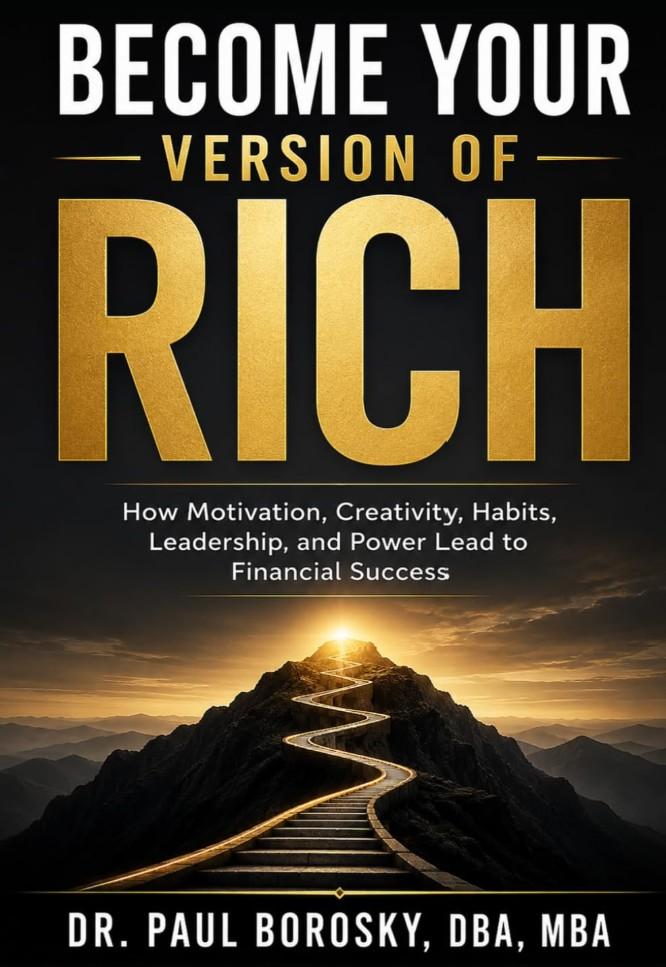
This page covers one arriver. Become Your Version of Rich places him beside Franklin, a long-haul trucker, Napoleon, and MC Hammer.
- The five-step method for defining and recognizing your version of rich
- The calculation, with the fictional $90,000 example
- Franklin at 42, and Napoleon on St. Helena
- The MC Hammer cautionary tale
- Daily Actions and the single page where your whole version of rich ends up
Go Further With Dr. Paul
Write Down What Your Business Is For
A written plan can carry more than numbers. Dr. Paul writes custom business plans built on 1,000+ client engagements, including your purpose, your milestones, and the targets that tell you when you have arrived.
FAQ
Common Questions About Milton Hershey’s Fortune
Why did Milton Hershey give away his fortune?
When did Milton Hershey set up the school trust?
Did the Hershey school always admit girls and all races?
Dr. Paul Borosky, DBA, MBA
Business Consultant, Author & Educator | 14+ Years | 1,000+ Clients Served
Dr. Paul Borosky, DBA, MBA is a business consultant, author, and educator, and the founder of Quality Business Plan. He helps small business owners across the United States and Canada with business planning, financial modeling, fractional CFO services, and the everyday problems of businesses that depend too much on their owners. He is the creator of Dr. Paul’s Organize-Plan-Grow™ Strategy, author of numerous published books on Amazon, and publisher of over 1,000 business-focused videos on YouTube. He has taught as an adjunct college instructor and teaches in Florida public schools.
This page is for general educational purposes only. It is not investment, tax, legal, financial, or retirement advice, and it does not guarantee any particular financial result. The examples, figures, and calculations are illustrative planning tools, not recommendations. Before making significant financial decisions, consult a qualified professional.