
Dr. Paul Borosky, DBA, MBA
Business Consultant & Author
Become Your Version of Rich: How Much Is Enough?
Most people chase more and never draw the finish line. Dr. Paul Borosky's book shows you the five traits that build financial success, in order, and how to define the one number and the one life that mean you have arrived.
Last Updated: 10/28/2026 · Written by Dr. Paul Borosky, DBA, MBA
The Short Answer
How Much Is Enough?
Enough is not a number you stumble into. It is the mix of money, work, time, relationships, freedom, and purpose that you decide is enough, written down before you start chasing. Most people never do that. They chase more, and more has no finish line. That is a treadmill. Your version of rich is the finish line you draw on purpose, so money serves your life instead of becoming the whole point of it.
Dr. Paul wrote Become Your Version of Rich to help you draw that line, then build what it takes to cross it. Five traits do the building: motivation, creativity, habits, leadership, and power. Chapter six turns the answer into numbers you can calculate. This page follows the same order, and every guide linked below goes deeper on one piece. Ready for the math first? Go straight to how to calculate your financial independence number.
From the Introduction of Become Your Version of Rich
Take a moment with it, because almost no one ever does. Most people spend their whole lives chasing "more," more money, more clients, more square footage, more than the person next door, without ever stopping to define the finish line they are supposedly running toward. And a target defined as "more" can never be reached, because the moment you get more, there is always more just beyond it. That is not a finish line. It is a treadmill. You can run on it until the day you die and never arrive anywhere.
Your version of rich is the specific combination of money, work, time, relationships, freedom, and purpose that you personally decide is enough. It is a destination you define on purpose, so that money finally serves your life instead of becoming the whole point of it.
Where the Idea Came From
Same Road. Same Paycheck. Two Different Lives.
This idea did not start in a classroom. It started in the cabs of trucks. Part of Dr. Paul's doctoral research meant interviewing a large number of over-the-road drivers about why they do what they do.
The study never set out to measure enough, and Dr. Paul is careful not to dress a reflection up as a formal finding. But he noticed something he could not shake. Among drivers doing the same job, on the same roads, for roughly the same money, there were two very different kinds of people.
The content drivers
At peace with the work and the money. Clear on what they wanted their income to give them, and feeling they were getting it.
The restless drivers
Always chasing something more, no matter what they earned. They measured against more, and no amount of road or money can satisfy more.
Dr. Paul offers his reading as interpretation, not the only explanation. Health, home life, sleep, and how a person is treated all shape contentment too. Still, the pattern matched research by psychologists Edward Deci and Richard Ryan, who found that the deepest motivation runs on three needs: autonomy, competence, and relatedness. The content drivers had built all three into the cab. They chose their routes and ran their own show. They had mastered a craft. They had a community of drivers and families to drive home to.
One driver stood out. He started as an employee and owned his own rig within a couple of years. He used the long hours on the road for self-improvement while the drivers around him just drove. He started his own freight company and grew it into a large, well-run operation. Then he did the thing that matters here. He had every reason to keep adding trucks and routes. He did not. He had defined enough, and it was never simply a bigger company. It was a thriving operation, the freedom to keep doing work he loved, and time with the people he loved. Last Dr. Paul knew, he still ran one route himself, because he wanted to, not because he had to.
Compare that driver with an emperor in the section below, or read the full story of Franklin and Napoleon.
The Ladder
Six Words That Carry You to Enough
Drive. Differentiate. Repeat. Multiply. Influence. Arrive. Each word is a chapter. Each one builds on the one before it. Every chapter has a plain definition, a step-by-step method, real people, and one cautionary tale of someone who had the capability and made the one mistake that undid it.
Motivation
Your driver is the personal reason underneath the work. Motivation turns it into force. Drive is what that force becomes when you keep it going day after day, long after the excitement fades.
Learn: What Is Motivation? →Do: How to Find Your Why →Warning: Why WeWork Failed →
Creativity
Creativity is the ability to generate, combine, adapt, or improve ideas so they produce something customers value. In business it shows up as differentiation: a road where none existed.
Learn: What Is Creativity in Business? →Do: How to Be More Creative →Warning: Why BlackBerry Failed →
Habits
A habit turns repeated action into results without a daily fight. Discipline gets you started. Habit keeps you going on far less of it, and most of yours formed by accident.
Learn: Discipline vs. Habit →Do: How to Build a Habit That Sticks →Warning: How Antoine Walker Went Broke →
Leadership
Leadership sets a direction, earns trust, develops capability in other people, and moves them toward a result worth reaching. It is where what you built inside starts working through others.
Learn and Do: Can Your Business Run Without You? →Warning: Why J.C. Penney Failed →
Power
Power is your capacity to influence decisions, behavior, and resources in a particular situation. The kind worth building is earned, so it travels with you when the title is gone.
Learn: What Is Power in Business? →Do: Build Influence Without Authority →Warning: What Went Wrong at Uber →
Your Version of Rich
The destination. Define enough on purpose, calculate it, draw a stop line, and recognize the day you cross it. Without this step, the other five just burn fuel.
Do: Calculate Your Financial Independence Number →Warning: How MC Hammer Went Broke →
Two Men on the Same Ladder
One Arrived. One Never Asked.
Two men walk beside you through every chapter of the book. Both climbed all five rungs. Only one knew when to stop.
Arrived at 42
Benjamin Franklin
In 1748, at forty-two, Franklin was one of the most successful printers in the colonies. He stepped back from the daily running of his shop. His foreman ran it and sent him roughly half the profits. That bought back his time, and he spent it on electricity experiments, public institutions, and diplomacy. He treated wealth as the means to buy freedom, not as the goal.
Never asked how much
Napoleon Bonaparte
Napoleon had more of all five traits than almost anyone in history. He never defined enough. His drive was built on proving himself, not on arriving anywhere, so there was only ever the next conquest. He dominated a continent and died a prisoner on a barren island in the South Atlantic.
The lesson is not about emperors. Skill with no destination does not protect you. It only decides how far you fall. Franklin vs. Napoleon: why one retired at 42 and one died on a rock tells the whole story, and Franklin's 13 virtues shows how he built the habits to get there.
Start Where You Stand
Which Guide Should You Read First?
You can climb the ladder in order or jump to the trait you need right now. Here are three good starting points.
If you own a business
Test whether it runs without you
Take a two-week vacation in your head. If the business wobbles the moment you leave, you are holding it together by hand. Start with the vacation test.
Can Your Business Run Without You? →If you are a business student
Get the vocabulary straight
Driver, motivation, drive, and passion get tangled in most writing. Start with four plain definitions, then see how they fit the rest of the course.
What Is Motivation? →If you manage people
Build influence without the title
You cannot order a peer, a vendor, or another department to help you. Learn to map who matters and earn their support.
How to Build Influence Without Authority →All 21 Guides
Every Guide, by Chapter
Each guide answers one question and ends with what to do next. New to a term? The Become Your Version of Rich glossary defines 38 of them in plain English.
Chapter 1: Motivation
Chapter 2: Creativity
Chapter 3: Habits
Chapter 4: Leadership
Chapter 5: Power
Chapter 6: Your Version of Rich
The People Who Walk the Ladder
Key Terms
Ten Terms You Will See Everywhere
The Honest Caveat
What This Book Does Not Promise
No book can promise you money. Opportunity, knowledge, capital, health, timing, and luck all get a vote, and real lives rarely climb the five traits in a straight line.
What the traits do is feed each other. They give you a way to aim your effort, build real skill, and improve your odds of reaching a success you define yourself. Think of it as tilting the odds your way, not rigging the game.
The Book
Become Your Version of Rich
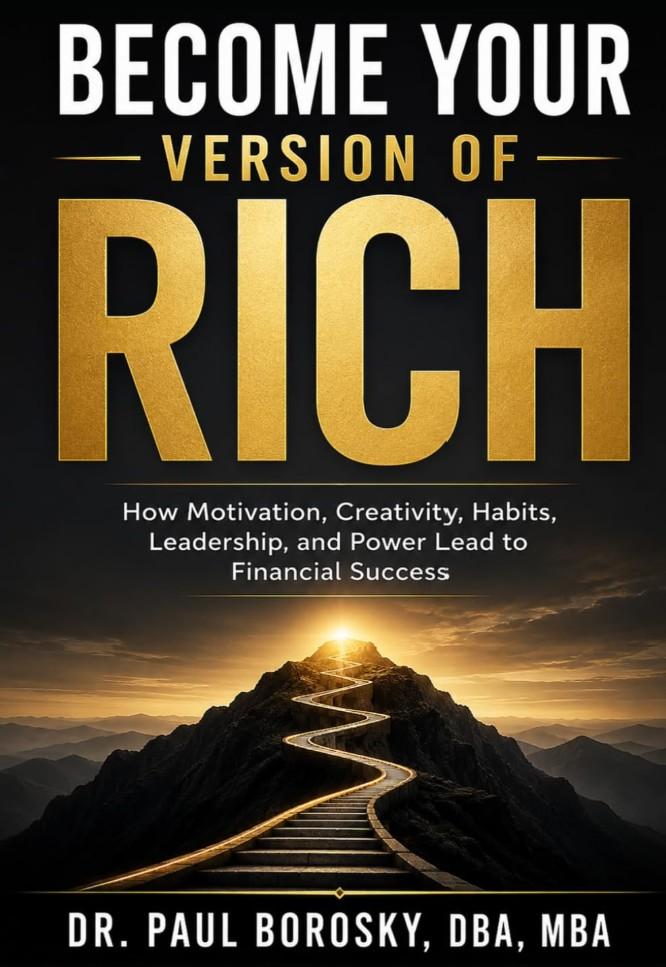
The full subtitle says it: How Motivation, Creativity, Habits, Leadership, and Power Lead to Financial Success. Six chapters, one ladder, and a destination you define for yourself. Every chapter is built the same way, so you always know where you are.
- A plain definition and a step-by-step method for each of the five traits
- Real people in every chapter: Madam C.J. Walker, Benjamin Franklin, Nikola Tesla, Warren Buffett, Milton Hershey, and Napoleon Bonaparte
- One cautionary tale per chapter: WeWork, BlackBerry, Antoine Walker, J.C. Penney, Uber, and MC Hammer
- Dr. Paul's Insights: stories from the clients, business owners, and drivers he has worked with and interviewed
- A step-by-step method to calculate your own enough number, with three lines: minimum security, comfortable, and abundant
- Daily Actions at the end of every chapter, so reading turns into doing
Go Further With Dr. Paul
Turn Your Version of Rich Into a Plan
The book gives you the method. If you want help applying it to your business, Dr. Paul has worked with 1,000+ clients and helped fund $100M+ in projects. Call or text (321) 948-9588.
FAQ
Common Questions About Your Version of Rich
How much money is enough?
What are the five traits of financial success in this book?
Does Become Your Version of Rich guarantee wealth?
Who is Become Your Version of Rich written for?
Dr. Paul Borosky, DBA, MBA
Business Consultant, Author & Educator | 14+ Years | 1,000+ Clients Served
Dr. Paul Borosky, DBA, MBA is a business consultant, author, and educator, and the founder of Quality Business Plan. He helps small business owners across the United States and Canada with business planning, financial modeling, fractional CFO services, and the everyday problems of businesses that depend too much on their owners. He is the creator of Dr. Paul's Organize-Plan-Grow™ Strategy, author of numerous published books on Amazon, and publisher of over 1,000 business-focused videos on YouTube. He has taught as an adjunct college instructor and teaches in Florida public schools.
This page is for general educational purposes only. It is not investment, tax, legal, financial, or retirement advice, and it does not guarantee any particular financial result. The examples, figures, and calculations are illustrative planning tools, not recommendations. Before making significant financial decisions, consult a qualified professional.