
Dr. Paul Borosky, DBA, MBA
Business Consultant & Author
How to Find Your Why: The 5-Step Driver Statement Method
Finding your why takes a pen and about twenty minutes. Dr. Paul Borosky walks through the five steps that turn a vague wish into a named driver you can say in one breath and act on the same day.
Last Updated: 10/28/2026 · Written by Dr. Paul Borosky, DBA, MBA
The Short Answer
How Do You Find Your Why?
Write your version of rich as a picture, find the one reason underneath it, turn that reason into three short driver statements, pair each with one action, and review them daily. That is the whole method.
It comes from Chapter 1 of Become Your Version of Rich by Dr. Paul Borosky, DBA, MBA. Not sure what a driver is yet? Start with what motivation really means. Want a team version of goal setting? See SMART goals for a small business. This page sits inside the full Become Your Version of Rich guide.
The Method
Five Steps From Vision to Driver Statement
Each step has a job. Skip one and the rest wobble.
- Write your version of rich in full detail. Not a number. A picture. How does a normal Tuesday feel on the day you have it? Who is in the room? What changed for your family? A goal you keep only in your head is a wish, and wishes do not survive a hard Monday.
- Name the one reason it matters most. Read the picture back and find the reason underneath it. That reason is your driver. Everything else in the method exists to keep it running.
- Turn it into three driver statements. Pick the three parts of life that most need one. Health, work and finances, and relationships is a fair place to start. Write one sentence for each that you can say in a single breath. Each one is a driver statement.
- Pair each statement with one real action. A sentence you only recite changes nothing. If the health statement is about being there for your kids, the action is a thirty minute walk. If the money statement is about independence, the action is a set transfer to savings.
- Review it daily, then take stock at thirty days. Say the three statements the moment you wake up. Once a month ask two questions: did I keep saying them, and did I do the actions? The second question is the one that counts.
Dr. Paul calls this a method, not a mood. It works on a day you feel nothing at all, because step one only asks you to write.
Not an Affirmation
Why a Driver Statement Is Not a Slogan
Dr. Paul does not like empty affirmations either. He says so in the chapter. Here is why this is different.
Here is how Become Your Version of Rich draws the line.
From Chapter 1 of Become Your Version of Rich
Yes, these are affirmations, and yes, I told you affirmations wear off by mid-morning. Here is the difference, and it is the whole game. A hollow affirmation is a borrowed slogan with nothing behind it. A driver statement is built out of your own written vision and points at a real destination you already defined. The words are not the magic. The vision behind them is.
That difference is why people who hate affirmations can still use this method. The statement is only the handle. The written vision is the thing you are holding. If you cannot connect a statement back to a vision you wrote, rewrite the statement, not the vision.
An Illustration
What Three Driver Statements Can Look Like
These three are made up for illustration. They show the shape, not the words you should use.
Health
Be there for the long haul
I stay strong enough to coach my daughter’s team in ten years.
Ask yourself: Action: a thirty minute walk after dinner, five days a week.
Work and Finances
Build the business that buys my time
I am building a business that pays me a fair wage and runs without me for two weeks.
Ask yourself: Action: move a set amount to savings every payday, and finish one task that grows the business.
Relationships
Protect the people this is for
I am present at home, and work stays at work after six.
Ask yourself: Action: phone in a drawer at dinner, and one planned family night a week.
These are illustrations, not a template to copy. Yours should sound like you and point at your own picture. Notice that each one names a reason, and each one comes with an action small enough to do on your worst day. If one of the three sounds like a business goal, check it against your enough line before you commit to it.
The Common Mistake
Do Not Keep Changing the Target
The most common way this fails is not weak motivation. It is a moving target. People pick a vision, chase it for a few weeks, then swap it for something shinier. Each swap throws away most of the ground they gained, because progress only compounds when it points one way. Dr. Paul calls what you build when you hold still target momentum.
Be careful not to turn this into stubbornness. Sometimes a target should change. New facts arrive, the market shifts, your health or family changes, or you finally admit the goal was never yours. That is not the mistake. The mistake is changing it on impulse. So build in a rule: hold a target for at least thirty days, review it on a date you set, and change it from the calendar, not on a whim.
Dr. Paul admits he has made this error himself. A new AI tool audited his website and returned a long list of fixes. He dropped his writing and video work for three days to chase them and fell behind on his own benchmarks. A useful new tool does not mean you stop doing everything else. Fold it in. Do not let it take over.
What the Research Says
A Why Only Works If It Is Yours
Self-Determination Theory, built by psychologists Edward Deci and Richard Ryan, names autonomy as one of three basic needs behind lasting motivation. Autonomy is the sense that you are choosing your own path, not being pushed down someone else’s. That is the reason step one starts with a picture you write yourself. A why copied from a podcast or a rival does not feel like yours, so it fades when the work gets dull.
It also explains step four. When an action is tied to a reason you chose, it feels like an expression of your own values, not a chore handed to you. Dr. Paul has watched that difference play out across 1,000+ client engagements: the owner who can say why tends to outlast the owner who can only say what.
Sources: Ryan, R. M., & Deci, E. L. (2000), Self-determination theory and the facilitation of intrinsic motivation, social development, and well-being, American Psychologist, 55(1), 68-78.
How This Helps a Business Owner
Use Your Driver Where Owners Get Stuck
Most owners know what they sell. Fewer can say why they are still doing it. A named driver pays off in three moments.
Before a Big Decision
Test the choice against the why
Hiring, expanding, or taking a risky client? Ask which choice serves your driver. If neither does, you are choosing out of habit. Pair it with the decision making process and you have both the reason and the method.
When Growth Feels Empty
Check for a missing destination
More revenue that does not feel like anything is a warning. WeWork chased size with no finish line. Read why WeWork failed and write your own stopping point.
When the Business Feels Stuck
Rebuild from the picture
Go back to step one and rewrite the picture. Then turn it into a plan with numbers. A driver tells you why. A written plan tells you how, and Dr. Paul writes those for owners.
One Honest Caution
This Is Not a Fix for Burnout
If you are exhausted, grieving, depressed, or struggling with your health, a writing exercise will not fix that. Those deserve real support, sometimes professional support. This method is for the narrower case: you are healthy enough to work and you have lost your reason, or never named it.
Do This Tomorrow
Your Twenty Minute Start
- Before you get out of bed, picture one ordinary day in your version of rich. Hold it for sixty seconds.
- Sit down with a pen. Write the whole picture for twenty minutes. Do not edit.
- Read it back and circle the one reason it matters most. Write it as one sentence at the top.
- Draft three driver statements and one action for each. Put them on a single page and add a date thirty days out.
You do not need to feel motivated first. Starting is what builds it. Next, see what happens when a driver has no destination in why WeWork failed, or watch motivation built on purpose in Madam C.J. Walker’s story.
The Book
The Full Method Is in Chapter 1
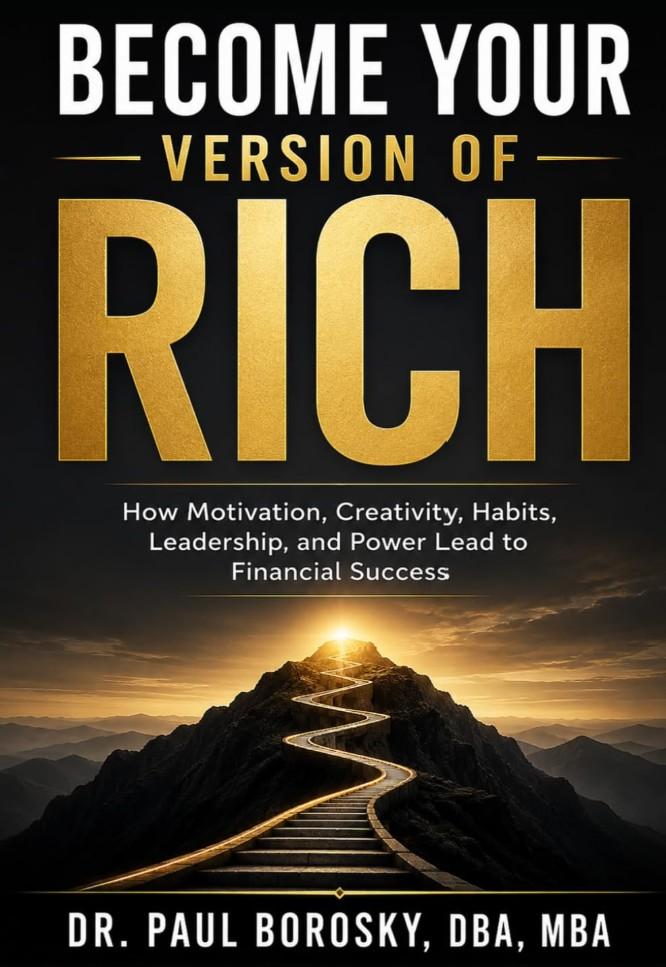
This page covers the method. Become Your Version of Rich gives you the stories behind it and the Daily Actions that make it stick.
- The five-step method with the three driver statements and the 30-day review
- Madam C.J. Walker and Benjamin Franklin, two people who built motivation on purpose
- Napoleon, and what happens when a driver has no finish line
- The WeWork cautionary tale
- The single page where your whole version of rich ends up
Go Further With Dr. Paul
Turn Your Why Into a Written Business Plan
A driver tells you why. A plan tells you how, with numbers a lender will read. Dr. Paul writes custom business plans built on 1,000+ client engagements, so your reason shows up on page one and the financials hold up behind it.
Keep Going
More From Chapter 1
FAQ
Common Questions About Finding Your Why
How do you find your why?
How long does it take to find your why?
What if I do not feel motivated enough to start?
Dr. Paul Borosky, DBA, MBA
Business Consultant, Author & Educator | 14+ Years | 1,000+ Clients Served
Dr. Paul Borosky, DBA, MBA is a business consultant, author, and educator, and the founder of Quality Business Plan. He helps small business owners across the United States and Canada with business planning, financial modeling, fractional CFO services, and the everyday problems of businesses that depend too much on their owners. He is the creator of Dr. Paul's Organize-Plan-Grow™ Strategy, author of numerous published books on Amazon, and publisher of over 1,000 business-focused videos on YouTube. He has taught as an adjunct college instructor and teaches in Florida public schools.
This page is for general educational purposes only. It is not investment, tax, legal, financial, or retirement advice, and it does not guarantee any particular financial result. The examples, figures, and calculations are illustrative planning tools, not recommendations. Before making significant financial decisions, consult a qualified professional.