
Dr. Paul Borosky, DBA, MBA
Business Consultant & Author
What Is Creativity in Business? It Means Differentiation, Not Art
Creativity is a practical skill, not a gift for painters. Dr. Paul Borosky defines it with two tests every idea has to pass, and shows why it is the rung that makes your work impossible to ignore.
Last Updated: 10/28/2026 · Written by Dr. Paul Borosky, DBA, MBA
The Short Answer
What Is Creativity in Business?
Creativity is the ability to generate, combine, adapt, or improve ideas in a way that produces something useful and meaningfully different. In business, that means differentiation: a reason your work stands apart from everyone else’s.
This is rung two in Become Your Version of Rich by Dr. Paul Borosky, DBA, MBA. It sits on top of motivation, because creativity needs something to point at. Ready to use it now? Go to how to be more creative. Looking for the process side of getting better? See continuous improvement. Everything here lives inside the Become Your Version of Rich guide.
The Definition
Two Tests Every Idea Has to Pass
The definition has two halves. Hold onto both.
Fails the first test
Strange
Different, but useless. It gets attention and helps no one.
Ask yourself: Does it improve the result for someone?
Fails the second test
Ordinary
Useful, but identical to everyone else’s. It works. It does not stand out.
Ask yourself: How is it meaningfully different?
Passes both
Creative
Useful and meaningfully different. The overlap is where you aim.
Ask yourself: Would a customer notice and value the difference?
Here is the definition in the words of Become Your Version of Rich.
From Chapter 2 of Become Your Version of Rich
Creativity is the ability to generate, combine, adapt, or improve ideas in a way that produces something useful and meaningfully different. Hold onto both halves of that, because they are the two tests every idea has to pass. Is it useful? And is it meaningfully different? An idea that is different but useless is just strange, and an idea that is useful but identical to everyone else's is not creative, it is ordinary. You are aiming for the overlap.
Different is not automatically better. Dr. Paul is blunt about it: if an idea adds complexity or strangeness without adding value, it is decoration, not creativity. Run every idea through both tests before you fall in love with it. The differentiation you want shows up on the customer’s side of the counter, not yours.
Not Only Art
Why “Not the Creative Type” Is an Expensive Mistake
Most people hear “creativity” and picture a painter, a musician, or an advertising team. If they do not see themselves that way, they file the subject under not me. Dr. Paul calls that an expensive mistake. Creativity helps you solve problems differently, improve ordinary ideas, and build something that stands apart from what everyone else is doing.
Look at three examples from the chapter. A man at Dr. Paul’s gym turned the dullest machine in the room into a dance floor, ballroom dancing on a treadmill. A long-haul trucker solved the loneliness of the job by building a morning chat group with other women drivers, and it grew into a real network. Benjamin Franklin turned a handful of tradesmen into the Junto, a club that sharpened each member’s thinking and business, and pooled money to open a subscription library. None of them painted anything.
The trucker is the telling case. She did not think she had done anything creative. It came naturally, so she assumed it did not count. Her problem was that she never used it on purpose. The moment you apply creativity deliberately, it opens up opportunities you would have walked past.
What the Research Says
Creativity Runs on Ordinary Thinking
Psychologist Robert Weisberg spent decades on this question. His argument is that creative advances at every level, from world-changing breakthroughs to the small daily improvements anyone makes, run on ordinary, disciplined thinking available to everyone, not on a special faculty a few people are born with. The Durham Commission on Creativity and Education reached a similar place from the schools side, describing creativity as the capacity to imagine, conceive, express, or make something that was not there before.
A practical finding sits on top of that. In research on new product ideas, analogies drawn from more distant fields tended to produce more original ideas than analogies from close to home, provided the idea was far enough away to shift your view and close enough to bridge. That is why borrowing from another industry works. It is also why the quickest route to a creative idea is rarely staring harder at your own market.
Sources: Weisberg, R. W. (2020), Rethinking Creativity: Inside-the-Box Thinking as the Basis for Innovation, Cambridge University Press. Durham Commission on Creativity and Education (2019), report summary. Dahl, D. W., & Moreau, P. (2002), The influence and value of analogical thinking during new product ideation, Journal of Marketing Research, 39(1), 47-60.
A Modern Warning
Polished Is Not the Same as Creative
Artificial intelligence is a useful tool, and Dr. Paul uses it every day. The trap is handing it the creative work. When everyone leans on the same tools with the same prompts and accepts the first output, results drift toward sameness. The emails sound alike. The websites look alike. A machine trained on everything tends to return the average of it.
That is also the opportunity. The person who still adds a real creative edge stands out more than ever. Use AI, but keep your thumbprint on the work: supply your own experience, push back on the first answer, combine ideas from unrelated fields, add specific examples and opinions, rewrite it in your own voice, and test it on real people.
In Lake Mary, the competitor that hurts most is often a national name down the road. Dr. Paul walks through a Lake Mary competitor scan.
Where It Stops
Creativity Is Like Garlic
Dr. Paul’s favorite picture of creativity is garlic. Used well, it makes almost everything better. Use too much and it overwhelms the dish. The goal is not to keep adding. The goal is to add just enough to make what you are building impossible to ignore.
Two points follow. First, creativity is a neutral tool. The same spark can build a library or a better weapon, so its value depends on what you aim it at. Second, creativity does not replace hard work. It makes the work stand out, which is why it needs the rung below it. Creativity has to point at something you are already driven to do. See how that goes wrong in why BlackBerry failed.
How This Helps a Business Student
Use the Two Tests in Class and in Your Plan
Textbooks mention creativity everywhere and define it rarely. Two tests give you something concrete to write down.
On the Exam
Define it, then apply both tests
Give the definition, name both tests, and add one example of an idea that fails each. Then separate creativity from improving an existing process. See the continuous improvement page for that line.
In a Case Study
Score the company on both tests
Ask whether the company’s big idea was useful, and whether it was meaningfully different. Then ask what happened when it stopped asking. BlackBerry is a clean example.
In Your Business Plan
Write the differentiation section last, but plan it first
Every plan needs a line on why a customer picks you. Test your line against both tests. If a rival could say the same sentence, it is ordinary.
One Honest Caution
Borrow the Principle, Not the Property
Borrowing an idea from another industry is fair. Copying someone’s logo, wording, designs, or confidential information is not. This page is general education, not legal advice. If you are unsure whether something crosses the line, ask a qualified attorney before you use it.
Do This Tomorrow
Three Steps for Tomorrow
- Pick one real problem or one boring task. Ask: how can I make this better? For a customer problem, ask how you can solve it better for your customer.
- Write down two or three genuinely different answers. Do not judge them yet.
- Find one idea from a different industry and ask how it could transplant into yours.
That is the on-switch. For the full process, including how to pressure-test and when to stop, read how to be more creative. When you have a differentiator worth keeping, the business plan templates give you a place to write it down.
The Book
Chapter 2 Goes Further
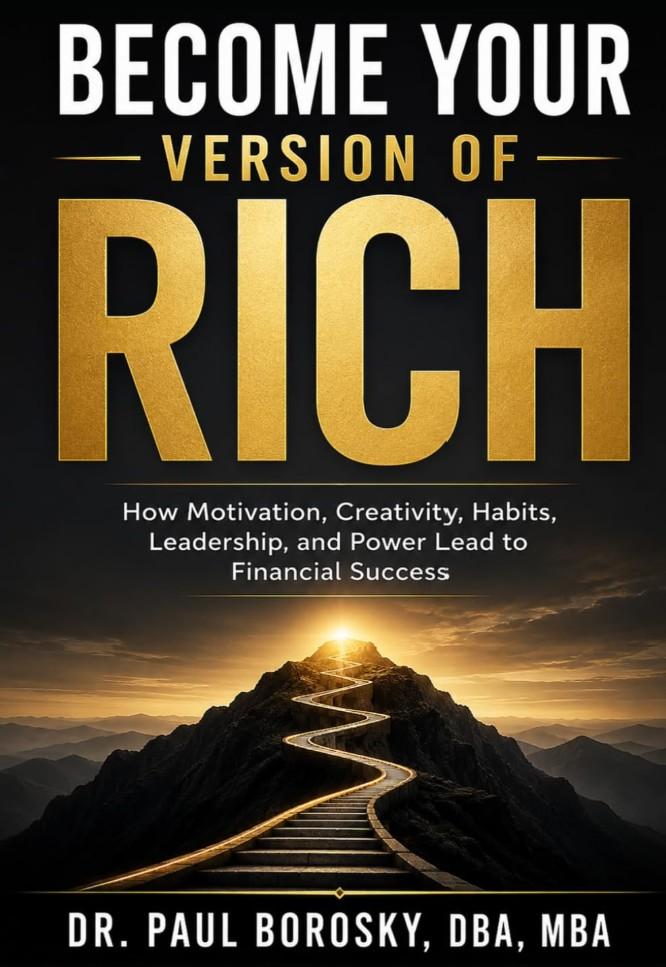
This page defines the term. Become Your Version of Rich shows the full method and the people who prove it.
- The seven-step creativity method and the stop rule
- Nikola Tesla and Benjamin Franklin, two ways creativity plays out
- Napoleon, and why creativity with no destination does not save you
- The BlackBerry cautionary tale
- Daily Actions, and a 30-day plan built to make you ship
Go Further With Dr. Paul
Write Your Differentiator Into a Plan
A differentiator on paper beats one in your head. Dr. Paul’s industry-specific business plan templates give you a formatted Word plan and an Excel financial model, with a section built for exactly this. Built on 1,000+ client engagements.
Keep Going
More From Chapter 2
FAQ
Common Questions About Creativity in Business
What is creativity in business?
Do you have to be the creative type to be creative at work?
Can AI replace creativity in business?
Dr. Paul Borosky, DBA, MBA
Business Consultant, Author & Educator | 14+ Years | 1,000+ Clients Served
Dr. Paul Borosky, DBA, MBA is a business consultant, author, and educator, and the founder of Quality Business Plan. He helps small business owners across the United States and Canada with business planning, financial modeling, fractional CFO services, and the everyday problems of businesses that depend too much on their owners. He is the creator of Dr. Paul's Organize-Plan-Grow™ Strategy, author of numerous published books on Amazon, and publisher of over 1,000 business-focused videos on YouTube. He has taught as an adjunct college instructor and teaches in Florida public schools.
This page is for general educational purposes only. It is not investment, tax, legal, financial, or retirement advice, and it does not guarantee any particular financial result. The examples, figures, and calculations are illustrative planning tools, not recommendations. Before making significant financial decisions, consult a qualified professional.