
Dr. Paul Borosky, DBA, MBA
Business Consultant · Author
Overwhelmed Running Your Business? Fix the System, Not Yourself.
You are not lazy. The business outgrew the way it is being run.
Every question comes to you. You finish nothing. Sales are up and the bank account still feels empty. Dr. Paul has seen it in 1,000+ businesses, and it is almost never a work ethic problem. It is a system problem, and systems can change.
Last Updated: 10/29/2026 · Written by Dr. Paul Borosky, DBA, MBA
For Owners
Why Am I So Overwhelmed Running My Business?
Because the business grew and the way it runs did not. Dr. Paul sees two patterns over and over. In the first, the business is growing and it is disorganized: more customers than last year, the same habits as five years ago, and every question still lands on the owner. In the second, sales are growing and profit is shrinking: revenue is up, profit is flat, and cash is never there when the bills are due.
You are not alone in either one. In the Federal Reserve's survey of more than 7,600 small employer firms, 75 percent named rising costs as a financial challenge and 51 percent named uneven cash flow.
Source: Federal Reserve Banks, 2025 Report on Employer Firms.
Stressed Out
You run from fire to fire, decide everything, and finish nothing. The day belongs to whoever interrupts you first.
Burned Out
You carry the whole business on your own back, and the back is starting to give. Rest does not fix it anymore.
Tapped Out
You are busier than ever, and the money still does not keep up. The best month you ever had did not feel like one.
"It's just a busy season." Dr. Paul hears that sentence from worn out owners more than any other, and it rarely is. A busy season ends. A system problem does not.
From Stressed Out, Burned Out, Tapped Out, Chapter 1Want Help Fixing the System, Not Just the Fire?
The Fix
How Do I Fix Problems in My Business for Good?
Dr. Paul's Organize-Plan-Grow Strategy is a simple, repeatable way to attack any problem in a small business.
Organize
Find out what is really happening. Look for the root cause underneath, not just the symptom you can see.
Plan
Choose the fix with the people involved. The crew doing the work usually knows the best option.
Grow
Put the fix in motion, check whether it works, and build on what does.
Fire Mode
One problem, burning right now
All three steps aimed at a single fire that needs to be out this month.
Foundation Mode
The structure underneath
Core plans and procedures in one place, a picture of the business five years out worked back to this month, and daily action toward 30-day goals.
Is this a fire, or is this a foundation?If the answer is both, put out today's fire first. Then ask what foundation would keep it from coming back.
Owners feeling stretched thin in West Virginia can call on the state SBDC, which runs coaches around the state through the Department of Economic Development. Dr. Paul adds plan writing on the West Virginia business plan writer page.
60-Second Self-Check
Which Business Problem Should I Fix First?
Answer yes or no. Be honest. Nobody is grading this.
Is there one problem you need fixed in the next 30 days?
Is a customer, crew, or cash problem keeping you up this week?
Did one event this month (a quit, a big order, a complaint) knock the business off course?
Has the same problem come back three or more times this year?
Could the business run for one week without you?
Does everyone know who owns each task?
Do you have written procedures for your most common jobs?
Do you know your top three priorities for the next 30 days?
Have you looked at a written business plan this quarter?
Do you know where you want the business to be in five years?
Foundation points: one for a yes on question 4, plus one for each no on questions 5 to 10.
2 or more Fire points
You need Fire Mode
Find your fire below and put it out first.
4 or more Foundation points
You need Foundation Mode
Read your fire, then build the structure underneath it.
Both (most owners)
Fire first, then foundation
Put out today's fire, then build what keeps it from coming back. Any problem that could do serious harm this month goes first, whatever your score. The book's Fire Cost Tag ranks the rest.
The 14 Fires
What Are the Most Common Small Business Problems?
Each fire is a sentence owners say to Dr. Paul almost word for word. Find yours, see why it happens, and start with the matching guide.
Part Two of the Book
Chapters 3 to 14How Do I Stop Putting Out Fires All Day?
"I spend my entire day putting out fires."
Every interruption lands on you because nothing was decided ahead of time. The fix starts by sorting each problem: fire or foundation. Then the repeat problems get a written answer so they stop coming back to your desk.
Find the root cause →Why Do I Never Finish My Priorities?
"I work constantly but never finish my priorities."
Urgent work always beats important work when nothing protects the important work. The book's fix is the Weekly Top Three: three finished results for the week, written down, with everything else waiting its turn.
How to prioritize work →How Do I Get Employees to Take Responsibility?
"Nobody knows who is responsible for what."
When a task belongs to everyone, it belongs to no one. The fix is a Who-Owns-It Chart: every recurring task, one name beside each, posted where the whole crew can see it.
Organizational structure →How Do I Keep Quality Consistent?
"Customers receive inconsistent quality."
Two people doing the same job two different ways is not a people problem. It is a missing standard. The Leave-the-Shop Test gives every common job five to ten lines it must pass before it goes out the door.
Keep quality consistent →How Do I Get My Business Out of My Head?
"Everything about running this business is in my head."
If the business only works when you are in the room, you do not own a business. You own a job. The fix starts with the Five Must-Know Sheets: one page each for what the business cannot run without.
Standard operating procedures →Why Is It Faster to Do It Myself?
"I do everything because explaining it takes too long."
Explaining it once takes longer than doing it once. Doing it every day forever takes longer than both. The Hand-Off Card makes the first hand-off fast: the task, five steps, what done looks like, and a check-in date.
How to delegate work →How Do I Take a Vacation From My Business?
"I cannot take a vacation without working through it."
A business that breaks when you leave is telling you where it is weak. The Away Test finds those spots on purpose, one day first, then a long weekend, then a week, with a Coverage Sheet for each.
Can your business run without you? →How Do I Stop Starting New Projects and Finish One?
"We keep launching new things and finishing none."
Every half-finished project drains time and cash and returns nothing. The One In, One Out Rule keeps one project active at a time. The Readiness Test asks five questions before any expansion gets a green light.
Read Chapter 10 in the book →When Should I Raise My Prices?
"Our prices have stayed the same while costs have increased."
Costs creep up quietly. Prices only move when someone moves them. A regular Price Review compares what your top products or services cost then and now, so you know which prices to raise first.
How to price your product →How Much Money Can I Actually Spend From My Business Account?
"I spend based on the bank balance."
The balance looks like spending money, but part of it already belongs to payroll, taxes, and next month's bills. The Weekly Money Check takes 20 minutes every Monday and shows what is truly free to spend.
Profitable but no cash →How Do I Know Which Jobs Make Money?
"I do not know which jobs actually make money."
Busy is not the same as profitable. Some jobs pay for themselves and some quietly lose money. A Job Scorecard records what each finished job really took against what you charged.
Customer profitability →How Do I Know Which Marketing Is Working?
"I do not know which marketing brings paying customers."
Most owners market hard when it is slow, stop when it is busy, and repeat. The Lead Source Scoreboard tracks calls and paying customers by source each month, so you keep what works and cut what does not.
Marketing attribution →The Foundation
How Do I Stop the Same Problems From Coming Back?
Part Three of the book turns the fixes into a system you run every month.
Managers and Students
What Can Managers and Business Students Learn From This?
How Do I Help an Overwhelmed Business Owner?
Managers often see the burnout before the owner admits it. Do not open with "You need to delegate." That lands as criticism.
- Take one fire off the owner's plate this week and handle it completely, start to finish.
- Rank the open fires together by what they cost in hours, cash, crew, and customers.
- Offer to build the Who-Owns-It Chart with the crew.
Trust grows one fire at a time. Related: how to delegate work.
What Is the Difference Between Reactive and Proactive Management?
Reactive management handles problems after they happen. The book calls it Fire Mode. Proactive management builds systems before problems happen. The book calls it Foundation Mode.
Research on process improvement explains why owners get stuck in the first: the fixes that prevent problems never get credit, because the problems never show up. Fighting fires looks heroic. Building foundations looks like nothing happened.
Source: Repenning and Sterman, "Nobody Ever Gets Credit for Fixing Problems That Never Happened," California Management Review, 2001. Terms defined in the Stressed Out glossary.
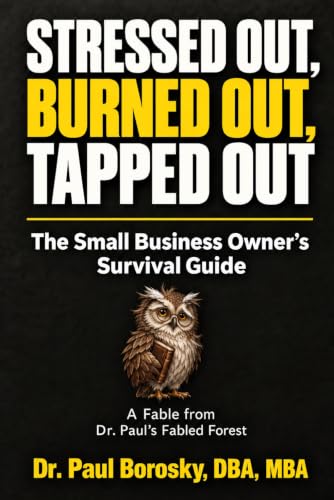
The Book
Stressed Out, Burned Out, Tapped Out
Each chapter opens with a short story from the Fabled Forest, where a worn out owner meets the same fire you are fighting. Then the field guide brings it back to your world with the why, the fix, and a one page action plan.
- The 60-second Fire or Foundation self-check and the Fire Cost Tag
- 14 fire chapters, each with a ready-to-use tool
- The Run-Without-Me File, the backward plan, and the 30-Day Rhythm
- The 100 Fires checklist and a full glossary
Questions
What Else Do Overwhelmed Business Owners Ask?
Why do small business owners burn out?
Is burnout a real condition or just stress?
What is the Organize-Plan-Grow Strategy?
Which business problem should I fix first?
Who is the book for?
Find your fire. Fix the system. Get your time back.
Get the Book →Written by Dr. Paul Borosky, DBA, MBA, business consultant, strategic planner, and business plan writer with 14+ years and 1,000+ businesses served.
This page is for general educational purposes only. It is not medical, legal, financial, or other professional advice. If stress is affecting your health, talk to a doctor.