
Dr. Paul Borosky, DBA, MBA
Business Consultant & Author
Small Business Management: 20 Foundations Every Manager Should Know
Nobody teaches you how to manage. You learn to do the work, you get good at it, and then someone hands you the keys. Running the work is a different job. These are the 20 foundations of that job, from SOPs and delegation to hiring, feedback, and change, explained in plain English.
Need help now? Call or text (321) 948-9588. Dr. Paul answers personally.
Last Updated: 10/28/2026 · Written by Dr. Paul Borosky, DBA, MBA
The Short Answer
What Is Small Business Management?
Small business management is running the business, not just doing its work. It comes down to four jobs, the four functions of management: plan the work, organize it, lead the people doing it, and control the results. In a small business, the owner usually does all four, on top of the daily work. That is exactly why things break.
Plan
Decide what you want to achieve and how. The steps, who does each one, what it costs, and in what order.
- Priorities
- SMART goals
- Operating plan
- Small Business Sales
- Small Business Strategy
Organize
Set up the people, roles, and processes so the work gets done the right way, even when you are not there.
- SOPs
- Delegation
- Org structure
Lead
Direct and support the team. Hire well, train well, communicate clearly, and keep good people.
- Hiring and onboarding
- Motivation
- Feedback
Control
Check the results against the plan. When something goes wrong twice, fix the cause, not just the problem.
- Root cause analysis
- Continuous improvement
- Decision reviews
Most owners are great at the work and nobody ever showed them the four jobs. The fix is not working harder. The fix is building the foundations, one at a time. Dr. Paul uses the same approach with clients through his Organize-Plan-Grow™ Strategy: build a business that runs on systems instead of on its owner.
Doing the work and running the work are two completely different jobs. Most of us learn the second one the hard way, one expensive mistake at a time.
Dr. Paul Borosky, DBA, MBA, Management and Leadership for Small BusinessesThe 20 Foundations
Find the Problem You Have Right Now
Each foundation starts with a question a real owner asks. Find yours. The first ten are about the work: how it gets planned, organized, done, and checked. The second ten are about the people: how they are hired, trained, led, heard, and kept. New to a term? The small business management glossary defines 51 of them in plain English.
The Florida Panhandle runs on military bases and beaches, and both compete with small businesses for workers. Dr. Paul helps Panhandle business owners hire, train, and keep good people.
Part One: Managing the Work
Foundations 1 to 10What Is a Standard Operating Procedure (SOP)? How to Write One
“Hypothetically. If somebody got sick. Who runs the business?”Chapter 1 · The Business in Your Head: A Bee’s Buzz
A standard operating procedure (SOP) is a written, step-by-step description of how a task gets done, so anyone trained on it can do it the same way every time.
Read the full guide →How to Delegate Work as a Small Business Owner
“How do you hand off work when nobody does it right?”Chapter 2 · Six Legs Are Not Enough: An Ant’s Backlog
Delegation is handing a task to someone else and giving them what they need to finish it, while you stay accountable for the result. The responsibility goes with the task. The accountability stays with you.
Read the full guide →What Does a Manager Do? The Role of a Manager in a Small Business
“How am I supposed to run the place when I’m too busy running it?”Chapter 3 · Two Minutes Tomorrow: A Fox’s Treadmill
The role of a manager is to run the business, not just do its work. Working in the business means doing the tasks. Working on the business means planning, organizing, leading, and checking the work.
Read the full guide →How to Prioritize Work: Urgent vs. Important
“How do I get through everything when everything is urgent?”Chapter 4 · Eight Half-Finished Jobs: An Octopus’s Pile
Prioritization is deciding which tasks matter most and doing those first. Urgent tasks cost you if they wait. Important tasks move your goals. A task can be one, both, or neither.
Read the full guide →What Is Root Cause Analysis? Symptom vs. Cause Explained
“Why do I fix the same problem every single week?”Chapter 5 · If It Fits, I’ll Haul It: A Raccoon’s Fire Drill
Root cause analysis is finding the real reason a problem happens, instead of fixing it every time it shows up. The symptom is what you see. The cause is why it keeps happening.
Read the full guide →How to Execute a Plan: Milestones and Follow-Through
“How do I know which idea is the one?”Chapter 6 · This One Is the One: A Monkey’s Graveyard
Execution is doing the work you agreed to do and following through until it is done. It starts with a finish line, in numbers, by a date, with weekly milestones to show you are on track.
Read the full guide →What Is Planning in Management? Operating Plans for Small Business
“How do I keep investors excited while the plan comes together?”Chapter 7 · Trunk Space for Everything: An Elephant’s Blueprint
Planning is deciding what you want to achieve and how: the steps, who does each one, what it costs, and in what order. An operating plan turns the long-term vision into this month, this week, and today.
Read the full guide →What Are the Types of Leadership Styles? Directive, Participative, Delegative
“Which one of us is doing it right?”Chapter 8 · Bolt It Down, Back It Up: Two Crabs’ Standoff
A leadership style is the way a leader directs and supports people. Directive leaders decide and instruct. Participative leaders involve the team. Delegative leaders step back and let skilled people decide how.
Read the full guide →What Is Continuous Improvement? Measuring and Benchmarking a Process
“Why do younger crews keep underbidding me?”Chapter 9 · Measure Twice, Change Never: A Beaver’s Ceiling
Continuous improvement is the habit of measuring how work gets done and making small changes to do it better. Process measurement shows where the time goes. Benchmarking compares you to the best way someone else does it.
Read the full guide →How to Avoid Burnout as a Small Business Owner
“How do I fit more in?”Chapter 10 · Just a Bit More Horsepower: A Horse’s Collapse
Work-life balance means managing your time and energy so work does not take over your health and the rest of your life. Burnout is what happens when it does. Boundaries and a stop-doing list are where the fix starts.
Read the full guide →Part Two: Leading the People
Foundations 11 to 20What Are SMART Goals? Examples for Small Business
“How do I get everyone to see what I see?”Chapter 11 · Grow Is Not a Number: An Elephant’s Target
A SMART goal is Specific, Measurable, Achievable, Relevant, and Time-bound. A key performance indicator (KPI) is one of the few numbers you watch to see if you are winning.
Read the full guide →How to Hire the Right Employee: Recruitment and Selection
“How do I find good help, fast?”Chapter 12 · Any Warm Body: A Fox’s Panic Hire
Recruitment is getting the right people to apply. Selection is choosing the best one. A clear job description and a structured interview, the same questions in the same order, make the choice fair.
Read the full guide →How to Run a Meeting That Gets Results
“Why does every meeting take three hours and decide nothing?”Chapter 13 · The Meeting That Decided Nothing: A Horse’s Council
Communication is sending a message and making sure it was understood. A meeting that gets results has an agenda sent ahead, confirmation that people heard it right, and action items: one task, one owner, one date.
Read the full guide →How to Resolve Conflict Between Employees
“How do you work with someone who’s always wrong?”Chapter 14 · Everyone and Nobody: Two Crabs’ Blame
Conflict resolution is working through a disagreement so the problem gets solved and the working relationship survives. Look past each person’s position to their interest. Two opposite positions often share one interest.
Read the full guide →How to Motivate Employees: Intrinsic vs. Extrinsic Rewards
“How do I get people to work as hard as I do?”Chapter 15 · The Drivers Who Quit: A Raccoon’s Revolving Door
Motivation is what makes people want to do good work. Extrinsic rewards come from outside, like pay and bonuses. Intrinsic rewards come from inside, like pride and mastery. Specific recognition by name feeds both.
Read the full guide →What Is Organizational Structure? Span of Control and Chain of Command
“Who’s supposed to be in charge when I’m busy?”Chapter 16 · Eight Arms, Eight Bosses: An Octopus’s Org Chart
Organizational structure is how a business arranges its roles: who does what, who reports to whom, and who decides what. Chain of command is the reporting line. Span of control is how many people one manager supervises.
Read the full guide →What Is Employee Onboarding? A Small Business Training Plan
“Why does it take new helpers forever to learn?”Chapter 17 · Watch Me and You Will Pick It Up: A Bee’s Apprentice
Onboarding is the planned way you bring a new person into a job. A training plan lays out the first days and weeks, and people learn by doing the job slowly, first with help, then alone.
Read the full guide →What Is the Decision-Making Process? 5 Steps for Managers
“How do I know if I’m making the right call?”Chapter 18 · This One Is Definitely the One: A Monkey’s Coin Toss
The decision-making process has five steps: name the decision, list the options, get the facts, weigh the costs and benefits, then choose and set a date to review it.
Read the full guide →How to Give an Employee Feedback on Poor Performance
“How do I tell someone their work isn’t good enough?”Chapter 19 · Nobody Knows How They Are Doing: An Ant’s Silence
Performance feedback is regular, specific information about what a person is doing well and what to improve. It works best in a short weekly check-in, not saved up for a once-a-year review.
Read the full guide →What Is Change Management? How to Get Employees to Accept Change
“How do you get a crew to stop doing it the old way?”Chapter 20 · New System, Same Forest: A Beaver’s Rollout
Change management is helping people move from the old way to a new one so the change lasts. Tell them why, ask them how, run a pilot, review it together, then roll it out.
Read the full guide →Read Before You Buy
Read a Chapter: The Fox Who Was Too Busy to Run His Business
Every lesson in the book happens to an owner in the Fabled Forest. They act like stressed adults. You will recognize them. You may recognize yourself. Here is how Chapter 3 begins.
Chapter 3 · The Role of a Manager
Two Minutes Tomorrow: A Fox’s Treadmill
“How am I supposed to run the place when I’m too busy running it?”
Fast Frankie came through the shop door the way he came through every door: already talking, already leaving. He was a blur of red fur with flour on his tail and a pocket that never stopped buzzing. He’d built Fast Frankie’s Fire-Baked Pizza from one borrowed oven into a restaurant and a fleet of three food trucks, and he’d done it on pure motion and charm. Every customer in the forest knew Frankie. Every supplier had his number. Every cook in his kitchen came to him with every question, because Frankie was the only one who had the answers. He knew the sauce. He knew the suppliers. He was the only creature who knew the alarm code. Frankie didn’t run his business. He ran inside it, all day, every day, like a wheel.
“Is it ready?” he said to the weasel, and then, into his buzzing pocket, “Two large, one plain, tell them twenty minutes,” and then, to the weasel again, “Is it ready?”
“No,” said the weasel.
“Tomorrow?”
“Maybe Thursday.”
“Thursday.” Frankie looked as if someone had told him the sun would be late. Then he saw Doctor Owl. “Doc! Doctor Owl. Great. Good. You were at the workshop. I had a question. About time.” His pocket buzzed again. He looked at it. “Two minutes,” he said. “I’ve always got two minutes. Tomorrow.”
He was gone before he finished the sentence. They heard him outside, on the call, walking fast toward nowhere in particular.
The weasel looked at Doctor Owl. “He does that.”
“I know,” said Doctor Owl.
Frankie came back four times that morning.
The first time, he needed a part number for the truck, and he didn’t have it, because it was written somewhere at the restaurant, and only he knew where. The second time, a cook named Marco called to ask where the extra flour was. Frankie told him, then told him again, then said, “Never mind, I’ll come do it,” and didn’t. The third time, he asked Doctor Owl for two minutes, tomorrow. The fourth time, he sat down on an upturned bucket, put his head in his paws, and stayed there.
He didn’t say anything for a while. His pocket buzzed. He let it.
“I haven’t looked at the schedule in a month,” he said finally. “Or the books. Or the trucks. I know that. I know I should. I just can’t find the time.”
“How many hours did you work last week?” asked Doctor Owl.
“All of them.”
“And how many of those hours were spent looking at the business, instead of working in it?”
Frankie didn’t answer right away.
“Zero,” he said.
“Frankie,” said Doctor Owl. “Who changes the oil in your trucks?”
“Nobody. I mean, I would. When I have time.”
“Who checks your supplier bills?”
“Me. When I have time.”
“Who makes the schedule?”
Frankie looked at the floor. “Marco keeps asking about that.”
“How long has he been asking?”
“Six weeks.” He said it quietly. “Maybe seven.”
Doctor Owl was quiet for a moment.
“You are doing the job of every creature in your business,” he said, “except one. You are the cook, the driver, the cashier, the delivery fox, and the only one who knows the alarm code. The one job nobody is doing is yours.”
What job is that, and what happens when Frankie gives it one hour on Thursday at the Lone Oak? The rest of Chapter 3 is in the book.
Keep Reading on Amazon →The 60-Second Self-Check
How Well Does Your Business Run When You Are Not There?
Four questions, one for each job of management. This is the same check that opens the Owner’s Scorecard in the back of the book. Answer yes or no. Be honest.
- Plan
Do I know my three priorities for tomorrow, and my three numbers for this season?
- Organize
If I disappeared for a week, would the work still get done the right way?
- Lead
Does every person on my team know how they are doing, and who to ask?
- Control
When something goes wrong twice, do I fix the cause, or just the problem?
Scored 3 to 5
Build the next foundation yourself
You have a base. Pick the one “no” from the four questions, find its foundation in the 20 above, and build it with the chapter and its worksheet. Score again in 90 days.
Get the Book on Amazon →Scored 1 or 2
That is a fire. Get a second set of eyes.
When the business only runs with you in it, you cannot see the fix from inside. Dr. Paul has worked with 1,000+ owners on exactly this: picking the one foundation to build first and getting it built. Call or text (321) 948-9588, or see business consulting and prices.
The Book
Management and Leadership for Small Businesses
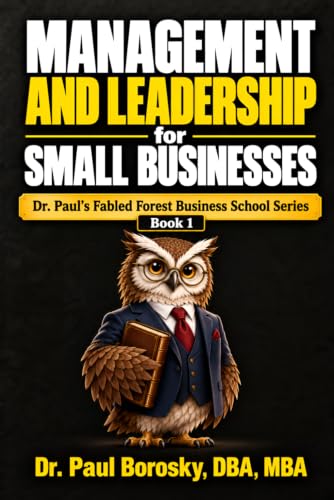
Book 1 of Dr. Paul’s Fabled Forest Business School Series. Each chapter follows one owner through one problem and teaches one real management idea, by its real name, so you recognize it in a class, a job interview, or a meeting. Watching over the forest is Doctor Owl, a careful old consultant who never answers a question without asking one first. He does not fix anyone’s business for them. He helps them see it.
- 20 chapters, one management foundation each, in two parts: the work and the people
- Dr. Paul’s Nutshell at the end of every chapter: what it is, why it matters, how to use it, and one question for you
- Doctor Owl’s Scrolls: 20 one-page worksheets you can copy and use
- The Talon Way: seven shortcuts that sound reasonable and cost more than they save
- A full glossary, with every management term defined
- The Owner’s Scorecard, to decide what to fix first and measure it 90 days later
You do not need a business to use this book. Every idea works on a team, a club, a job, or a plan you have not started yet. Terms like delegation, span of control, and change management are taught by their textbook names and defined in the glossary, which makes the book a plain-English companion for intro business and management courses. Teaching a course and want to talk about using it? Call or text Dr. Paul at (321) 948-9588.
The Series
Dr. Paul’s Fabled Forest Business School Series
Every book adds one line to the Owner’s Scorecard. Management comes first because the other jobs need a business that runs. These four are available now.
Looking for the money side of leadership? Once the business runs without you, the next question is how much is enough. Dr. Paul’s book Become Your Version of Rich takes it on, and the free Become Your Version of Rich guide covers motivation, habits, leadership, and power in 21 short pages. It is a separate book from the Fabled Forest series.
See every title, including the Fabled Forest editions of Cash Flow Management and Budgeting, on Dr. Paul’s business books page.
Michigan’s minimum wage is rising under a scheduled series of increases. Managers should budget each step ahead of time, a point covered on the Michigan business plan writer page.
Want to see these foundations inside a real plan? Dr. Paul’s city guides use this book for turning an idea into a business plan in Rochester, a family succession plan in Scranton and profit and purpose goals in Burlington.
Southern owners face the same leadership questions. See a first business plan in Huntington, when a Port St. Lucie contractor should update the plan, growing past doing everything in Little Rock and practice partners planning in Birmingham.
FAQ
Common Questions About Small Business Management
What is small business management?
What are the four functions of management?
What is the difference between management and leadership?
What should I fix first if my business depends on me?
Who is Management and Leadership for Small Businesses written for?
Why does the book use animal stories?
Start with the book. Call when you want help building it.
Dr. Paul Borosky, DBA, MBA
Business Consultant, Author & Educator | 14+ Years | 1,000+ Clients Served
Dr. Paul Borosky, DBA, MBA is a business consultant, author, and educator, and the founder of Quality Business Plan. He helps small business owners across the United States and Canada with business planning, financial modeling, fractional CFO services, and the everyday problems of businesses that depend too much on their owners. He is the creator of Dr. Paul’s Organize-Plan-Grow™ Strategy, author of numerous published books on Amazon including Dr. Paul’s Fabled Forest Business School series, and publisher of over 1,000 business-focused videos on YouTube. He has taught as an adjunct college instructor and teaches in Florida public schools.
This page is for general educational purposes only. It is not legal, financial, tax, accounting, or other professional advice. The Fabled Forest, its characters, and its businesses are fictional. For decisions about your own business, consult a qualified professional.