
Dr. Paul Borosky, DBA, MBA
Business Consultant & Author
Can Your Business Run Without You? The Two-Week Vacation Test
Take two weeks off, turn off your phone, and watch what happens. Dr. Paul Borosky explains what the result says about your leadership, and the learnable moves that build a business that does not run through you.
Last Updated: 10/28/2026 · Written by Dr. Paul Borosky, DBA, MBA
The Short Answer
Can Your Business Run Without You?
It can if you built the people and the standards to carry it. The test is simple: leave for two weeks, turn off your phone, and see whether the business keeps running at a high level or wobbles the moment you walk out. A business that depends on your approval for every decision has a ceiling.
This is the opening test of Chapter 4 in Become Your Version of Rich by Dr. Paul Borosky, DBA, MBA, and it follows habits, because a leader’s standards must hold on a bad day. The how-to pages live in the Management cluster: how to delegate work and what an SOP is. The whole set sits inside the Become Your Version of Rich guide.
Want a Business That Runs Without You?
The Test
Leave. Then Look at What Happened.
Most owners know the answer before they try it. The test makes it visible.
Dr. Paul opens Chapter 4 of Become Your Version of Rich with this test.
From Chapter 4 of Become Your Version of Rich
Take a two-week vacation. Turn off your phone. Then come back and look at what happened while you were gone. Did the business keep running at a high level? Did your people make sound decisions, solve problems, and hold the standards you set? Or did it start to wobble the moment you walked out the door?
If the business can run without your constant presence, you built something durable. If it depends on you to approve every decision and solve every problem, you may be working hard, but you are holding a fragile machine together with your own two hands. That is a different job, and it has a ceiling.
Here is a practical way to run the test without betting the company on it:
- Pick the stretch. Two weeks is the full test. If you cannot leave that long yet, start with two days, then a week.
- Brief the people, not the tasks. Tell each person what result they own, what they can decide alone, what needs your approval, and when to escalate.
- Go dark for real. Phone off. A trusted backup handles true emergencies, and you define in advance what counts as one.
- Audit on your return. List what wobbled, what decisions waited for you, and what knowledge sat only in your head. That list is your fix list.
The Definition
Leadership Is Four Things, and a Title Is Not One of Them
Dr. Paul defines leadership as the ability to set a clear direction, earn trust, develop capability in other people, and move them toward a result worth reaching. A person who does only some of the four is doing something narrower than leading. A title gives you authority. It cannot make people trust you, believe in your direction, or do their best work when you are not watching. That gap is the authority vs. trust gap, and it is where most owners get stuck.
Leadership is also the turning point in the book. The first three traits, motivation, creativity, and habits, are built largely inside you. Leadership is where they start working through other people. It does not guarantee financial success, since markets and timing get a vote. It sharpens an organization’s ability to execute, adapt, and keep good people.
Be careful with the word management. Management builds structure, coordination, and controls. Leadership sets direction, earns commitment, develops people, and guides change. Most owners must do both. The real failure is micromanagement: too much control and too little delegation, one person with a finger on every decision. Nothing can grow larger than the single person trying to hold all of it.
Free advising for owners statewide comes from the Kentucky SBDC, run through the University of Kentucky. Owners building a business that runs without them can start there, and see business plans for Kentucky owners.
A Real Example
Berkshire Hathaway Does Not Need Buffett Hovering
By Dr. Paul’s measure, Warren Buffett is not only a great investor but a serious leader. A Stanford Graduate School of Business case describes Berkshire’s model as extreme decentralization of operating authority, with local managers fully accountable for their results and running largely without supervision or corporate control. The case notes managers had two formal duties: report financial statements monthly and send free cash flow to headquarters. Partner Charlie Munger described the system as “delegation just short of abdication.”
That is a high form of leadership, and almost nobody aims for it, because it means giving up the control that feels like power. The phrase is a target, and the “just short” does real work. You hand over authority and the result, but you never hand over your own accountability for the outcome. Delegate. Do not abdicate. For the habits behind that style, see Warren Buffett’s daily habits.
Sources: Stanford Graduate School of Business, The Management of Berkshire Hathaway (case study).
Where to Fix It
The Test Shows the Gap. These Pages Close It.
Dr. Paul keeps this cluster focused on the mindset. The how-to detail lives in the Management cluster.
What the Research Says
Safe People Speak Up, and Management Is Not the Enemy
Harvard professor Amy Edmondson’s research on psychological safety finds that teams work better when people feel safe enough to speak up, admit a mistake, or raise a concern without being humiliated. Be clear about what safety does. It makes people willing to talk. It does not make them skilled, accountable, or well directed. Strong performance still needs competence, clear expectations, and follow-through on top.
John Kotter’s classic Harvard Business Review article draws the line between the two jobs: management copes with complexity, while leadership copes with change. Organizations need both. For you, that means the vacation test measures two things. Is the structure sound, and do the people trust the direction?
Sources: Edmondson, A. C. (2019), The Fearless Organization: Creating Psychological Safety in the Workplace for Learning, Innovation, and Growth, Wiley. Kotter, J. P. (2001), What Leaders Really Do, Harvard Business Review (December 2001).
Two Owners
One Was Quiet. One Turned Habits Into Processes.
Dr. Paul once worked with the owner of an elephant garlic farm who did not fit the loud, charismatic picture of a leader. He was soft-spoken and extraordinarily organized. Every time Dr. Paul asked a question, he paused, heard it whole, and thought before answering. When a worker made a mistake, he walked the person through what went wrong and left the responsibility with them. He kept several key hands for years, longer than other growers in the region. People stayed because the work was well ordered, the standards were clear, and the man was steady.
Another client in South Florida owned a fitness center, trained clients in it, and owned the building. The day mostly ran itself because he had built habits of delegating, solving problems fast, and holding people accountable. He called them his processes. Dr. Paul draws the line this way: a habit makes one person consistent, and a documented process makes a whole organization consistent. That is the move from building a habit to building a business that runs without you.
How This Helps a Business Owner
Three Questions to Ask Before You Book the Trip
You do not need to leave to learn something. Three questions show where the business depends on you.
Find the Single Points of Failure
Who knows what only you know?
List the essential roles and the tasks that only one person can do, you included. Give each role a trained backup and cross-train the critical tasks. Then document them as SOPs so the knowledge leaves your head.
Hand Over Decisions, Not Just Tasks
What may each person decide alone?
Most poor performance is people who do not know what they own or what they may decide. State the result, the budget, when to escalate, and how you will review it. Delegation fills in the rest.
Watch From the Right Altitude
When do you step in?
Review results at the right level, and step in only when you must. Learning to watch instead of grab is where most owners fail, and it is the difference between a business that needs you and one that does not.
One Honest Caution
Do Not Run the Test During a Crisis, and Scale It to Your Business
Not every business can go dark for two weeks. A solo professional, a regulated operation, or a safety-critical operation needs a safe emergency path and a shorter first test, perhaps two days. Do not run the test in the middle of a crisis, and do not use it to avoid a hard conversation with someone who is underperforming. Leadership is also not proven by whether people follow you, since people have followed reckless figures. Judge it by purpose, methods, and results.
Do This Tomorrow
Three Steps for Tomorrow
- Have one real listening conversation about an actual problem. Ask what is happening, why, what has been tried, and what support is needed. Summarize what you heard before you answer.
- Delegate one meaningful, recurring responsibility. Define the result, the authority, the deadline, and the check-in points, then track how often you step in and whether it was necessary.
- Ask two of your people what you should keep doing, what creates confusion, and what decisions they could make without you. Then listen.
If tomorrow allows only one, make it the first: listen, and think before you respond. It costs nothing but your ego for a moment. At thirty days, check the signals: are people bringing you problems sooner, making more calls without you, and repeating fewer mistakes? Then read how an overreaching leadership story ends in why J.C. Penney failed under Ron Johnson.
The Book
Chapter 4 Has the Full Method
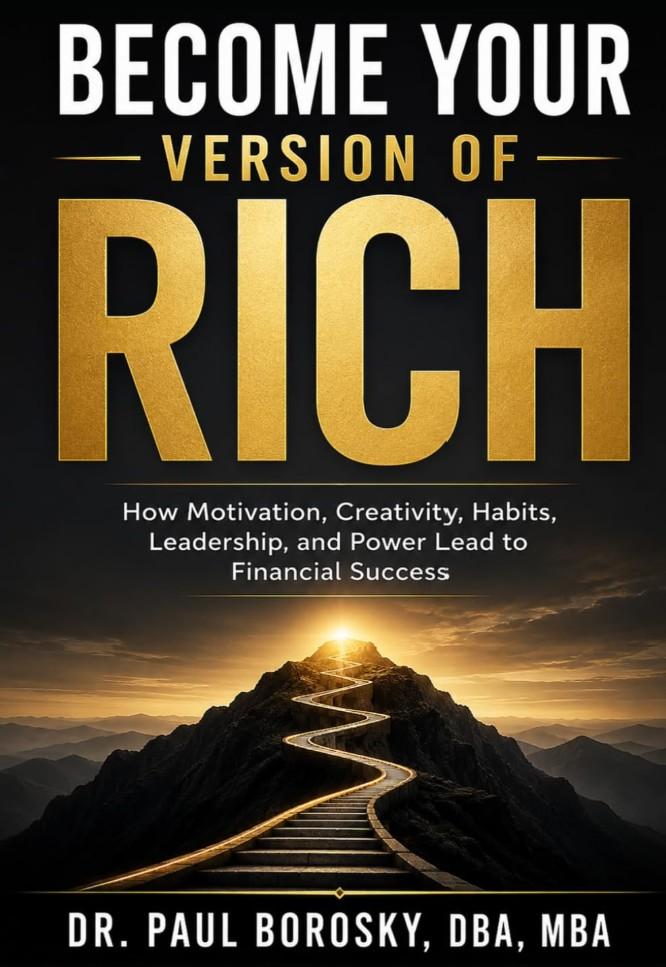
This page covers the test and the framing. Become Your Version of Rich gives you the seven-step method and the people behind it.
- The seven-step leadership method, from direction to successors
- Madam C.J. Walker, Benjamin Franklin, and Napoleon, three leaders with no title that mattered
- The J.C. Penney cautionary tale
- The quiet garlic farmer and what he did that kept good people
- Daily Actions and a 30-day check on whether your standards hold through other people
Keep Going
More From Chapter 4
FAQ
Common Questions About Running a Business Without You
What is the two-week vacation test?
What does delegation just short of abdication mean?
What is the difference between leadership and micromanagement?
Dr. Paul Borosky, DBA, MBA
Business Consultant, Author & Educator | 14+ Years | 1,000+ Clients Served
Dr. Paul Borosky, DBA, MBA is a business consultant, author, and educator, and the founder of Quality Business Plan. He helps small business owners across the United States and Canada with business planning, financial modeling, fractional CFO services, and the everyday problems of businesses that depend too much on their owners. He is the creator of Dr. Paul's Organize-Plan-Grow™ Strategy, author of numerous published books on Amazon, and publisher of over 1,000 business-focused videos on YouTube. He has taught as an adjunct college instructor and teaches in Florida public schools.
This page is for general educational purposes only. It is not investment, tax, legal, financial, or retirement advice, and it does not guarantee any particular financial result. The examples, figures, and calculations are illustrative planning tools, not recommendations. Before making significant financial decisions, consult a qualified professional.