
Dr. Paul Borosky, DBA, MBA
Business Plan Writer · Business Consultant
How Do You Train Restaurant Staff on the Menu? Put the Sentence in Their Mouth
Customers ask “what’s good here?” and most servers answer “everything.” That one answer costs you more referrals than any bad review.
Written by Dr. Paul Borosky, DBA, MBA
The Definition
What Is Restaurant Menu Training?
Restaurant menu training is the process of teaching servers and front-of-house staff the ingredients, preparation, flavors, and recommended pairings of every menu item, so they can describe dishes accurately, guide guests’ choices, and answer questions about allergens and preferences.
“Your servers are the only part of the menu that can talk. If they have never tasted the food, they can only read it to the guest. Feed them the menu, give them one dish to be proud of, and let them tell the story.”
Need the answer fast? Read the gold Short Answer boxes and the numbered steps. Want the full picture? Follow Louie Waffles, the big-hearted Labrador who runs Waffle Woofs Bakery & Café, from Dr. Paul’s Fabled Forest, as his friendly new server answers every question with “it’s all good”. The story shows up in a few short gold notes along the way. The study numbers sit in one section, clearly marked.
Get Your Restaurant Plan Written, or Build It Yourself
Lenders want covers, prime cost, and break even before they read the menu. Pick how you want to get there.
Business Consulting
Packed dining room and a thin bank balance? Dr. Paul helps restaurant owners sort out prime cost, cash, staffing, and menu pricing.
See consulting options →Business Plan Writing
FeaturedCovers by shift, prime cost, and break even, built into one plan your lender and landlord can follow. Dr. Paul writes it with you.
Start your plan →Restaurant Business Plan Template
A Word plan and an Excel model built around covers, check size, and food cost, with video tutorials for both.
See the template →Small Business Education
Free guides on funding, financial statements, and running the business, plus Dr. Paul’s plan-writing videos.
Start learning →From Dr. Paul’s Fabled Forest
Meet Louie: It’s All Good
Some lessons stick better as a story. Dr. Paul’s Fabled Forest is his business school told through a forest full of small business owners. Doctor Owl, a dry-witted consultant who lives in the Lone Oak, helps them fix the same problems real owners face. Today he takes a seat at Waffle Woofs Bakery & Café, where Louie Waffles has just hired a cheerful young chipmunk to wait tables.
DOCTOR OWL: What do you recommend?
SERVER: (bouncing on her toes) Oh, it’s all good! Everything!
DOCTOR OWL: What is in the Mountain Stack?
SERVER: Waffles! And… stuff on top. It’s really good.
Louie hurries over, wiping his paws on his apron.
LOUIE: She’s new. Isn’t she wonderful? Everyone loves her.
DOCTOR OWL: She is wonderful. Has she ever eaten a Mountain Stack?
LOUIE: (quietly) Well. No. Those are for customers.
DOCTOR OWL: Then she is selling a dish she has only ever seen walk past her.
An original Fabled Forest moment. Similar stories about Doctor Owl and the forest’s owners are in Human Resources for Small Businesses, Book 8 of Dr. Paul’s Fabled Forest Business School.
Louie has a decision to make. Keep reading. You’ll see what he does, and why it works for your restaurant too.
 Similar stories in Human Resources for Small Businesses
Dr. Paul’s Fabled Forest Business School, Book 8 See the Books →
The Finding
Why Does Menu Knowledge Matter So Much?
Dr. Paul’s study of 752 customer reviews across 12 restaurants in 12 states found that friendly staff are everywhere in reviews. Staff who know the food are rare. And customers need a single sentence they can repeat about you, a dish worth the drive, before they can recommend you to anyone.
Your servers are the ones who hand them that sentence. Or do not.
Louie’s new server was friendly, eager, and could not describe a single dish. Nobody had ever let her taste one.
Show the Numbers
What Do Reviews Say About Staff and Menu Knowledge?
| Finding | What the reviews showed |
|---|---|
| Staff who knew the food | Only 23 of 752 described staff who knew the menu, explained a dish, or guided the table. The smallest group in the study. |
| A dish worth naming | 27 named a signature dish. They recommended the restaurant at 22.2%, against 12.0% for everyone else. The largest referral gap in the study. |
| Attentive service | 86 described staff checking on them. They mentioned coming back at nearly three times the rate of everyone else. |
Lots of reviews say the staff were friendly. Almost none say why. The few that describe great service describe staff who knew the food and guided the table.
The Training
How Do You Train Servers on the Menu?
- 1
Feed your staff the menu
Literally. Every server tastes every dish before they sell it.
Louie’s FixLouie closed early one afternoon and had his new server taste every item on the menu. She took notes on a napkin.
- 2
Pick the dish, and give them the sentence
One signature dish, one sentence every server can say: what it is, what makes it special.
- 3
Teach the why, not just the what
Where the ingredients come from, how it is made, what it pairs with.
- 4
Run a short pre-shift lineup
Five minutes on the special, a sold-out item, and one dish to push tonight.
- 5
Know the allergens cold
Guests trust servers who can answer without running to the kitchen.
- 6
Set a table check standard
Attention brings customers back. Make it a habit, not a hope.
From Dr. Paul’s Work as a Business Consultant
What a Business Consultant Looks for on the Floor
When Dr. Paul visits a restaurant, one of the simplest tests is asking a server what they recommend, and why. The answer tells you a lot about training, morale, and how the kitchen and floor talk to each other.
Training costs a few plates and an hour. It pays back on every table.
Your servers are the only part of the menu that can talk. Give them something worth saying.
From Dr. Paul’s Fabled Forest
What Louie Did Next
The next week, Doctor Owl sat at the same table. The same chipmunk bounced over.
DOCTOR OWL: What do you recommend?
SERVER: (without missing a beat) The Mountain Stack. Blueberries from the north meadow, whipped cream Louie makes every morning, and the waffles are crispy on the outside and soft in the middle. It’s the best thing here.
Louie watches from the counter, tail going a mile a minute.
LOUIE: She sold six this morning. Six! She tells everyone about the meadow.
DOCTOR OWL: Now your customers have a sentence to repeat.
The lesson for your restaurant: Feed your staff the menu, give them one dish and one sentence, and let them tell the story. Friendly gets a smile. Knowledgeable gets a referral.
In Your Business Plan
How Does Staff Training Go in Your Business Plan?
Lenders read your management and staffing section to see whether service will hold up when you are not in the room. Related guides: Why Don’t Restaurant Customers Come Back After a Good Meal? and How Do You Price a Restaurant Menu for Profit?.
- 1
Describe your training program
Menu tasting, allergen training, and a pre-shift lineup.
- 2
Name who owns training
A manager or lead server with time set aside.
- 3
Describe your service standard
Table checks, section coverage, and how you measure them.
- 4
Tie it to retention
Trained staff stay longer, and so do customers.
This is one piece of the full plan. See How to Write a Restaurant Business Plan for every section, start to finish.
Want your staff selling the menu, not just serving it?Dr. Paul works with restaurant owners on training, service standards, and the habits that bring customers back.
Questions
Restaurant Menu Training Questions
How do you train servers on a restaurant menu?
Have every server taste every dish, teach the ingredients and preparation, give them one signature dish and a sentence to describe it, and review specials in a short pre-shift lineup.
Why is menu knowledge important for servers?
Guests need a reason to recommend you. In Dr. Paul’s study of 752 customer reviews across 12 restaurants in 12 states, customers who could name a signature dish recommended the restaurant at nearly twice the normal rate.
How often should restaurants do menu training?
At hiring, whenever the menu changes, and briefly before every shift.
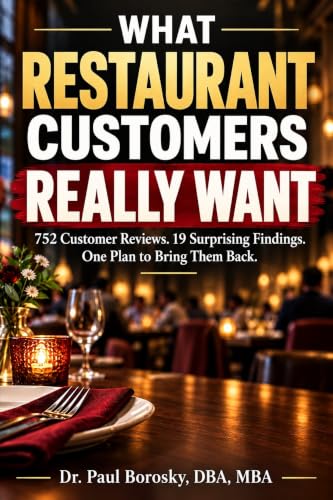
What Restaurant Customers Really Want
What customers say about service, food, and the staff who bring them back.