
Dr. Paul Borosky, DBA, MBA
Business Consultant & Author
Survival Glossary: Small Business Risk and Recovery Terms in Plain English
A lender mentions a reserve floor. A buyer quotes a multiple. A notice claims you’re in default. In a hard season the vocabulary shows up fast, usually from someone on the other side of the table. This glossary defines every standard survival term in the book in plain English, each linked to the chapter page that shows it in a real decision.
Last Updated: 11/15/2026 · Written by Dr. Paul Borosky, DBA, MBA
The Definition
What Counts as a Survival Term for a Small Business?
Short Answer
A survival term is any word for how a business protects itself, gets through a bad stretch, works with others under pressure, or plans to outlast its owner. Most are simple ideas with formal names: know what you’re worth, keep a cushion, decide ahead of time, write it down.
Every term here answers one of four questions: Protect? Endure? Unite? Last?
Doctor Owl, in Plain English
“You will hear most of these words for the first time from someone who wants something from you. Better to know them first.”
How This Guide Works
Need a word fast? Jump to its letter and read the short definition. Want to use it? The link under each term opens the chapter page that shows it at work, with a story from Dr. Paul’s Fabled Forest Business School Series. Legal and lending rules differ by place, so check yours.
Know the Terms but Facing the Real Thing?
Definitions help you follow the conversation. A cash gap, a buyout, or a lender call still needs a plan. Pick the help that fits.
Business Consulting
FeaturedGoing through a hard season? Dr. Paul helps you size the gap, rank the moves, and talk to lenders early.
See consulting options →Business Plan Writing
Dr. Paul writes plans with reserves, risks, and debt schedules a lender can trust.
Start your plan →Business Plan Templates
A Word plan and Excel model with cash forecast and break-even built in.
Browse templates →Small Business Education
Free guides, videos, and the Fabled Forest Business School books on surviving and lasting.
Start learning →From Dr. Paul’s Fabled Forest
Whose Hard Winter Do These Terms Come From?
Stories make vocabulary stick. Dr. Paul’s Fabled Forest Business School Series teaches business through forest owners facing the same problems real owners do. In Book 10, the hardest winter in memory arrives, and a hawk sends the same letter to fourteen owners offering to buy them out.
Each chapter page linked below follows one owner through one threat: a labrador whose waffle got thinner, a monkey with a notice nailed to his door, a raccoon counting eleven coins on payday, a jaguar running four juice bars when two are losing.
In the Fabled Forest
The forest’s own words, like Founders’ Day and the quiet corner by the round window, belong to the stories. You won’t hear them from a lender or a lawyer, so the definitions below stick to the real business terms.
The Terms
Survival and Recovery Vocabulary, Sorted A to Z
Each term below is taught by name in Survival for Small Businesses, Book 10 of Dr. Paul’s Fabled Forest Business School Series. Prefer the big picture first? Start with the small business survival guide.
Story words from the forest are left off this list: coins (the forest’s only money), Founders’ Day (the spring festival when the hawk’s offers ran out), and the Talon Way (the hawk’s shortcut that works until it doesn’t).
- Break-even occupancy
- The share of rooms, seats, or appointment slots you must fill each month just to cover costs. Fixed monthly costs divided by what each filled slot keeps after its own costs.
- Guide: How to Calculate Break-Even Occupancy →
- Business continuity planning
- Working out in advance how the business keeps going if a building, machine, or system fails: the work that can’t stop, a second place for it, who to tell, and where copies are kept.
- Chapter 6: Continuity Planning →
- Business pivot
- Changing what customers pay you for, or who pays, while keeping the strength the business already has.
- Chapter 13: Business Pivot →
- Business valuation
- An estimate of what a business is worth, based on what it owns, what it earns for its owner, and what a buyer would reasonably pay for those earnings.
- Chapter 1: Business Valuation →
- Cash crisis management
- The short-term plan for when cash on hand can’t cover what’s due: a weekly list of money in and out, essentials paid first, collections chased, and lenders called before anything is late.
- Chapter 9: Cash Crisis →
- Contract dispute
- A disagreement over what a signed agreement means or what is owed under it. Start by rereading the agreement itself, not the other side’s demand.
- Chapter 7: Contract Disputes →
- Cooperative buying
- Nearby small businesses combining orders for the same supplies to get big-buyer prices and delivery, each paying its own share and never coordinating selling prices.
- Chapter 12: Cooperative Buying →
- Cost cutting
- Lowering costs in the right order: hidden waste first, then other costs customers never notice, while protecting safeguards and the reason customers buy.
- Chapter 5: Cost Cutting →
- Debt management
- Handling existing loans so they never threaten the business: on-time payments, a protected reserve, early payoff only from money above that reserve, and early word to the lender.
- Chapter 15: Debt Management →
- Diversification
- Adding another income stream so one slow market can’t sink the business. Best when it builds on existing skills, reaches different customers, starts small, and is capped.
- Chapter 14: Diversification →
- Exit strategy
- A plan for how an owner will eventually leave: sell to an outsider, hand it to an employee, hand it to family, or close it, and what the business must become for that path to work.
- Chapter 18: Exit Strategy →
- Investing in a downturn
- Buying something the business truly needs during a weak economy, only if the reserve stays healthy afterward, payback works on cautious numbers, and it fits the core business.
- Chapter 11: Investing in a Downturn →
- Key account loss
- Losing a customer large enough to dent the business. Measure the gap as the sales that left minus only the costs that leave with them.
- Chapter 3: Key Account Loss →
- Key person risk
- The chance the business freezes when one person is suddenly unavailable, because only they can sign, unlock, log in, or decide.
- Chapter 8: Key Person Risk →
- Late fee
- A charge for a late payment. The amount comes from the signed agreement and local rules, not from whatever a demand letter says.
- Chapter 7: Contract Disputes →
- Line of credit
- Borrowing a lender approves ahead of time, which you draw on only if needed. It’s easiest to get while the business is healthy.
- Guide: When to Get a Business Line of Credit →
- Long-term thinking
- Making big decisions for the business you want to own in ten years: growth at a pace you can carry, a known break-even for each new piece, and control kept.
- Chapter 20: Long-Term Thinking →
- Multiple
- A rule of thumb for valuing a small business: yearly owner’s earnings times a number of years, commonly a low single-digit figure for small firms.
- Chapter 1: Business Valuation →
- Notice of default
- A formal claim that someone has broken the terms of an agreement. Check what the agreement actually says before accepting what the notice demands.
- Guide: What Is a Notice of Default? →
- Owner’s earnings
- What a business leaves its owner in a year after every expense except the owner’s own pay. It covers both the owner’s labor and the return on owning it.
- Guide: What Is Seller’s Discretionary Earnings? →
- Partnership dispute
- A serious disagreement between co-owners that won’t settle on its own. Handle it with the partnership agreement, a written list, and a neutral person both trust.
- Chapter 10: Partnership Disputes →
- Price floor
- Your full cost for each sale at normal volume: direct costs plus running costs spread over what you usually sell. When volume drops, the floor rises.
- Guide: What Is a Price Floor? →
- Price war
- A cycle where a competitor cuts prices to win your customers and you cut back to keep them, until one side can’t afford to continue.
- Chapter 2: Price Wars →
- Recession planning
- Deciding before sales fall what you’ll watch and what you’ll do at each level of decline, so the hard choices are already made.
- Chapter 4: Recession Planning →
- Reserve floor
- The minimum cash reserve you commit to keeping, usually several months of the costs that continue when sales stop. It can fund a paying job but never early debt payoff.
- Chapter 15: Debt Management →
- Retrenchment
- Shrinking the business on purpose to protect it: closing parts that lose money, treating affected staff fairly, and moving time and money to what earns.
- Chapter 19: Retrenchment →
- Signing authority
- Written permission, held by a bank or partner, for someone besides the owner to sign payments or documents, usually with a limit.
- Chapter 8: Key Person Risk →
- Strategic alliance
- A short written agreement among independent businesses to cooperate on referrals, a joint offer, or shared buying, with each keeping its own prices and the freedom to leave.
- Chapter 16: Strategic Alliances →
- Succession planning
- Choosing in advance who will run or own the business after you, when it happens in stages, how they’ll learn, and how they’ll pay, all put in writing.
- Chapter 17: Succession Planning →
Put the Terms to Work
Which Survival Job Do You Need Help With?
The book sorts its foundations into four jobs. Pick the question that sounds like your week, then open the foundation that answers it.
A Consultant’s View
Which Survival Terms Trip Up Small Business Owners Most?
The mix-ups Dr. Paul sees most change real decisions. Owners treat a demand letter as the contract and pay fees they never owed. They confuse paying off debt with managing it, and empty the reserve doing it. They judge a business by its total and miss the location quietly losing money. And they hear an offer before they know their own value. None of this needs a finance degree. It needs the right word tied to the right habit, which is the Organize step in Dr. Paul’s Organize-Plan-Grow™ Strategy.
The Book
From Definitions to the Full Stories
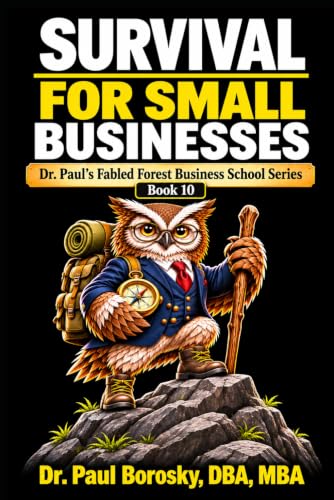
Every term here shows up in the book inside a real decision: a roof that gave way over three rooms, a sealed offer on a workbench, a slate nobody could see, a saw held out by the handle. 20 foundations, a Nutshell for each, and line 10 of the Owner’s Scorecard. Book 10 of Dr. Paul’s Fabled Forest Business School Series.
More Glossaries
Glossaries From the Rest of the Series
All 20 foundations are on the small business survival guide. More subjects are in the Small Business Education Center.
Written by Dr. Paul Borosky, DBA, MBA, business consultant and author of books on Amazon, with 14+ years of experience and 1,000+ clients served. Want help putting these terms to work? Dr. Paul works with owners one-on-one.
This page is for general educational purposes only. It is not legal, tax, lending, or other professional advice. Contract, lending, and employment rules differ by place, so check the rules where you operate. The Fabled Forest and its characters are fictional.