
Dr. Paul Borosky, DBA, MBA
Business Consultant & Author
How to Be More Creative: A 7-Step Method for Solving Business Problems
Creativity follows a repeatable process, and the whole trick is not to mix up its two modes. Dr. Paul Borosky walks through the seven steps he teaches, and the stop rule that keeps you from polishing forever.
Last Updated: 10/28/2026 · Written by Dr. Paul Borosky, DBA, MBA
The Short Answer
How Do You Become More Creative?
Use a repeatable process with two modes. First open up and generate options without judging them. Then narrow, test, and choose. Define the problem, generate options, borrow one idea from another field, narrow, pressure-test, improve, then test the smallest version and measure.
This is the method in Chapter 2 of Become Your Version of Rich by Dr. Paul Borosky, DBA, MBA. Need the definition first? Read what creativity means in business. Juggling too many ideas at once? Sort them with how to prioritize work. It all belongs to the Become Your Version of Rich guide.
The Method
Seven Steps, Two Modes
Generating and judging at the same time is how good ideas get killed early. Keep the modes apart.
Mode one: open up
Generate
Steps 1 to 3. Name the problem, put several different options on the table, and borrow one idea from outside your field. No criticism allowed.
Mode two: narrow down
Judge
Steps 4 to 7. Pick the strongest two or three, pressure-test them, improve the best, and test the smallest real version.
- Define the problem and the outcome you want. Name what you are solving and what a win looks like, so you know when you have hit it.
- Generate several genuinely different options. Rough is fine. The only rule is no criticism, because the moment you evaluate you stop generating.
- Borrow one idea from outside your field. Reach into another industry and ask what happens if you apply its approach to your problem.
- Narrow to the strongest two or three. Now switch modes. Weigh each option on how much the customer would value it, how different it is, what it costs, how hard it is to run, the risk, and whether it still fits the goal from step one.
- Pressure-test against real constraints and real people. Can you afford it, can you run it, is it legal and practical, and will the person you serve want it?
- Improve the strongest option and add your judgment on top. Layer your voice and experience over what the test taught you, and push it one more round.
- Test the smallest workable version, then execute and measure. Put the smallest real version in front of a real user and watch what they do.
Step Three In Depth
Borrow the Principle, Not the Specifics
This is Dr. Paul’s favorite move. Find an idea a competitor uses, or better, an idea from a completely different industry, and apply it to a problem in your own. A restaurant can borrow the idea behind an airline’s loyalty program. A landscaper can borrow the subscription model software companies use. The principle is fair game.
The line is the protected specifics: someone’s exact wording, branding, designs, or confidential information. A restaurant cannot copy the airline’s logo and copy. Research on new product ideas supports the move: analogies from more distant fields tended to produce more original ideas, as long as they were close enough to bridge. Your creativity is in the transplant.
Sources: Dahl, D. W., & Moreau, P. (2002), The influence and value of analogical thinking during new product ideation, Journal of Marketing Research, 39(1), 47-60.
Step Five In Depth
Whose Opinion Counts Most
When you pressure-test, outside eyes help, but they are not equal. Dr. Paul ranks them in this order:
- A real customer or user. Behavior beats opinion. Watch what they do.
- Someone who knows the work firsthand. They see what a spreadsheet will not.
- A mentor or colleague. Useful, but they are not buying.
- An AI tool as a sparring partner. Fast, cheap, and the least reliable of the four.
A customer’s behavior outranks a colleague’s opinion, which outranks a chatbot’s suggestion, every time. If you only have time for one test, use the first.
Step Seven In Depth
Ship a Small Version
Dr. Paul sums up step seven this way in Become Your Version of Rich.
From Chapter 2 of Become Your Version of Rich
Before you invest heavily, put the smallest real version in front of a real user, customer, student, or audience and watch what they do. Then execute the best version and measure the result, because creativity without execution is just daydreaming with extra steps, and an idea a customer has actually reacted to beats one that only sounded good in your head.
Dr. Paul worked this way with a client who set out to build her own skincare line. She did not invent a new molecule. She took existing ingredients, kept asking how they could be combined and used differently, ran the question through round after round, and tested versions on real users before committing. The result was a distinctive product line that found a real audience. No art degree required.
The Stop Rule
How Many Rounds Is Enough?
For ordinary decisions, two or three focused rounds is a practical starting point. Past that, another round of “let me make it better” can bury the objective and stall you. But the real stop rule is not a number. Stop when you hit your deadline, when the idea clears the quality bar you set, when a real customer’s response says it is ready, or when another round will not improve the result in any way a customer would notice.
Dr. Paul sees two opposite versions of the same mistake. Some people avoid creativity entirely and never ask the question. Others keep polishing and never ship. Both end up with nothing. Creativity counts when it is applied, tested, and shipped. His own habit: he walks his seven Labradors and talks ideas out loud, even arguing against himself. A few walks later he has reached ideas more sophisticated than any he found at a desk. Same walk, different use of it.
How This Helps a Business Owner
Point the Method at the Problems Owners Actually Have
You will not run this on abstract problems. Run it on the three places where a different idea pays the fastest.
Your Offer and Pricing
Ask how to serve the customer better
Instead of discounting, ask what the customer finds hard about buying from you and fix that. Weigh options with the decision making process so the best one wins, not the loudest.
Your Marketing
Borrow from another industry
Look at how a gym, an airline, or a software company keeps customers, then adapt the principle to yours. Check it first with a small test to a small group.
Your Daily Operations
Fix the boring task
Pick one slow, ordinary task and ask how to make it better. The same method that improves a product improves a process. See continuous improvement for how to keep the gains.
One Honest Caution
Creativity Is Not a Replacement for the Work
Creativity makes hard work stand out. It does not replace it. A clever idea with no execution, no customer test, and no money behind it is daydreaming with extra steps. This page is general education, not legal advice. If a borrowed idea touches someone else’s protected designs, wording, or confidential information, speak to an attorney first.
Do This Tomorrow
The Thirty Day Version
- Week one: take one real problem, run it through the seven steps, and test one improvement in the real world.
- Week two: pick a new problem. Do not go back and buff the first one.
- Week three: repeat with a third problem. Borrow from a different industry each time.
- Week four: repeat once more. Then write your one best differentiating move on the single page where you keep your version of rich.
The month is built to make you ship, not polish. You will have four improvements that met reality, not one idea buffed to death in private. When you have a differentiator worth protecting, see why BlackBerry failed to learn what happens when you stop asking the question.
The Book
The Full Method Is in Chapter 2
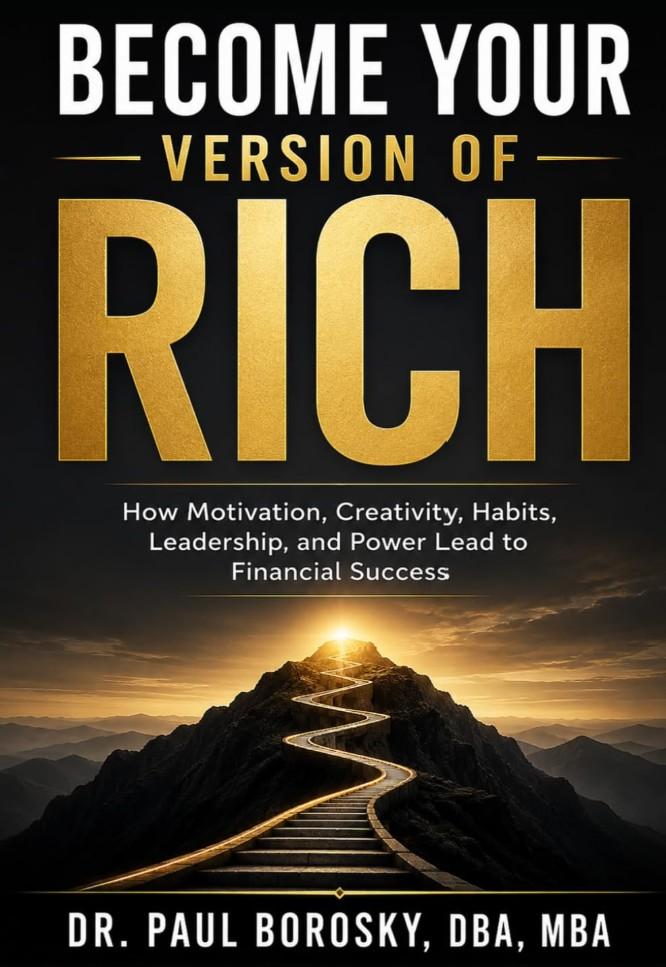
This page walks the seven steps. Become Your Version of Rich adds the stories behind them.
- The seven-step method with the generate and judge modes
- Nikola Tesla, Benjamin Franklin, and Napoleon, three versions of creativity at work
- A long-haul trucker who built a community without knowing it was creative
- The BlackBerry cautionary tale and the question that cost a company
- A 30-day plan built to make you ship
Go Further With Dr. Paul
Put Your Best Idea on Page One of a Plan
When the method gives you a differentiator worth building on, it needs a business plan that explains it and numbers that support it. Dr. Paul writes custom business plans built on 1,000+ client engagements, so the idea reads as clearly to a lender as it does to you.
Keep Going
More From Chapter 2
FAQ
Common Questions About Being More Creative
How do you become more creative at work?
How many rounds of improvement are enough?
How can I borrow ideas without copying?
Dr. Paul Borosky, DBA, MBA
Business Consultant, Author & Educator | 14+ Years | 1,000+ Clients Served
Dr. Paul Borosky, DBA, MBA is a business consultant, author, and educator, and the founder of Quality Business Plan. He helps small business owners across the United States and Canada with business planning, financial modeling, fractional CFO services, and the everyday problems of businesses that depend too much on their owners. He is the creator of Dr. Paul's Organize-Plan-Grow™ Strategy, author of numerous published books on Amazon, and publisher of over 1,000 business-focused videos on YouTube. He has taught as an adjunct college instructor and teaches in Florida public schools.
This page is for general educational purposes only. It is not investment, tax, legal, financial, or retirement advice, and it does not guarantee any particular financial result. The examples, figures, and calculations are illustrative planning tools, not recommendations. Before making significant financial decisions, consult a qualified professional.