
Dr. Paul Borosky, DBA, MBA
Business Consultant & Author
Small Business Marketing: 20 Foundations Every Owner Should Know
Good work is not enough if nobody past the creek knows you exist. Most owners either hide or shout at everyone. Neither works. These 20 foundations cover getting found and getting chosen, from your target market and value proposition to referrals, reviews, and knowing what actually brought customers in, in plain English.
Marketing not bringing in customers? Call or text (321) 948-9588. Dr. Paul answers personally.
Last Updated: 10/25/2026 · Written by Dr. Paul Borosky, DBA, MBA
The Short Answer
What Is Small Business Marketing?
Marketing is helping the right people find out you exist and giving them a true reason to choose you. It is not bragging, and it is not shouting at everyone. For a small business it comes down to four jobs: know who you are for, say it plainly, show up where those people already look, and count what works.
Target
Know exactly who your business is for, and who it is not for, so every dollar goes to the right people.
- Target market
- Segmentation
- Relationship marketing
Message
Say what you do, what they get, and why you, in plain words, under one name and one look.
- Positioning
- Value proposition
- Brand identity
Reach
Show up in the two or three places your customers already look, with something useful in their hands.
- Collateral and direct
- Content and calendar
- Referrals and reviews
Measure
Ask how every customer heard about you, count it, and spend next month where the count says.
- Attribution
- Conversion rate
- Marketing budget
Small businesses cannot outspend big ones, and they do not have to. They can know their customers by name, say something specific, and be local in a way no chain can copy. Marketing that starts with a clear customer and ends with a count is the growth side of Dr. Paul's Organize-Plan-Grow™ Strategy.
Loud is not the same as found, and found is not the same as kept. Small businesses win on the second half.
Dr. Paul Borosky, DBA, MBA, Marketing for Small BusinessesThe 20 Foundations
Find the Reason Customers Are Not Calling
Each foundation opens with a question a real owner asks. Start with the one that sounds like you. The first ten are about being found: who you are for and what you say. The second ten are about being chosen: content, referrals, reviews, and counting what works. Need a term? The marketing glossary defines 62 of them in plain English.
Part One: Being Found, Telling the Right Customers You Exist
Foundations 1 to 10How to Find Your Target Market, With Examples
"I'll haul anything for anybody. Why isn't anybody calling?"Chapter 1 · Anything for Anyone: A Raccoon's Flyer
A target market is the specific group of customers your business is built to serve best. A target customer is one of them, described so clearly you would recognize them walking in.
Read the full guide →What Is Market Segmentation? Examples for Small Business
"I stock everything anyone ever asked for. Why does nobody buy any of it?"Chapter 2 · Forty Hats, No Heads: A Camel's Everything
Market segmentation is dividing customers into groups that want the same thing for the same reason, then serving each group well instead of stocking a little for everyone.
Read the full guide →How to Build Brand Awareness for a Small Business
"If my work is good enough, won't they find me?"Chapter 3 · The Studio with No Sign: A Squirrel's Secret
Brand awareness is whether the people you serve know you exist at all. Visibility is the practical side: a sign, your name on the work, a sentence you can say out loud.
Read the full guide →What Is Brand Positioning? How to Stand Out From the Shelf
"It's the best honey on the coast. Why are they buying the other one?"Chapter 4 · Honey, Three Coins: A Bee's Blank Label
Positioning is the place you hold in a customer's mind next to the other choices. You have one whether you chose it or not. A short, true brand story sets it on purpose.
Read the full guide →How to Write a Value Proposition: Features vs. Benefits
"I listed everything we can do. Why do they leave before they ask?"Chapter 5 · Sixteen Services, Zero Customers: An Ant's Spec Sheet
A value proposition is one clear sentence telling a customer what they get from you and why from you. Features are what you do. Benefits are what they get.
Read the full guide →What Is a Brand Promise? Examples You Can Actually Keep
"Shouldn't I market the dream? That's what sells!"Chapter 6 · Six Resorts, One Open: An Elephant's Poster
A brand promise is what a customer can count on from you every time, because you can deliver it every time. The gap between expectation and experience decides repeat business.
Read the full guide →What Is Brand Identity? Name, Logo, and Look
"Everybody knows Frankie's. Why can't anybody say what it is?"Chapter 7 · Three Trucks, Three Names: A Fox's Blur
Brand identity is the name, mark, colors, and look that let a stranger recognize you the second time. A brand is what they expect when they see it.
Read the full guide →Why Brand Consistency Matters, and When to Rebrand
"I keep refreshing the brand. Why does nobody remember us?"Chapter 8 · New Name Every Season: A Monkey's Signboard
Brand consistency is the same name, look, and voice everywhere, long enough that strangers stop having to think. Recognition takes repetition, and a rebrand resets it.
Read the full guide →What Is Marketing Collateral? Examples for Small Business
"I have a brochure. It's a good brochure. Why would I need a new one?"Chapter 9 · The Brochure from Twenty Years Ago: A Beaver's Pamphlet
Marketing collateral is every printed or posted piece that speaks for you when you are not there: brochure, sign, card, price list, menu, and listing. Each must be true today.
Read the full guide →What Is Direct Marketing? Examples for Small Business
"The market's one day a month. What do I do with the other twenty-nine?"Chapter 10 · Nobody Walks Past: A Camel's Catalog
Direct marketing reaches customers where they are, by name, instead of waiting for them to pass your door. A customer list, a catalog, and standing orders make it work.
Read the full guide →Part Two: Being Chosen, Earning It Once They Know
Foundations 11 to 20What Is Content Marketing? A Small Business Guide
"Why would I give away what I know? That's the service."Chapter 11 · The Sheet Everyone Took: An Octopus's Packing Guide
Content marketing is being useful to the people you want as customers before they buy, so they trust you when they need you. Good content is worth keeping even without your name.
Read the full guide →How to Create a Marketing Calendar and Stick to It
"I'll send it when it's right. Why does everyone keep asking when?"Chapter 12 · Draft Fourteen, Not Ready: An Ant's Unsent Notice
A marketing calendar is a fixed schedule for what goes out and when, with one owner and a set date. Cadence beats perfection: good enough to ship means true, useful, and clear.
Read the full guide →How to Ask Customers for Referrals and Reviews
"They love the place. Isn't that enough? Why would I ask them for anything?"Chapter 13 · Her Sister Would Love It: A Labrador's Unasked Favor
Referral marketing turns customers who already like you into the way new customers find you, on purpose: ask for the referral, ask for the review, and make both easy.
Read the full guide →How to Respond to a Bad Review
"One bad review out of a hundred good tours. Why does everyone read that one?"Chapter 14 · The Card He Kept Tearing Down: A Horse's Bad Review
Reputation management is what you do about what is said about you where other customers can see it. Respond in public, fix the cause, and leave the review up.
Read the full guide →How to Differentiate Your Business From Competitors
"He copied my jar, my crown, and nearly my name. What am I supposed to do, sue a sea otter?"Chapter 15 · Feel It, It's Real: A Bee's Knockoff
Differentiation is making the real difference between you and a competitor visible. It is usually the people, place, process, or proof, the things nobody can copy in an afternoon.
Read the full guide →What Is Marketing Attribution? Track Where Customers Come From
"I'm paying for five kinds of marketing. Which one is working?"Chapter 16 · Four Flyers, One Customer: A Raccoon's Napkin
Marketing attribution is knowing which piece of marketing each customer came from. It starts with one question, how did you hear about us, asked and written down every time.
Read the full guide →What Is Conversion Rate? Attention vs. Action
"Everybody loves the board! Why is nobody in the chair?"Chapter 17 · Three Hundred Waves, One Chair: A Monkey's Board
Conversion rate is the share of people who noticed you who then took the action you wanted. Waves, views, and followers are attention. Sales and bookings are action.
Read the full guide →How to Set a Marketing Budget for a Small Business
"My name is on every banner in the forest. How is that not marketing?"Chapter 18 · The Mayor's Name on Everything: A Horse's Sponsorships
A marketing budget is a fixed amount, decided in advance, spent on purpose where it reaches customers. Cost per customer shows which channels earn their share.
Read the full guide →What Is Word-of-Mouth Marketing? How to Grow It on Purpose
"I've never spent a coin on marketing. Word of mouth works! Doesn't it?"Chapter 19 · Everybody Knows Louie: A Labrador's Full Room, Same Faces
Word-of-mouth marketing is customers telling others about you. It is real and free, but it only reaches as far as your customers' circles unless you feed it on purpose.
Read the full guide →What Is Relationship Marketing? How Small Beats Big
"They've got four hundred posters and a hawk. I've got a sign. How do I compete with that?"Chapter 20 · Four Hundred Posters, One Sign: A Squirrel's Fair
Relationship marketing is built on knowing customers as individuals and staying in touch on purpose. Personal, specific, and local are what small can do that big cannot.
Read the full guide →Read Before You Buy
Read a Chapter: The Raccoon Who Marketed to Everyone
Dumpster Dani printed six hundred flyers for anyone, anything, any time. The phone stayed quiet. If your marketing talks to everybody, this one is for you. Here is how Chapter 1 begins.
Chapter 1 · Target Market
Anything for Anyone: A Raccoon's Flyer
"I'll haul anything for anybody. Why isn't anybody calling?"
The Lone Oak's stove had burned all winter, and by the first week of real spring there were eleven sacks of ash in the lean-to behind the kitchen, and Mrs. Owl-Willow had said the word "eleven" twice at breakfast without otherwise commenting, and so on Thursday Doctor Owl sent for Dani.
He did not have to send far. Her flyer was on the Lone Oak's own gate. It was on the library door, under the workshop flyer, and on the bank, and on the lamppost by Louie's, and on the side of the lamppost by Louie's that faced the other way. He had seen one on a tree halfway to the creek, where there were no doors at all. WE HAUL ANYTHING FOR ANYONE. ANY TIME. ANY PLACE. Under it, smaller: DUMPSTER DANI'S HAULING AND DISPOSAL. IF IT FITS, WE'LL HAUL IT! And a drawing of the truck, piled impossibly high.
The truck arrived at ten, and parked across the gate and part of the hedge.
"Doc!" Dani swung down from the cab. Behind her, Rufus and Roy climbed down from the other side in their matching caps and stood, in turn, waiting. "Ash, right? Eleven sacks? Say no more. We'll have it gone by lunch. Boys, the lean-to." The boys went. Dani did not. She leaned on the gate and looked at her own flyer on it, with real affection. "You saw it, right? Six hundred. Every door in the forest. Printed them in the winter when the zones freed up the mornings." She tapped it. "Anything for anyone. Can't miss."
"Does it include ash?"
"Doc. It includes everything. That's the whole point." She looked at the truck, which was empty, and which had been empty when it arrived. "That's why I don't get it. Six hundred flyers. Six hundred. And the phone's..." She waved a paw at the cab. "I mean, you called."
"You were already on my gate."
"See? Works."
Rufus came round the corner with two sacks and set them in the truck. Roy came round with two more. They did this in silence, in turns, and the truck began to fill, and Dani watched it fill with the expression of a raccoon who would rather have been doing it herself and had been told, more than once, not to.
"How many jobs this week?" asked Doctor Owl.
"Plenty. Lots. A piano, Tuesday." She said it before she could stop herself, and then looked at him, and he did not say anything, and she went on more quietly. "Different piano. Across the forest. Guy haggled me down two coins because it was 'just a piano.' Took the boys all afternoon. And a shed roof, and some fence posts for a hedgehog out past the mill, who paid half and said he'd mail the rest." She counted on her claws. "And three of the regulars. The ones who don't call. They just have the standing Tuesday."
"Which regulars?"
"The stationer at number four. Frankie's, for the boxes and the ash. Alton's, for the metal." She shrugged. "Shop stuff. Weekly. They don't call because they don't have to. They're the boring ones."
Doctor Owl, who had been straightening the ash sacks in the truck so that their labels faced the same way, stopped, and looked at her over his spectacles.
"Say the last part again," he said.
Six hundred flyers, a quiet phone, and three customers she called boring. What did Doctor Owl hear in that last line? The rest of Chapter 1 is in the book.
Keep Reading on Amazon →The 60-Second Self-Check
Would the Right Customer Find You Tomorrow?
Four questions, one for each job. They come straight from line 4 of the Owner's Scorecard in the back of the book. Yes or no. Be honest.
- Target
Can I say in one sentence who my business is for, and who it isn't, and does my marketing go to the first group instead of to everyone?
- Message
Does everything a stranger sees (the sign, the label, the card, the page) say what I do, what they get, and why me, in plain words, under one name and one look that hasn't changed this year?
- Reach
Am I in the two or three places my right customers are already looking, with something useful in their hands, and do I answer what's said about me in public?
- Measure
Do I ask every new customer how they heard about me, write it down, count it monthly, and spend next month's money where the count says?
Scored 3 to 5
Build the missing foundation yourself
Pick your one "no," find its foundation in the 20 above, and work through that chapter and its Nutshell steps this month. Most cost a few dollars, not a campaign. Score again in 90 days.
Get the Book on Amazon →Scored 1 or 2
Get a second set of eyes on your marketing.
When you are spending money and cannot say what it brings back, the fix starts with the count, not a new ad. Dr. Paul works with owners one-on-one on who to target, what to say, and what to stop paying for. Call or text (321) 948-9588, or see business consulting and prices.
The Book
Marketing for Small Businesses
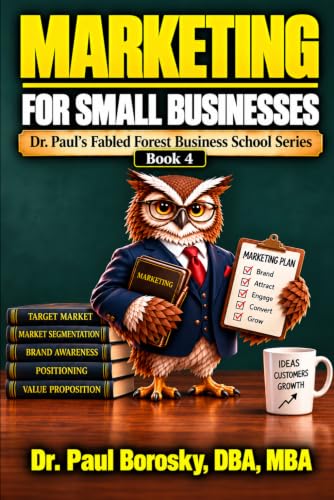
Book 4 of Dr. Paul's Fabled Forest Business School Series. The forest owners can run their businesses, read their numbers, and handle the rush. Now they have to get found by the creatures who would love what they do, while a hawk with a huge budget papers the forest with his name. Each chapter follows one owner through one marketing problem and teaches one real marketing idea by its real name.
- 20 chapters in two parts: being found and being chosen
- Dr. Paul's Nutshell after every chapter: what it is, why it matters, how to use it, and one question for you
- Doctor Owl's Wise Words and Mrs. Owl-Willow's Reminder: the lesson in one line, twice
- The Talon Way: seven big-budget shortcuts that buy attention and never earn a second look
- A full glossary with every marketing term defined
- Line 4 of the Owner's Scorecard, to pick the first fix and measure it in 90 days
Terms like market segmentation, positioning, value proposition, and conversion rate are taught by their textbook names and tied to a story you can picture: a flyer on every door, a jar with a blank label, a board full of waves and an empty chair. That makes the book a plain-English companion for intro marketing and small business courses. Teaching one and want to talk about using it? Call or text Dr. Paul at (321) 948-9588.
The Series
Every Book Adds a Line to the Scorecard
Every book in Dr. Paul's Fabled Forest Business School Series adds one line to the Owner's Scorecard. The first three built a business that runs, counts, and holds up when it gets busy. Marketing makes sure the right customers find it.
Books 5 to 10 (Sales, Strategy, Growth, Human Resources, Technology and AI, Survival) are coming next. See every current title on Dr. Paul's business books page.
FAQ
Common Questions About Small Business Marketing
What is small business marketing?
What are the four main jobs of marketing?
What is the first step in marketing a small business?
How much should a small business spend on marketing?
Who is Marketing for Small Businesses written for?
Is word of mouth enough for a small business?
Learn to get found with the book. Call when you want help with your plan.
Dr. Paul Borosky, DBA, MBA
Business Consultant, Author & Educator | 14+ Years | 1,000+ Clients Served
Dr. Paul Borosky, DBA, MBA is a business consultant, author, and educator, and the founder of Quality Business Plan. He helps small business owners across the United States and Canada with business planning, financial modeling, fractional CFO and COO work, and the growth decisions that come after the business runs. He has built his own practice on content, referrals, and teaching, the same small-budget marketing this book covers. He is the author of numerous books on Amazon and has published over 1,000 business videos on YouTube. He has taught as an adjunct college instructor and teaches in Florida public schools.
This page is for general educational purposes only. It is not legal, financial, or other professional advice. Trademark and advertising rules vary, so talk with a qualified professional before registering a name or making claims about a competitor. The Fabled Forest, its characters, and its businesses are fictional.