
Dr. Paul Borosky, DBA, MBA
Business Consultant & Fractional CFO
Cheaper Ingredients, Longer Mornings. Count Both.
Vegan food truck menu costs include the usable ingredients, preparation time, packaging, and food you buy but cannot sell. Compare a purchased substitute with a house-made version using all of those costs before deciding which belongs on the menu. A lower ingredient price can be useful, but it does not pay the person who spends the morning preparing it.
Here is the difference in this example: a purchased portion costs $1.80, while a house-made portion costs $1.10 in ingredients plus $1.20 of additional labor. The house-made version totals $2.30 under those assumptions. It may still be the better product, but now you know what its price has to support. Apply that same reasoning to a complete bowl, produce waste, and the weekly menu.
Or call/text (321) 948-9588. Dr. Paul answers personally.
Last Updated: 9/7/2026 · Reviewed by Dr. Paul Borosky, DBA, MBA
Start Here
Which vegan food truck menu costs change with the recipe?
The meal and the occasion decide the portion, the packaging and the cooking.
Begin with the meal and the occasion. A loaded potato bowl, a mushroom sandwich, and a fresh salad meet different expectations. Decide whether the truck is serving a quick workday lunch, comfort food at an evening stop, or a catered meal. That choice guides portions, packaging, and the amount of cooking needed during service.
When testing the menu, offer the complete meal at the price you intend to charge. Someone enjoying a free taste of sauce has not yet chosen a thirteen-dollar lunch. Record which meal they buy and whether they finish it. Those observations give you a better basis for adjusting the portion than compliments about one ingredient.
Describe the actual meal before asking customers to judge it. A roasted vegetable bowl, a plant-based burger, and a mushroom sandwich solve different lunch preferences. If a customer says the bowl was not filling enough, ask about the portion and ingredients rather than assume the answer is a larger serving of the cheapest base. The goal is a meal people buy again at a price that supports its recipe.
Build a menu whose ingredients have sensible uses. Roasted vegetables may fit a bowl and a wrap. A dressing may work on a salad and as a sandwich sauce. Sharing can reduce partial containers and purchasing complexity, but the dishes should still feel deliberate rather than assembled from whatever remains. Two neighboring menus have already solved parts of this problem: falafel and its fryer time are costed in the guide to falafel portions and other Mediterranean menu costs, and the plant forward bowls and sauce batches are costed in the guide to rice bowls and sauce batches on an Asian fusion truck.
A purchased vegan cheese or patty can be worth using when it produces the food customers want and saves preparation time. Check its cost per usable serving, pack size, and reorder quantity. A good portion cost can still create a poor purchase if the minimum order leaves you holding more stock than you can use. The choice needs to fit this truck's sales, not an arbitrary rule about how much of a vegan menu must be made from scratch.
Start with enough variety to offer a real choice and little enough to run consistently. A focused launch makes it easier to identify whether a weak result comes from price, location, portion, or preparation. The guide to what to sell from a food truck can help connect that menu with a defined customer and setting.
The Money
What does the usable plant-based portion cost?
Cost the vegetable after the preparation stage you actually serve it from.
Cost vegetables after the preparation stage used for serving. If you portion roasted sweet potatoes, account for trimming and roasting in the measured yield (the usable amount obtained from the purchased food). If you portion raw sliced vegetables, use the usable raw yield. Do not apply a generic loss percentage to every item or count the same loss twice.
Measure the food at the stage where you portion it. With roasted vegetables, weigh the usable cooked batch after the preparation steps in your recipe. With a purchased ready-to-serve product, use its actual usable contents. This keeps the comparison fair. Comparing the raw price of whole produce with a fully prepared ingredient can make the whole produce look cheaper before you have counted the trimming and cooking loss.
Keep that contribution separate from net profit. Preparation labor, commercial kitchen charges, transport, insurance, and owner compensation still need to be covered. A favorable food percentage is useful, but it does not prove that the business pays enough for the hours required. The food cost percentage guide explains how to read that percentage against your own purchase records.
Here is the make-or-buy calculation from the opening, one step at a time. Suppose a purchased portion costs $1.80. Your house-made version uses $1.10 of ingredients and requires ninety additional minutes for thirty portions. At an illustrative $24 per hour, including the employer's labor costs, those ninety minutes cost $36. Divide $36 by thirty and you get $1.20 of labor per portion. Add the ingredients and the house-made cost is $2.30. If you do that work yourself, the time still belongs in the comparison.
This does not mean purchased ingredients are always better. The house-made version may sell at a premium or create repeat demand. It means the comparison must include work. The menu pricing guide helps connect complete item costs with prices rather than relying on a broad category target.
Capacity
How much preparation can the schedule support?
A menu that looks simple at the window can take a long morning behind it.
Write the preparation plan as tasks with quantities and times. Washing, trimming, chopping, roasting, blending, portioning, and cleaning all need space and people. A menu that looks simple at the window may require a long morning at the commercial kitchen. Include those hours in the labor forecast.
Identify which tasks must happen close to service for quality and which can be scheduled earlier under your approved procedures. This helps prevent a crowded morning in which every component needs attention at once. Match the schedule with storage capacity so prepared food has an appropriate place to go.
Test purchased prepared produce where it could save work. Compare usable cost, consistency, minimum order size, and labor saved. A higher invoice price may still produce a lower complete cost. On the other hand, a large pack that goes unused can erase the benefit. Measure the result over several services.
Include setup and cleanup when timing a sauce batch. Getting the blender ready, weighing ingredients, transferring the sauce, and cleaning the equipment are part of making it. If doubling the batch takes little extra time, calculate the lower labor cost per portion, then check whether you can use the larger batch under the approved process. Do not claim a batch saving while ignoring the extra sauce discarded at the end.
Plan how the truck will be replenished during service. Staff should know which components are running low and where the reserve is stored. A well-organized opening station does not solve a mid-shift shortage if the replacement containers are difficult to reach or have not been portioned as planned.
Run a service test with the full menu and realistic modifications. Record complete orders rather than timing only one bowl assembly. Payment, questions, packing, and restocking are part of the work. Use repeatable performance to set the forecast, including the staffing needed before and after the window opens.
Review the most complicated item honestly. It may be a customer favorite and worth keeping at the right price. If it sells rarely, adds several ingredients, and slows every other order, it may need revision. A menu item should justify its effect on the whole operation, not just its ingredient margin.
Control
How do you manage produce and ingredient claims?
Trimming, spoilage and unsold prepared food are three different problems.
Keep a waste record that distinguishes trimming, spoilage before preparation, unused prepared food, and returned orders. These losses need different corrections. A better supplier may improve purchase yield. Smaller batches may reduce prepared leftovers. Training may reduce inconsistent portions or remakes.
Forecast short-lived components from actual menu sales. Avocado usage, for example, depends on the number of orders that include it and the portion you promise. Buy and prepare to that forecast, then review the result. Do not assume every piece of produce has the same usable life or ripens on your preferred schedule.
Preserve flexibility where it helps the food. A seasonal vegetable change can reduce reliance on one ingredient, but it needs a new cost check and an accurate menu description. Confirm that the substitute works with the recipe and customer promise. Availability alone is not enough reason to make an untested change during service.
Avoid using an improvised preservation step to rescue an oversized purchase. Pickling, fermenting, or vacuum packaging can introduce requirements beyond a basic recipe change. Use the processes approved for your operation. Waste prevention begins with buying and batch planning, not an unsupported claim that vinegar gives every vegetable a fixed extra shelf life.
Review supplier ingredients even when a product appears to be plant-based. Breads, sauces, seasoning blends, and prepared toppings can contain ingredients that conflict with the menu promise. Record the specific product and review replacements. A familiar brand name does not establish that every product in the range has the same formulation.
Vegan does not mean free from food allergens. Nuts, soy, wheat, and sesame can be central ingredients in plant-based dishes. The FDA food allergy information explains allergen labeling and cross-contact. Give staff reliable information about your actual recipes and handling conditions.
Use specific language when answering customers. A dish made without dairy may still contain a different ingredient the customer needs to avoid. Shared equipment also matters. If the kitchen cannot support a request, say so clearly. Do not turn a dietary preference label into a broad safety promise.
The Arithmetic
When does a produce saving actually lower menu cost?
A lower case price only helps if you sell what the case contains.
Suppose a supplier offers a case containing twenty usable portions of a prepared vegetable for $30. That looks like $1.50 per portion. If you sell only fifteen portions and the other five must be discarded, the $30 purchase supported fifteen sales. The purchase cost per portion sold is now $2. Compare that result with smaller packs, delivery frequency, and the preparation time saved, rather than choosing the lowest price on the invoice.
Whole produce needs the same treatment. Record the purchased amount, usable amount after preparation, and the amount that sells. These are three separate numbers. Trimming loss tells you about the ingredient and preparation method. Prepared leftovers tell you about demand and batch size. Combining them into one waste estimate makes it hard to know whether to change suppliers, improve preparation, or simply make less food.
For a seasonal substitution, update the recipe cost before changing the menu description. Replacing one roasted vegetable with another can change usable yield, cooking time, and the flavor of the finished bowl. Make a small batch, weigh it, and serve the complete meal in a test. The substitute needs to work in the dish, not merely be available at a lower raw price.
Keep a second price for expensive optional ingredients when customers value them. Extra avocado, for example, can have a measured portion and a stated charge. If your illustrative added portion costs $0.50 and sells for $2, a 3% fee takes $0.06, leaving $1.44 before any extra work. That gives you a useful basis for the decision. It also lets customers choose the addition without forcing its cost into every bowl.
From here, review the menu using purchases, usable portions, sales, and paid preparation hours together. A dish can have a higher ingredient cost while being cheaper to produce consistently. Another can justify extra preparation because customers pay more for it. In Dr. Paul's experience, those are reasonable business choices when the numbers and customer response support them. Avoid declaring either scratch cooking or purchased substitutes automatically more profitable before doing the comparison.
Include a make-or-buy comparison for the items that consume the most preparation time. Show ingredients, usable portions, labor including employer costs, and waste for each option. Then explain why the selected version fits the customer and price. This is more useful than a rule that all food must be made from scratch or that all convenience products are too expensive.
Do This
What Dr. Paul Would Do
In This Order
Dr. Paul would compare the purchased $1.80 portion with the house-made $2.30 portion after adding preparation labor. He would then check whether customers value the house-made version enough to support its cost. Next, he would track produce from purchase to usable portions and actual sales, keeping trimming separate from unsold food. A lower case price would need enough sales to avoid losing the saving through discarded stock. He would review ingredient labels before accepting substitutions and keep dietary claims specific. The menu decision would come from the complete cost and the meal customers want to buy.
FAQ
Frequently asked questions
The four questions Dr. Paul gets most about a plant-based menu.
Are meat substitutes too expensive for a truck menu?
Is scratch cooking always more profitable?
How can I reduce vegetable waste?
Does a vegan menu also qualify as gluten-free?
Next Step
Put the Recipes, the Prep Hours and the Forecast in One Plan
A make-or-buy decision is a labor decision before it is an ingredient decision. The Excel financial model is where the recipe costs, the preparation hours and the produce waste meet your actual sales assumptions, along with a 12 month profit and loss statement, a 5 year pro forma and a break-even analysis.
For help connecting recipe choices, labor, and a realistic forecast, review the business growth planning services. The food truck planning hub covers the wider business plan.
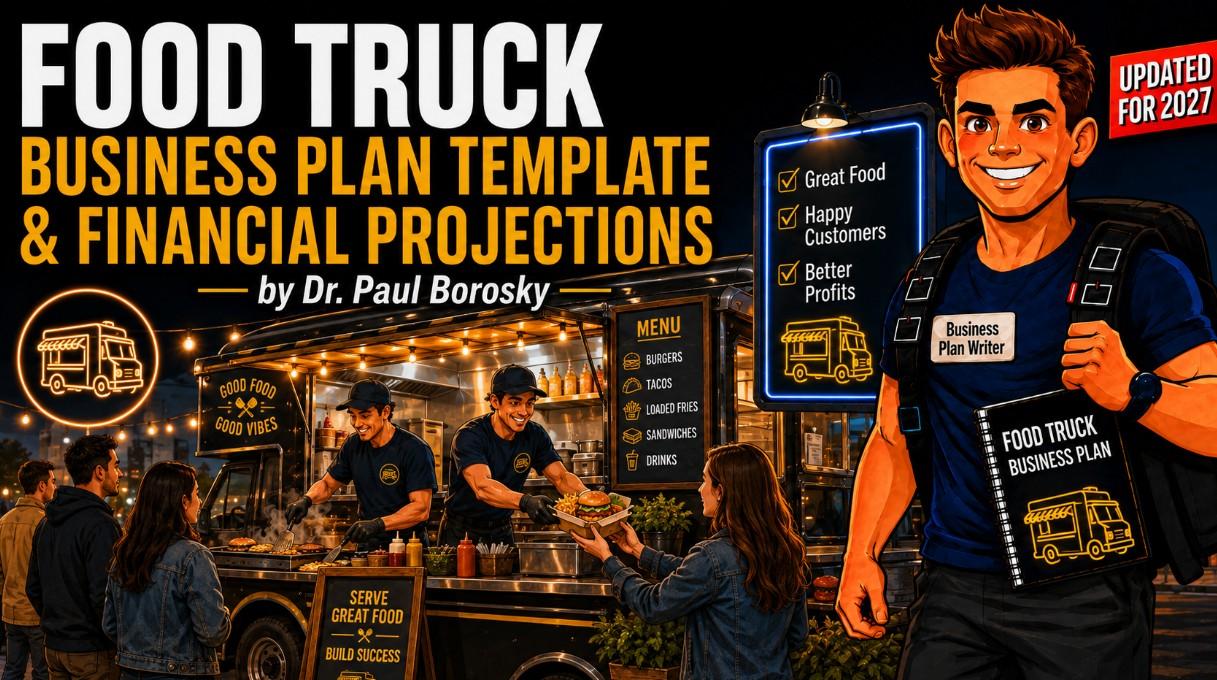
Food Truck Business Plan Template
An editable Word plan and an Excel financial model. Set your average ticket, your costs, and your volume, and it builds a 12 month profit and loss statement, a 5 year pro forma, a break-even analysis, and a valuation based on cash flow.
Dr. Paul Directly
Consulting and Business Plan Writing
Dr. Paul writes every plan himself. No hand-offs, no junior staff. Fourteen plus years helping food truck and small business owners turn a busy operation into a profitable one.

The Food Truck Business All-in-One Handbook
The full Organize-Plan-Grow system in book form. The eight steps before you buy anything, the five numbers that decide whether a truck makes money, and the growth decisions that come after.
Dr. Paul Borosky, DBA, MBA
Business Consultant & Fractional CFO | 14+ Years | 1,000+ Clients Served
Dr. Paul Borosky, DBA, MBA, business consultant and fractional CFO, is dedicated to making CEOs stronger, sharper, and more effective. He is the founder of Quality Business Plan, creator of Dr. Paul's Organize-Plan-Grow™ Strategy, author of numerous published books on Amazon including The Food Truck Business All-in-One Handbook, and publisher of over 1,000 business-focused videos on YouTube. For over 14 years, he has helped food truck, restaurant, and small business owners turn a busy operation into a profitable one.
Dollar figures on this page are illustrations used to show the calculation, not projections for your business. Ingredient prices, yields and portion costs are examples, not quotes. Industry figures are presented to the best of our knowledge based on publicly available information at time of publishing and may change over time. Source: U.S. Food and Drug Administration, food allergies page. Always verify current details before making business decisions.