
Dr. Paul Borosky, DBA, MBA
Business Consultant & Author
Warren Buffett’s Daily Habits (and the House He Bought in 1958)
One of the most successful investors in history has no exotic secret. Dr. Paul Borosky shows the boring habits he has refused to break for decades, what they cost him, and how an owner can copy the method without copying the results.
Last Updated: 10/28/2026 · Written by Dr. Paul Borosky, DBA, MBA
The Short Answer
What Are Warren Buffett’s Daily Habits?
Buffett reads for hours every day, guards an open calendar so he can think, stays inside what he calls his circle of competence, and has lived since 1958 in the Omaha house he bought for $31,500. None of it is complicated. Its power comes from being repeated for decades.
This is a case study from Chapter 3 of Become Your Version of Rich by Dr. Paul Borosky, DBA, MBA. Habits are how motivation and creativity compound, so this page assumes those two rungs. To build a habit of your own, see how to build a habit that sticks. The whole set sits inside the Become Your Version of Rich guide.
The Habits
Four Behaviors Repeated for Decades
The book says it plainly: what he has is a set of boring habits he refuses to break.
Habit one
Read, a lot
At a 1994 University of Nebraska session, Buffett said he reads at least six hours a day, maybe more. Knowledge builds up, as the line goes, like compound interest.
Habit two
Guard an open calendar
Notes from a 2005 student meeting say he has no set schedule and hates a full calendar. Time to read and think is the product.
Habit three
Stay inside your circle
He has said the key to a circle of competence is not how big it is, but how well you define the perimeter.
Habit four
Live inside your number
He bought a house in Omaha in 1958 and, by one report, still lives there. Spending did not follow the fortune upward.
Sources: Buffett, 1994 University of Nebraska session, quoted by Novel Investor. Notes from a January 2005 meeting with Buffett (synthesized by a note-taker). Dividend Power, Warren Buffett House (updated March 2024).
A widely repeated line has Buffett telling students to read 500 pages a day. It comes from investor Todd Combs, who recalled it years later, and Quote Investigator treats the exact wording as unconfirmed. Use it as a picture, not a quotation.
The Visible Proof
A House Bought in 1958
Dr. Paul is careful about what a house can prove. He treats it as a clue, not a theorem.
Dr. Paul puts the house in context this way in Become Your Version of Rich.
From Chapter 3 of Become Your Version of Rich
I will not pretend a house proves what is in a man’s head. But it fits a person whose habits are aligned with a settled idea of what he actually wants, so that a growing fortune never dragged his life around behind it. His number, to borrow this book’s theme, was settled long ago, and his habits simply kept him living inside it.
The house cost $31,500. Whether a house proves anything is a fair question, and Dr. Paul says so. It is useful as a symbol of a number settled early. Compare it with MC Hammer, whose costs rose with his income, and with Antoine Walker, who had income and no system.
What It Cost Him
Less Than It Costs People Without the Habits
The habits cost him the noise, the crowded calendar, the deals outside his circle, and the appearance of a big life. He traded all of that for the reality of a focused one. The method was never complicated. It was relentless.
Notice what is not claimed. Buffett also had capital, timing, and luck on his side, and no habit explains all of a fortune. The book calls habit the rung that let motivation and creativity compound. For the next rung, see the two-week vacation test, where leadership takes those habits through other people.
What the Research Says
Restraint Is Not Boring, It Is Profitable
Finance professors Brad Barber and Terrance Odean studied the accounts of tens of thousands of households at a large discount brokerage. They found that the households that traded most earned markedly lower net returns than those that traded least. Buffett’s habit of saying no outside his circle is an extreme version of the same lesson: decide once, and let the habit hold the line.
Psychologists Don Moore and Paul Healy add that overconfidence takes several forms, including overestimating your own ability. A circle of competence works only if you define its edge honestly. Neither study is investment advice.
Sources: Barber, B. M., & Odean, T. (2000), Trading is hazardous to your wealth, Journal of Finance, 55(2), 773-806. Moore, D. A., & Healy, P. J. (2008), The trouble with overconfidence, Psychological Review, 115(2), 502-517.
How This Helps a Business Owner
Copy the Method, Not the Results
Owners rarely lack ideas. They lack protected time and the discipline to say no. Three habits transfer.
Protect Your Thinking Time
Block it before the week fills
Put two hours of unscheduled time on the calendar for reading and thinking, and treat it like a client meeting. If you cannot find the time, see how to avoid burnout as an owner.
Draw Your Circle
List what you know and what you do not
Write three things you understand deeply and three you do not. Say no to new ventures in the second list until you have earned a place in the first. How to prioritize work helps with the rest.
Settle Your Number
Decide what is enough before you grow
Write down the life your business should pay for, so growth does not drag your spending after it. Then use the financial independence number to size it.
One Honest Caution
Habits Do Not Guarantee a Fortune
Buffett’s results reflect habits plus capital, timing, and luck, and Berkshire has made contested decisions over a long history. This page is general education, not investment advice, and it does not recommend any security. Reading and restraint are choices, not guarantees. Ask a qualified professional before you make investment decisions.
Do This Tomorrow
Three Steps for This Week
- Block one hour a day for reading in your field, and protect it for seven days.
- Write your circle of competence on one page: three things you know, three you do not.
- Write the number that means enough for your business and your life, and the date you will review it.
Start with the hour. It is the cheapest habit on the list. To see the same idea from another angle, read Franklin’s 13 virtues, then see what a missing system costs in how Antoine Walker went broke.
The Book
Buffett Appears Twice in the Book
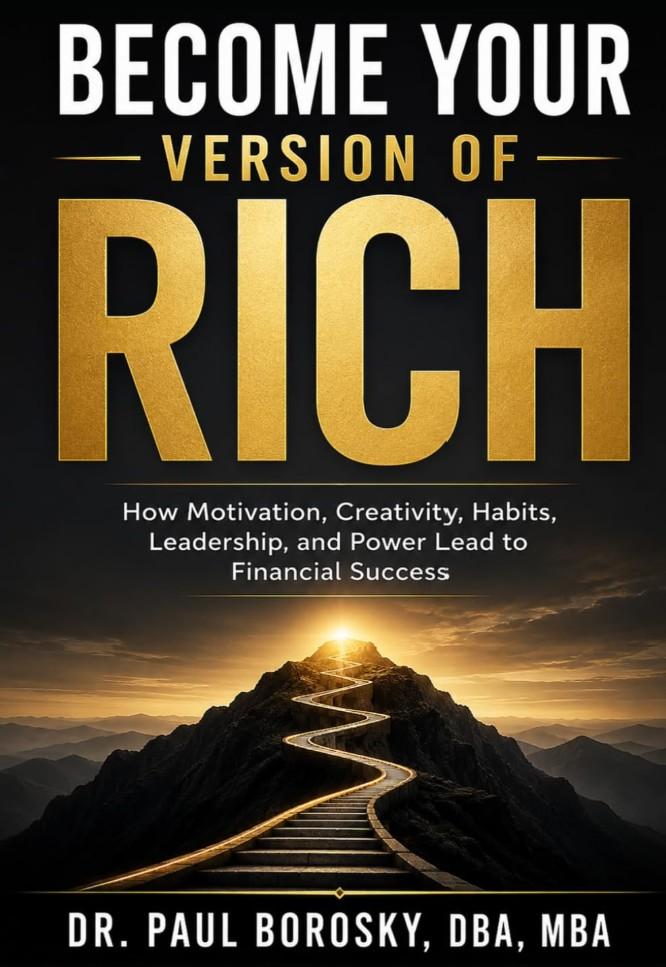
This page covers his habits. Become Your Version of Rich returns to him in Chapter 5, where his reputation becomes power in 2008.
- The seven-step habit method, including the missed-day plan
- Benjamin Franklin and Napoleon, two more lives run on repeated behavior
- A business owner who turned personal habits into company processes
- The Antoine Walker cautionary tale
- Daily Actions and a 30-day way to measure real progress
Go Further With Dr. Paul
Build Your Own Routine Into the Growth Plan
Habits need a target and a review. Dr. Paul’s business growth plan consulting turns your vision into a written target, a calendar that protects the work, and a review rhythm you can keep. Built on 1,000+ client engagements.
FAQ
Common Questions About Warren Buffett’s Habits
What are Warren Buffett’s daily habits?
How much does Warren Buffett read each day?
What is a circle of competence?
Dr. Paul Borosky, DBA, MBA
Business Consultant, Author & Educator | 14+ Years | 1,000+ Clients Served
Dr. Paul Borosky, DBA, MBA is a business consultant, author, and educator, and the founder of Quality Business Plan. He helps small business owners across the United States and Canada with business planning, financial modeling, fractional CFO services, and the everyday problems of businesses that depend too much on their owners. He is the creator of Dr. Paul’s Organize-Plan-Grow™ Strategy, author of numerous published books on Amazon, and publisher of over 1,000 business-focused videos on YouTube. He has taught as an adjunct college instructor and teaches in Florida public schools.
This page is for general educational purposes only. It is not investment, tax, legal, financial, or retirement advice, and it does not guarantee any particular financial result. The examples, figures, and calculations are illustrative planning tools, not recommendations. Before making significant financial decisions, consult a qualified professional.