Foundation 11 of 20 · Analyze
What Is Cash Flow? Why Profit Is Not Cash
The Page Says You Earned It. The Till Says You Do Not Have It.
“How can we sell out and still be broke?” If you had a record month and still could not make payroll, nothing is wrong with your math. Profit and cash answer two different questions. Here is what cash flow is, and how a 13-week forecast shows a short week before it arrives.
Last Updated: 10/27/2026 · Written by Dr. Paul Borosky, DBA, MBA
The Short Answer
What Is Cash Flow?
Textbook Definition
Cash flow is the net amount of cash moving into and out of a business over a period, reflecting the timing of actual receipts and payments rather than when revenue is earned or expenses are incurred.
In Plain English
Cash flow is when money actually moves in and out of your business. Profit tells you whether you earned money over a month. Cash flow tells you whether you have money on Friday. They are almost never the same number.
Restaurant owners hit this every month. Read Why Is My Restaurant Busy but Out of Cash?
Profitable but Still Short on Cash?
Why It Matters
Why Can a Profitable Business Run Out of Cash?
Because a sale counts as profit the day you earn it, but the cash may not arrive for 30 days. Meanwhile, payroll, suppliers, and rent come due on fixed dates. In a big month, those two schedules drift far apart. The bigger the month, the bigger the gap.
Visitor spending at Waikiki hotels, restaurants and tours is a pillar of the Oahu economy, so demand rises and falls with travel trends. Plan a cash reserve for soft stretches with business plans for Hawaii owners.
That gap is timing. It is why good businesses with real profits still miss payroll. And it is almost always predictable. You know when rent is due. You know when payroll runs. You set the payment terms on your invoices. The only thing missing is writing it all down, week by week, before it happens.
For a city example, see how a business plan builds cash flow projections for a growing Syracuse business before bigger contracts arrive.
Signs you have this problem:
- Your best month was also your tightest month for cash.
- You have had a profitable month and still worried about payroll.
- You learn about cash shortfalls on the day they happen.
- Customers pay on terms, but your suppliers and staff do not wait.
- A once-a-year bill, like insurance, catches you off guard every year.
- You have been tempted by fast, expensive money to cover a short week.
- What Is a Sales Pipeline? How to End Feast and Famine
What It Looks Like
What It Looks Like to Sell Out and Still Be Short
From the Fabled Forest · Chapter 11
Fast Frankie the Fox had the busiest festival weekend in forest history. Sold out Saturday, sold out Sunday. His bookkeeper’s page showed thirty-three coins of profit for the week, twice a normal one. The till held seventy-five coins, and Friday he owed fifty-five for payroll and fifty-five to his flour supplier.
Neither number was lying. A hundred and twenty coins of catering had been billed but would not arrive for a month. Rent counted in the week had left the till weeks earlier. Last week’s flour bill was due this Friday. He had earned thirty-three and was thirty-five short.
Nearly every Jackson business runs on visitor demand from the national parks and ski resorts, so cash flow rises and falls with the seasons. The Wyoming business plan writer page covers that.
Frankie called his supplier and split the bill. He made payroll with nothing left, and put a loan shark’s card in a drawer. Then he built a 13-week forecast and spotted the next crunch six weeks out: the yearly truck insurance. He fixed it before it happened.
Frankie’s story is Chapter 11 of Accounting and Finance for Small Businesses, Book 2 of Dr. Paul’s Fabled Forest Business School Series.
The Fix
How to Build a 13-Week Cash Flow Forecast in 5 Steps
Thirteen weeks is one season. Far enough to see trouble coming, close enough to fill in honestly.
Draw thirteen columns, one per week.
Start with this week. Write the cash you have on hand at the top of week one.
Fill in cash coming in, by when it will arrive.
Not when you make the sale. When the customer actually pays. A job billed today on 30-day terms goes in week five.
Fill in every bill you know about, on the week it is due.
Payroll, rent, suppliers, loan payments, insurance, and quarterly taxes. Once-a-year bills are the ones that catch owners. Hunt for them.
Find any week where cash runs short.
Starting cash, plus cash in, minus cash out, gives the ending balance. Look for any week that ends below what you owe. That is the fire, and you can see it weeks away.
Fix it now, then update every week.
Move a payment, ask for a deposit, split a bill, or delay a purchase. Then every week, cross out the week that just ended, write in what really happened, and add a new week at the end.
Dr. Paul’s Insight
The forecast does its best work in good months, not bad ones. Big orders mean big supply bills paid up front and customer payments that arrive later. That is exactly when owners feel richest and are closest to the edge. When a big job comes in, put its cash timing into the forecast before you buy the materials, and ask for a deposit on anything large. Most customers planning a big order expect to pay something up front.
Sample: The First Six Weeks of a 13-Week Forecast
Ending cash for each week becomes the starting cash for the next.
| Week | Cash in | Cash out | Ending cash |
|---|---|---|---|
| Week 1 | $14,000 | $16,000 | $5,500 |
| Week 2 | $13,500 | $14,500 | $4,500 |
| Week 3 | $14,000 | $14,500 | $4,000 |
| Week 4 | $13,000 | $14,000 | $3,000 |
| Week 5 (catering pays) | $25,000 | $14,500 | $13,500 |
| Week 6 (yearly insurance due) | $13,500 | $23,500 | $3,500 |
Sample for illustration. Without the catering payment landing in week 5, week 6 would end $8,500 short.
Watch
Video: Why Profit Is Not Cash, and How to Forecast It
What Is Cash Flow? Why Profit Is Not Cash
Dr. Paul builds a 13-week cash flow forecast from scratch on screen.
From the Book
Made Thirty-Three, Thirty-Five Short
Chapter 11 · Cash Flow
Sold Out and Broke: A Fox’s Busiest Month
“So I made thirty-three,” he said slowly, “and I’m thirty-five short.”
“Yes.” Doctor Owl tapped the till’s column. “What you are looking at is called cash flow. Not how much you earn. When the coins actually move: in, out, and in what order.”
How did Frankie make payroll on Friday, and what did the forecast find six weeks out? Find out in Chapter 11. Book 2 of Dr. Paul’s Fabled Forest Business School Series.
Get the Book on Amazon →Watch Dr. Paul Walk Through It
Short lessons from Dr. Paul’s YouTube channel that go with this page.
Preparing a Cash Budget
How to prepare a cash budget so you always know what is coming in and going out. (13:52)
Profit and Loss calculation
How to calculate a profit and loss statement, explained for small business owners. (3:30)
FAQ
Cash Flow Questions
What is the difference between cash flow and profit?
What is a cash flow forecast?
Why use a 13-week cash flow forecast?
How do I fix a cash flow problem fast?
Keep Going
Related Foundations
Cash flow connects four foundations. It is where the score meets the bank account. New to a term on this page? Every one is in the accounting and finance glossary.
In Southwest Florida, visitor spending peaks in winter and drops hard in summer, so a profitable business can still run short of cash. The Southwest Florida business consultant page covers that squeeze.
Foundation 4 · Income Statement
The income statement tells you what you earned. Read it alongside the forecast.
Foundation 12 · Accounts Receivable
Collecting what customers owe is the fastest way to improve cash flow.
Foundation 13 · Cash Reserve
A cash reserve carries you through the weeks the forecast flags.
Foundation 20 · Budgeting and Forecasting
The budget plans the year. The forecast manages the next 13 weeks.
Go Deeper
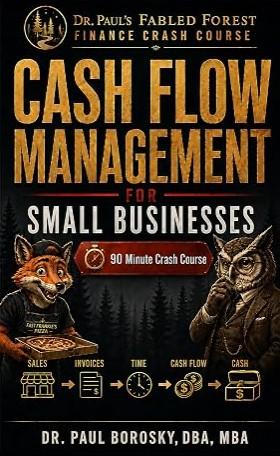
Cash Flow Management for Small Businesses
A record month and an empty drawer is the whole book in one line. Ready to see the short weeks coming? Build a 13-week cash flow forecast.
See the cash flow book →Written by Dr. Paul Borosky, DBA, MBA, business consultant, author, and educator with an MBA focused in finance. Want help building and running a 13-week forecast? See fractional CFO services.
This page is for general educational purposes only. It is not legal, financial, tax, accounting, or lending advice. Tax rules change by place and by year. Dollar figures are illustrations. The Fabled Forest and its characters are fictional. For decisions about your own business, consult a qualified professional.