Foundation 13 of 20 · Decide
How Much Cash Reserve Should a Small Business Have?
One Bad Month Should Not Close the Doors.
"How much should I keep in the bank, just in case?" If your business spends every dollar it makes, it is one leak, one storm, or one slow month away from missing payroll. Here is how much cash reserve a business should keep, and how to build it a little at a time.
Last Updated: 10/27/2026 · Written by Dr. Paul Borosky, DBA, MBA
The Short Answer
How Much Cash Reserve Should a Business Have?
Textbook Definition
A cash reserve is liquid funds set aside to cover a business's operating expenses during periods of reduced revenue or unexpected costs, commonly sized as a number of months of essential operating expenses.
In Plain English
A common target is three months of what it costs to keep the doors open: wages, rent, loan payments, and utilities. Not growth spending. Just survival. Keep it in its own account and build it a little every week.
Why It Matters
Why Do Good Businesses Run Out of Cash in One Bad Month?
It usually happens to businesses that are doing well. The money finally comes in, and the owner, who has waited years for there to be money, spends it on the business. New equipment. A better sign. The next good idea. It feels responsible, and most of the time it is.
The trouble is that a business that spends every dollar is one bad month from being unable to pay its people. Not a bad year. A month. Thin working capital, meaning little cash on hand against the bills due soon, means one surprise can stop you.
Signs you have this problem:
- You hit your monthly targets and still have almost nothing in the bank.
- You could not cover one month of payroll if sales stopped tomorrow.
- Every good month's extra goes straight into the next idea.
- A single repair or slow week sends you scrambling.
- You keep "savings" in the same account you spend from.
- You have paid deposits on things you do not need yet.
What It Looks Like
What It Looks Like When Every Coin Goes to the Next Idea
From the Fabled Forest · Chapter 13
Visionary Veronica finally built her yoga studio, EleWell, with four stone walls and a roof. She hit all three of her targets: sixty-two members, every class three-quarters full, and 120 coins left over every month. And every month, she spent them: new mats, a juice bar deposit, half a mural.
Then the roof leaked over the third row. Drop-ins stopped coming. Seven members paused. Bella quoted ninety coins to fix it, and there were none. Mrs. Owl-Willow did the sum: three hundred coins a month to keep the doors open, fifteen in the till. If nobody came to class for a month, EleWell could last about two days.
They got the juice bar deposit back, moved the mural to spring, and patched the roof with good old slate for fifty. Twenty-five coins went into a new reserve account. Flora chalked a fourth box on the wall: RESERVE: 900.
Veronica's story is Chapter 13 of Accounting and Finance for Small Businesses, Book 2 of Dr. Paul's Fabled Forest Business School Series.
The Fix
How to Build a Cash Reserve in 5 Steps
Small is fine. Steady is what matters. You do not need the whole target to start.
Add up one month of doors-open costs.
Wages, rent, loan payments, utilities, insurance. The costs that come whether or not a single customer shows up. Leave out growth spending.
Multiply by three for a starting target.
Three months is a common target. Seasonal or riskier businesses may want more. Write the target down where you will see it.
Open a separate account and make the first deposit today.
In the business name, not the spending account and not a jar on the shelf. The first deposit can be small. It makes the account real.
Move a set amount every week, before new spending.
Pick an amount you can keep up, and move it the same day every week, before you buy anything new. Treat it like a bill.
Decide in advance what counts as an emergency.
Payroll in a slow month: yes. A roof leak: yes. A new idea: no. Post the target and the balance where you can see them. Out of sight of your ideas, in sight of your eyes.
Dr. Paul's Insight
When a bad month hits before the reserve exists, look first at what you have paid for and not received. Refundable deposits, prepaid orders, and half-finished projects can often be paused or reversed to free cash. Then ask each quote for its cheaper honest option: the repair, not the upgrade. Once the month is survived, start the reserve with whatever is left, even if it is small.
Sample: A Cash Reserve Plan
One page. Post it where the owner and the bookkeeper both see it.
| Monthly doors-open cost | $30,000: wages, loan payments, rent, utilities, supplies |
| Target | 3 months: $90,000 |
| Weekly transfer | $2,500 every Friday, before any new spending |
| Where it lives | Separate savings account in the business name |
| What counts as an emergency | Payroll or rent in a slow month, urgent repairs, a lost major customer. Not new projects. |
Sample for illustration. Size your own target from your own monthly costs.
Watch
Video: How Much Cash Should Your Business Keep?
How Much Cash Reserve Should a Small Business Have?
Dr. Paul sizes a reserve target and sets up a weekly transfer plan on screen.
From the Book
How Long Could You Stay Open?
Chapter 13 · Cash Reserve
One Bad Month: An Elephant's Rainy Day
"So if no one came to class for one month," said Mrs. Owl-Willow, "for any reason, a leak, a storm, a sickness going around the forest, you could keep EleWell open for..."
"Two days," said Flora. "About."
Veronica made a small, scratchy sound and sat down on a yoga block.
How did EleWell survive the bad month, and start a reserve with almost nothing? Find out in Chapter 13. Book 2 of Dr. Paul's Fabled Forest Business School Series.
Get the Book on Amazon →FAQ
Cash Reserve Questions
How many months of expenses should a business keep in reserve?
What is working capital?
Where should I keep a cash reserve?
How do I build a cash reserve with thin margins?
Keep Going
Related Foundations
The cash reserve connects four foundations. It is the cushion under the forecast and the budget. New to a term on this page? Every one is in the accounting and finance glossary.
Foundation 11 · Cash Flow
Your forecast shows which weeks will lean on the reserve.
Foundation 9 · Tax Planning
The tax reserve and the cash reserve are two separate accounts.
Foundation 20 · Budgeting and Forecasting
Build the reserve into your budget as a line, not a leftover.
Foundation 5 · Balance Sheet
Your reserve shows up as cash on the balance sheet, and lenders notice.
Go Deeper
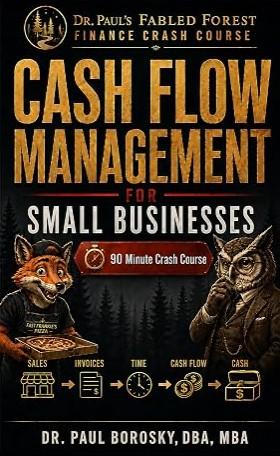
Cash Flow Management for Small Businesses
A reserve is only as good as your view of the next few months. Pair it with a 13-week cash flow forecast, then keep the habit with the cash flow crash course.
See the cash flow book →Written by Dr. Paul Borosky, DBA, MBA, business consultant, author, and educator with an MBA focused in finance. Want help sizing a reserve that fits your business? See fractional CFO services.
This page is for general educational purposes only. It is not legal, financial, tax, accounting, or lending advice. Tax rules change by place and by year. Dollar figures are illustrations. The Fabled Forest and its characters are fictional. For decisions about your own business, consult a qualified professional.