
Dr. Paul Borosky, DBA, MBA
Business Consultant & Author
How to Build Influence Without Authority: Stakeholder Mapping in 7 Steps
Most of the people you need cannot be ordered. Dr. Paul Borosky teaches a seven-step method that starts with a one-page stakeholder map and ends with safeguards, so influence you build holds up when the title is gone.
Last Updated: 10/28/2026 · Written by Dr. Paul Borosky, DBA, MBA
The Short Answer
How Do You Build Influence Without Authority?
Name the outcome and your ethical limits, map the people who can help or block it, read what each one controls and needs, build real value for them, form coalitions on mutual benefit, use formal authority sparingly, and add safeguards. Then measure results and consequences.
This is the method in Chapter 5 of Become Your Version of Rich by Dr. Paul Borosky, DBA, MBA. Need the definition first? Read what power in business is. If the people you need are in conflict, see how to resolve conflict between employees. This page sits inside the Become Your Version of Rich guide.
The Method
Seven Steps From Outcome to Safeguards
Notice that only one step uses your title. The rest are about relationships and outcomes.
- Define the outcome and your ethical boundaries. Name what you want, who it affects, and what you will not do to get it. Then plan backward: three years, one year, six months, thirty days, today.
- Map the stakeholders. List everyone who can support, block, fund, approve, supply, buy, or carry out the outcome. Most plans fail because someone with the power to stop them was never counted.
- Read the power in each relationship. For each person, ask what they control, need, fear, and value, and what alternatives they have.
- Build legitimate value. Strengthen your expertise, reliability, relationships, and ability to solve real problems for the people you need.
- Build coalitions on mutual benefit. Give people a reason grounded in their interests, not only yours, to support the work.
- Use formal authority clearly and in proportion. When the moment calls for the position, explain the decision, the boundaries, and who is accountable.
- Add safeguards, then measure. Build in checks: transparency, people who can challenge you, and an honest review. Judge yourself on the objective and on what your methods did to trust and people.
Steps Two and Three
Build the One-Page Stakeholder Map
This is the single most useful page in Chapter 5. It costs nothing but honesty about who needs whom.
Column one
What they control
Budget, approval, information, access, or the work itself. This is where their power comes from.
Column two
What they need
The result they are judged on, the problem they cannot solve alone, the fear that keeps them cautious.
Column three
Their alternatives
If they say no to you, what do they do instead? Few alternatives for them is strength for you. Many is a warning.
When you talk to a stakeholder, ask what outcome matters most to them, what their biggest concern is, what would make this worth supporting, and what would stop them from backing it. The map has a plain name in the glossary: stakeholder map. Pair it with dependence and alternatives.
A Real Example
A Day Spa With No Revenue and Plenty of Power
Dr. Paul once worked with a young woman in California who set out to open a day spa. She could describe the finished business down to the parking. By the time she came to him she had already lined up three professionals willing to work there on contract, worked out their compensation, found people willing to invest, and told her loyal clients the plan.
He is careful about what that proves. It was pre-launch influence and readiness, not a thriving business. The contracts, the space, the permits, and the cash flow still lay ahead. But look at the method. She had almost no position power, because the business did not exist yet. She had earned power, and she had mapped the people she needed and given each a reason to say yes.
Another Example
Franklin Shared the Credit and Got the Library Built
Franklin could not order anyone. He still organized people toward one good end after another.
Here is the first Daily Action in Become Your Version of Rich.
From Chapter 5 of Become Your Version of Rich
Pick one real objective and map its power. On one page, list the stakeholders who can help or block it, and for each, jot what they control, what they need, and what alternatives they have. That map will show you where you are strong and where you have to build.
Benjamin Franklin had no formal power over the people he organized. When he proposed a subscription library, he presented it as the plan of “a number of friends,” because claiming the credit bred envy and sharing it got the thing built. That is step five in action: people back what they help build. Franklin later turned the same reputation into diplomatic leverage in France, as Franklin vs. Napoleon shows.
Measuring Progress
Five Signals That Influence Is Real
Do not measure whether people gravitate toward you. That rewards charisma. Measure direct signals: Can you get the meeting? Can you secure the commitment? Can you get access to the resource you need? Will people give you honest information, including bad news? The truest test is the last one: does your influence hold even when your title is taken away?
When those keep turning to yes, your influence is compounding. Check the signals at thirty days against the map you started with.
What the Research Says
Stakeholders Are Not Equal
Management scholars Ronald Mitchell, Bradley Agle, and Donna Wood proposed in 1997 that managers should rank stakeholders by three attributes: their power, the legitimacy of their claim, and the urgency of it. Stakeholders with all three deserve attention first. The idea is a useful check on your own map. A loud stakeholder with no power may matter less than a quiet one who controls a decision.
The wider stakeholder idea goes back to R. Edward Freeman, who argued that a firm should account for everyone its actions affect or who can affect it. Neither source promises results. Both help you avoid leaving someone out.
Sources: Mitchell, R. K., Agle, B. R., & Wood, D. J. (1997), Toward a theory of stakeholder identification and salience, Academy of Management Review, 22(4), 853-886. Freeman, R. E. (1984), Strategic Management: A Stakeholder Approach, Pitman.
How This Helps a Manager
Use the Map Where Managers Lack Authority
Managers rely on people they do not manage. Three situations call for a map before a meeting.
A Peer You Need
Find out what they are judged on
Another department holds the approval or the data. Map what they control and what they are measured on, then offer something that helps their number. If you end up in conflict, see resolving conflict.
A Cross-Team Project
Name the blockers early
List everyone who can approve, supply, or carry out the work. The person nobody remembered is the one who stops it. Then use an effective meeting to align them.
A Boss With Competing Priorities
Read their alternatives
Your boss has other asks. Show how your outcome serves what they are judged on. Understanding the structure above you shows who else weighs in.
One Honest Caution
This Is Persuasion, Not Manipulation
The method only works honestly. Truthful information that leaves people a real choice is persuasion. Hiding facts, exploiting weaknesses, or threatening people is not, and it can end careers and break laws. This page is general education, not legal or HR advice. If your goal affects other people’s jobs, safety, or money, add safeguards and ask a qualified professional.
Do This Tomorrow
Three Steps for This Week
- Pick one real objective. On one page, list the people who can help or block it.
- For each person, write what they control, what they need, and what alternatives they have.
- Take one concrete step today, however small, such as a short honest conversation with the stakeholder you know least.
If you only have time for one, build the map. It is the most useful thing in the chapter. When you have it, see how power goes wrong without safeguards in what went wrong at Uber.
The Book
The Full Method Is in Chapter 5
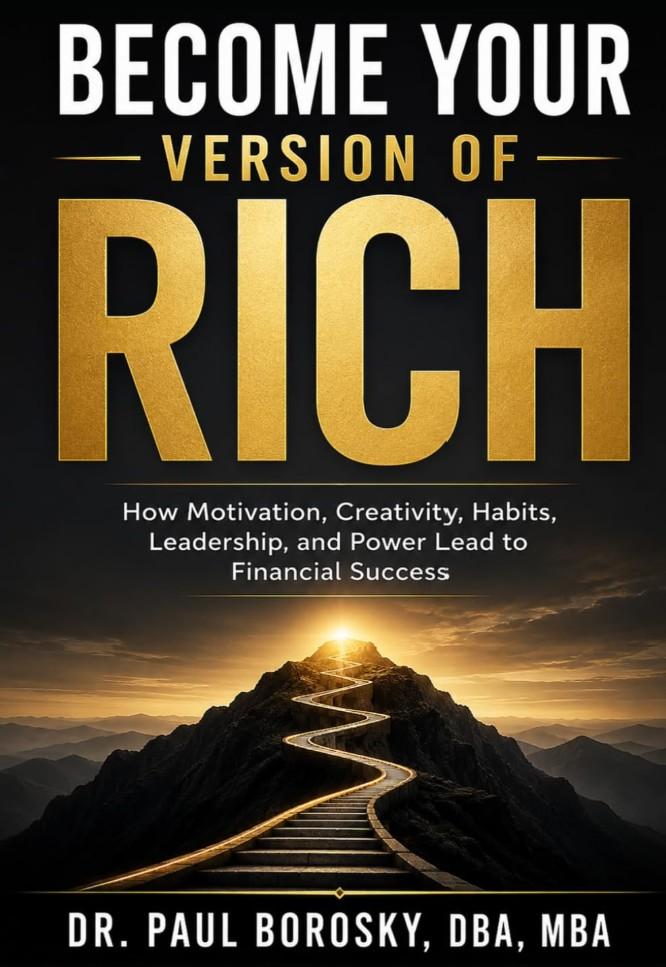
This page walks the seven steps. Become Your Version of Rich adds the stories behind them and the full Daily Actions.
- The seven-step power method and the ethical floor under it
- Warren Buffett, Benjamin Franklin, and Napoleon, three versions of power at work
- The power paradox, and why values alone are not enough
- The Uber cautionary tale
- A 30-day check on whether your influence holds without your title
Go Further With Dr. Paul
Put Your Stakeholder Map Into a Growth Plan
A stakeholder map shows who you need. A growth plan shows what you will do about it, with milestones and a review rhythm. Dr. Paul’s business growth plan consulting turns the map into actions. Built on 1,000+ client engagements.
Keep Going
More From Chapter 5
FAQ
Common Questions About Influence Without Authority
How do you build influence without authority?
What is a stakeholder map?
How do you know your influence is real?
Dr. Paul Borosky, DBA, MBA
Business Consultant, Author & Educator | 14+ Years | 1,000+ Clients Served
Dr. Paul Borosky, DBA, MBA is a business consultant, author, and educator, and the founder of Quality Business Plan. He helps small business owners across the United States and Canada with business planning, financial modeling, fractional CFO services, and the everyday problems of businesses that depend too much on their owners. He is the creator of Dr. Paul’s Organize-Plan-Grow™ Strategy, author of numerous published books on Amazon, and publisher of over 1,000 business-focused videos on YouTube. He has taught as an adjunct college instructor and teaches in Florida public schools.
This page is for general educational purposes only. It is not investment, tax, legal, financial, or retirement advice, and it does not guarantee any particular financial result. The examples, figures, and calculations are illustrative planning tools, not recommendations. Before making significant financial decisions, consult a qualified professional.