
Dr. Paul Borosky, DBA, MBA
Business Plan Writer & Financial Projections
Human Resources Glossary: Small Business HR Terms in Plain English
You hired fast because the busy season would not wait. Now the words start: total rewards, misclassification, a performance improvement plan. This glossary defines every human resources term from the book in plain English, with the chapter it comes from and a full guide wherever one exists. The rules behind some of these terms differ by place, so check yours.
Last Updated: 11/08/2026 · Written by Dr. Paul Borosky, DBA, MBA
The Definition
What Counts as an HR Term for a Small Business?
Short Answer
An HR term is any word that describes how a business finds, pays, trains, manages, and keeps the people who work for it, along with the records and rules that come with being an employer. For a small business, most of them are plain ideas with formal names.
Every term here answers one of four questions: Choose? Develop? Pay? Keep?
Doctor Owl, in Plain English
“You have been doing most of this for years. These are just the names other people use for it.”
How This Guide Works
Need a word fast? Jump to its letter and read the one-line definition. Want to use it? The link under each term opens a chapter page or a short guide that shows the idea at work, with a story from Dr. Paul’s Fabled Forest Business School Series and the math in one marked section. Rules on pay and records differ by place, so check yours.
Know the Term but Need a Hand Applying It?
Definitions settle the vocabulary. The hiring, pay, and policy calls still need doing. Pick the help that fits.
Business Consulting
FeaturedFor owners stuck on hiring, pay, or a team that keeps turning over. Dr. Paul helps you set the roles, the pay, and the rules.
See consulting options →Business Plan Writing
When a lender or investor needs it, Dr. Paul writes the plan, including the management and staffing sections lenders read closely.
Start your plan →Business Plan Templates
An industry Word plan and Excel model with the staffing and payroll lines already built in.
Browse templates →Small Business Education
Free guides, videos, and the Fabled Forest Business School books on hiring, training, pay, and keeping good people.
Start learning →From Dr. Paul’s Fabled Forest
Whose Teams Do These HR Terms Come From?
Some lessons stick better as a story. Dr. Paul’s Fabled Forest Business School Series teaches business through a forest full of small business owners who run into the same problems real owners face. Doctor Owl, a dry-witted consultant who lives in the Lone Oak, asks them the question nobody else does.
Each chapter page linked below follows one of these owners through a people problem: a squirrel painter whose helpers keep quitting, a fox who never checked what the market pays, a bee who loses her best worker and never asks why.
In the Fabled Forest
Words like coins are part of the forest stories, not business vocabulary. You will not hear them from a lender or an attorney, so the definitions below stick to the real business words.
The Terms
HR Vocabulary, Sorted A to Z
Each term below is taught by name in Human Resources for Small Businesses, Book 8 of Dr. Paul’s Fabled Forest Business School Series. The link under each definition opens the chapter page or guide that shows how to use it. Prefer the big picture first? Start with the small business human resources guide.
Story words from the forest are left off this list: coins (the forest’s only money), fire or foundation (Doctor Owl’s first question about any problem), and the Talon Way (the hawk’s shortcut of buying a team instead of building one).
- Behavioral interviewing
- Interviewing by asking about real situations a candidate has already faced and what they did, instead of hypotheticals.
- Chapter 5: Behavioral Interviewing →
- The Bench chart
- A one-page grid of the key jobs, the person in each, who could cover it today, and who could cover it after training.
- Chapter 20: Bench Strength →
- Bench strength
- Having someone ready, now or soon, to step into every key job, including the owner’s.
- Chapter 20: Bench Strength →
- Closing the loop
- Telling the team what happened with the ideas and problems they raised, so they keep raising them.
- Chapter 12: Employee Voice →
- Compensation structure
- A pay plan with a range for each level of job, based on the role’s value to you and local wages for similar work.
- Chapter 7: Compensation Structure →
- Cross-training
- Teaching a person a second job in the business so no key task depends on only one person.
- Guide: Why Should You Cross-Train Employees? →
- Decides, is asked, is told
- The three columns of a decision map: who makes the call, who must be consulted first, and who hears about it after.
- Chapter 18: Decision Rights →
- Decision rights
- A written agreement on who makes each kind of decision, who has to be consulted before it is made, and who simply hears about it afterward.
- Chapter 18: Decision Rights →
- Development
- Getting someone ready for a bigger role down the road, beyond the job they do today.
- Chapter 19: Training and Development →
- Employee handbook
- A brief written guide to the rules of working at the business, like hours, pay day, time off, lateness, and conduct.
- Chapter 9: Employee Handbook →
- Employee or contractor
- The legal question of whether a worker is on your payroll. The way the work gets done usually decides it, whatever you call the person.
- Guide: Is a Worker an Employee or Contractor? →
- Employee turnover
- The number of people who leave over a period, measured against your usual headcount.
- Chapter 17: Employee Turnover →
- Employee voice
- The channels a team uses to speak up with ideas or problems, and the proof that their input led somewhere.
- Chapter 12: Employee Voice →
- Employment compliance
- Meeting the legal duties of an employer, including worker classification, recordkeeping, tax withholding, wage rules, and required postings.
- Chapter 10: Employment Compliance →
- Exit interview
- A conversation with someone who is leaving about why they are going, held to learn rather than to argue.
- Guide: What Do You Ask in an Exit Interview? →
- Halo effect
- When one standout trait in a candidate makes all their other qualities seem stronger than they really are.
- Guide: What Is the Halo Effect in Hiring? →
- Hire
- The first people job in the book: deciding what the job is and choosing the right person for it.
- Introduction: Small Business Human Resources Guide →
- Hiring bias
- Judging candidates on things unrelated to the work, such as how much they remind you of yourself.
- Chapter 3: Hiring Bias →
- Hiring for fit
- Picking someone whose habits at work match how your business runs, spelled out as specific behaviors rather than a feeling.
- Chapter 4: Hiring for Fit →
- Human resources
- How a business finds, pays, grows, and keeps the people who do the work.
- Introduction: Small Business Human Resources Guide →
- Improvement plan
- A written plan for closing a performance gap, with clear targets, a deadline, and the support the employee will get.
- Chapter 14: Managing Underperformance →
- Job analysis
- Working out what a job really involves, task by task, before you hire someone to do it.
- Chapter 1: Job Analysis →
- Managing underperformance
- Telling someone plainly where their work misses the standard, agreeing on targets and a date, helping, and then deciding.
- Chapter 14: Managing Underperformance →
- Market rate
- The going wage for comparable roles at nearby employers.
- Guide: What Is the Market Rate for a Job? →
- Misconduct
- Breaking workplace rules or the trust a job depends on, which is different from simply not doing the work well enough.
- Chapter 15: Termination →
- Must-haves and nice-to-haves
- The skills a new hire needs from the first day, and the ones that would help but can be taught later.
- Chapter 1: Job Analysis →
- Partnership agreement
- A signed contract among co-owners that sets ownership shares, contributions, decision authority, profit splits, and the exit process.
- Chapter 16: Partnership Agreements →
- Pay
- The third people job in the book: everything someone receives for the work, plus the employer rules that come with it.
- Introduction: Small Business Human Resources Guide →
- Pay grades and ranges
- Bands of jobs at a similar level, each with a lowest and a highest wage.
- Chapter 7: Compensation Structure →
- Performance problem
- An employee falling short of the role’s standards. It usually gets a written improvement plan with a deadline before anything else.
- Chapter 14: Managing Underperformance →
- Performance review
- A scheduled sit-down between a manager and one employee to compare recent work with the standards for the role and agree on next steps.
- Chapter 13: Performance Reviews →
- Reference check
- A call to a candidate’s former boss to confirm dates and duties and hear how the person actually worked.
- Chapter 6: Reference Checks →
- Retain
- The fourth people job in the book: the reasons good people choose to stay.
- Introduction: Small Business Human Resources Guide →
- Similar-to-me bias
- Leaning toward candidates who share your background, style, or interests.
- Chapter 3: Hiring Bias →
- Stay interview
- A conversation with someone who is staying about what keeps them, what could make them go, and what you could change.
- Guide: What Is a Stay Interview? →
- Termination
- Ending someone’s employment, handled differently for performance problems than for misconduct.
- Chapter 15: Termination →
- Total rewards
- Everything a job gives an employee: pay plus time off, benefits, training, a path up, a title, a reliable schedule, and a voice.
- Chapter 8: Total Rewards →
- Train
- One of the four people jobs in the book: building skill for today’s role and readiness for tomorrow’s.
- Introduction: Small Business Human Resources Guide →
- Training
- Teaching an employee to do the job they hold now, and do it well.
- Chapter 19: Training and Development →
- Workforce planning
- Forecasting how many people you will need, in which months, and where you will find them.
- Chapter 2: Workforce Planning →
- Workplace culture
- How a team really behaves day to day, set by what the owner rewards, pays for, and puts up with.
- Chapter 11: Workplace Culture →
- Written warning
- A dated note telling someone what went wrong and what will happen if it happens again.
- Guide: How Do You Write an Employee Warning? →
Put the Terms to Work
Which HR Job Do You Need Help With?
The book sorts every foundation into four jobs. Pick the question that sounds like your week, then open the foundation that answers it.
A Consultant’s View
Which HR Terms Trip Up Small Business Owners Most?
The HR mix-ups Dr. Paul sees most are not about jargon. They change what owners do. Calling an employee a contractor shifts taxes and rules the owner still owns. Treating a performance review like an improvement plan turns a routine talk into a threat. Counting turnover without asking why people left hides the fix. Confusing a written warning with a firing decision skips the step that protects everyone. None of these needs a department to get right. It needs the right word attached to the right action, written down once, and used the same way every time.
The Book
From Definitions to the Full Stories
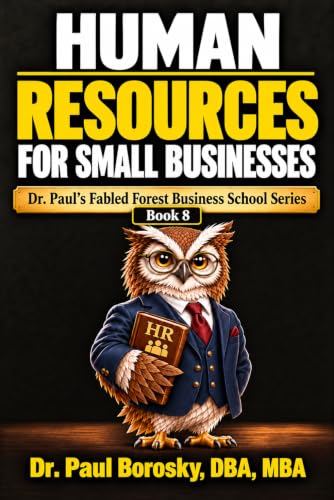
Every term here shows up in the book inside a real people problem: a helper card that says nothing, a counteroffer from a hawk, a crew that stopped talking, a name on the sign with nothing on paper. 20 foundations, a Nutshell for each, and line 8 of the Owner’s Scorecard. Book 8 of Dr. Paul’s Fabled Forest Business School Series.
More Glossaries
Glossaries From the Rest of the Series
All 20 foundations are on the small business human resources guide. More subjects are in the Small Business Education Center.
Written by Dr. Paul Borosky, DBA, MBA, business consultant and author with 14+ years of experience and 1,000+ clients served. Want help putting these terms to work in your own business? Dr. Paul works with owners one-on-one.
This page is for general educational purposes only. It is not legal, employment, tax, financial, or other professional advice. Employment rules differ by place, so check the rules where you operate. The Fabled Forest and its characters are fictional. For decisions about your own business, consult a qualified professional.