
Dr. Paul Borosky, DBA, MBA
Business Plan Writer & Financial Projections
Small Business Growth: 20 Foundations Every Owner Should Know
The business finally works. Now everyone wants you to make it bigger: a second location, a bigger order, a new truck, a partner with a checkbook. Six months later the bigger business keeps less than the small one did. Growth did not cause that. The sequence did. These 20 foundations teach the order, from knowing when you are ready to holding it together at twice the size.
About to sign a lease, a loan, or a big contract? Call or text (321) 948-9588. Dr. Paul answers personally.
Last Updated: 11/08/2026 · Written by Dr. Paul Borosky, DBA, MBA
Growth Without the Hype
What Does Growing a Small Business Actually Mean?
Short Answer
Small business growth means adding customers, locations, products, or staff by choice, without losing the quality and control you had when things ran well. For a small business it comes down to four jobs, done in order: know when you are ready, pick where to go, pay for it the right way, and hold onto what works.
Growing well = When + Where + Fund + Hold, in that order
Doctor Owl, in Plain English
“Anyone can get bigger. The trick is still liking the business when you get there.”
How This Guide Works
Need the answer fast? Read the Short Answer above and the four jobs below. Want the full picture? Each of the 20 foundations links to its own page, and each page follows one owner from Dr. Paul’s Fabled Forest Business School Series through one growth decision. The stories show up in short gold notes. The math sits in one marked section on each page.
The four jobs, in order:
When
Prove the demand is steady, the work runs without you, and one location turns a profit before you open another.
- Growth readiness
- Unit economics
- Growth stages
Where
Choose the channel, the place, the market, or the product, and make sure it grows out from your core.
- Channel strategy
- Second location
- Core business
Fund
Pay with your own profits first, then money that matches what it buys, at payments the business can carry.
- Growth financing
- Equity investment
- Working capital
Hold
Keep the method, the quality, the cash, and your own attention intact at twice the size.
- Scalability
- Middle management
- Quality control
Growth comes after the other foundations for a reason. Skip the direction, and the business sprawls. Skip a repeatable way of working, and expansion copies your problems along with your profits. Growth is the Grow in Dr. Paul’s Organize-Plan-Grow™ Strategy, and when a lender or investor is paying for the next step, it becomes a written business plan with the numbers to back it.
Where Do You Want Help With Your Next Growth Step?
Talk it through, have the plan written, build it from a template, or learn it first. Every path starts with your real numbers.
Business Consulting
FeaturedFor owners weighing a lease, a loan, or a new location. Dr. Paul works the numbers with you before the money moves.
See consulting options →Business Plan Writing
A lender-ready expansion plan: the unit numbers, the funding request, and a payment the business can actually carry.
Start your plan →Business Plan Templates
Build it yourself with an industry Word plan and an Excel model that shows what the next location does to your cash.
Browse templates →Small Business Education
Free guides, videos, and the Fabled Forest Business School books. Learn the growth math before you sign anything.
Start learning →The 20 Foundations
What Breaks First When a Small Business Grows?
Each foundation opens with the kind of question owners bring to Dr. Paul right before a growth move. Start with the one you are about to make. The first ten are the decision itself: timing, direction, and how to pay for it. The second ten cover what cracks once growth succeeds: an owner who slows every decision, a new site that runs nothing like the first, and profit that never shows up as cash. Need a term? The growth glossary defines every one in plain English.
Part One: Growing Right
Foundations 1 to 10 · When, where, and how to payIs My Business Ready to Grow? How to Tell Before You Buy
The cash is in the bank and the truck is for sale. What could go wrong?Chapter 1 · Nine Times Around the Truck: A Raccoon’s Good Winter
Before you grow, check four things: demand that holds month after month, work that gets done when you are out, a backup for your own role, and a cash cushion that survives the purchase.
Read the full guide →What Are Unit Economics? Prove One Before You Open Two
Every location is busy. Why doesn’t the bank account feel it?Chapter 2 · Two Bars, No Profit: A Jaguar’s Grand Opening
Unit economics measures the profit of a single location, truck, or crew standing alone. When one loses money, a second copy doubles the loss instead of the profit.
Read the full guide →What Is Channel Strategy? Direct, Retail, or Wholesale
A big retailer wants all my stock. Should I say yes?Chapter 3 · Four Pages and a Meadow: A Bee and a Whale
Channel strategy decides how your product reaches buyers: direct, through stores, or wholesale. Each route changes your margin, how fast you get paid, and what comes back unsold.
Read the full guide →What Is Customer Concentration? When One Customer Is Too Big
One account is half my sales. Is that a problem?Chapter 4 · Half the Cases Say W: A Bee’s Biggest Customer
Customer concentration measures your dependence on a single buyer. Once one account carries a big share of sales, it can dictate price and terms, so smart owners set a ceiling.
Read the full guide →How to Open a Second Location Without Losing the First
Customers across town keep asking for us. Can I run two places at once?Chapter 5 · Two Griddles, One Labrador: A Café on the Dock
A second location works when someone on site can make real decisions, your visits follow a set calendar, and a brief end-of-day report keeps you informed from anywhere.
Read the full guide →How to Enter a New Market With a Small Business
My product sells here. Will it sell in the next town over?Chapter 6 · Forty Feet Up: A Squirrel at the Canopy Festival
Entering a new market means selling to people who buy differently than your regulars. Study them first, start with a small test, borrow a local’s credibility, and adjust the offer.
Read the full guide →What Is Product Line Extension? When to Add a New Product
Business is good. Should I add something new to the menu?Chapter 7 · Pasta in the Fourth Truck: A Fox’s New Menu
Extending a product line works best when customers already request the item, it reuses your equipment and skills, and it earns more per hour of your scarcest resource.
Read the full guide →How to Scale a Small Business Without Doing More Yourself
How do I take on more work without lowering the standard?Chapter 8 · One Tape, Three Frames: A Beaver’s Method
Scaling means your toughest task no longer depends on you. Document it, train two people on it, add a tool or template, and inspect key checkpoints instead of doing it yourself.
Read the full guide →How to Finance Business Growth Without Overloading the Business
Does it matter where growth money comes from?Chapter 9 · Three Forms, One Signature: A Horse Pays for His Ladder
Fund growth with retained profit first. When you borrow, match the loan term to the life of the asset and keep the payment below what that asset brings in.
Read the full guide →What Is Equity Investment? What an Investor Gets for the Money
An investor wants in. What am I actually giving up?Chapter 10 · A Third of the Lodge: An Elephant’s Partner
Equity investment trades part ownership for cash with no loan payment. The signed agreement spells out the investor’s share of profit, voting power, and exit rights.
Read the full guide →Part Two: Growing Pains
Foundations 11 to 20 · Holding it together at twice the sizeWhat Is Middle Management? When Your Business Needs a Manager
I hired a manager. Why do the questions still come to me?Chapter 11 · Four Trucks, One Fox: A Kitchen Waiting for an Answer
A middle manager only helps when their authority is in writing: which calls are theirs, which stay with the owner, and when they report back.
Read the full guide →How to Productize a Service: Fixed Scope, Price, and Time
Every job is custom. How do I finish more of them?Chapter 12 · Forty-One Snowflakes: An Ant’s Backlog
Productizing packages a service you sell often into a fixed offer, the same deliverables, price, and turnaround every time, so buyers say yes faster and staff can deliver it.
Read the full guide →What Are the Stages of Business Growth?
It worked when it was just me. Why is it breaking now?Chapter 13 · Twelve Painters, One Squirrel: A Studio Outgrows Itself
Growth stages describe how structure has to change with headcount: solo owner, owner plus helpers, then team leads. The setup that worked at one stage cracks at the next.
Read the full guide →How to Replicate Your Business So the Copy Actually Works
I opened a copy of my business. Why doesn’t it run like the first?Chapter 14 · Same Sort, Different Truck: A Raccoon’s Third Truck
Replication means a new crew or site produces the same results as the original. Duplicate the process, not just the logo, and inspect the new unit often until it matches.
Read the full guide →What Is Quality Control? How to Check Quality as You Grow
We are faster than ever. Why are more orders going wrong?Chapter 15 · Six in a Hundred: An Octopus at Nearly Twice the Volume
Quality control at higher volume means full checks on high-risk items, spot checks on the rest, and tracking every defect back to its cause so the fix sticks.
Read the full guide →What Are Step Costs? How to Add Fixed Costs Without Sinking
Should I hire ahead of the busy season?Chapter 16 · Staff for a Lodge That Is Not Open: An Elephant’s June
Step costs are fixed expenses that arrive in big chunks, a full salary or a whole lease. Add each one when demand is close to certain, plan cash for the gap, and rent capacity when possible.
Read the full guide →What Is Working Capital? Why a Profitable Business Runs Out of Cash
We are profitable. So where did the cash go?Chapter 17 · Profitable and Out of Coins: A Jaguar’s Fourth Bar
The cash conversion cycle counts the days between paying for stock and labor and collecting from customers. The longer that gap, the more cash growth swallows, even while profit looks healthy.
Read the full guide →How to Buy a Small Business: Find Out What You Are Really Buying
A business is for sale, and it’s cheap. Is buying faster than building?Chapter 18 · The Bell, the Stool, and the Book: A Horse Buys a Desk
Due diligence on an acquisition tests four things: how well it fits, whether earnings justify the price, what leaves with the seller, and how you will fold it in.
Read the full guide →What Is Optimal Business Size? How to Know When Big Is Big Enough
How big is big enough?Chapter 19 · Two Is Plenty: A Labrador and a Whale
Optimal size is the scale that delivers the income, hours, and quality of work you want while costs stay manageable. Past that point, more volume can mean less of what you wanted.
Read the full guide →What Is a Core Business? Grow From the Middle Out
Should I open something next to my main business?Chapter 20 · The Shine Stand: A Monkey Grows Sideways
Your core is the line of work that earns most of your profit and that you do best. Growing outward sells more to the same buyers. Diversifying sideways means starting from scratch.
Read the full guide →From Dr. Paul’s Fabled Forest
Meet the Fabled Forest: Who Are These Owners?
Some lessons stick better as a story. Dr. Paul’s Fabled Forest Business School Series teaches business through a forest full of small business owners: bakers, haulers, shopkeepers, and crews who run into the same problems real owners face. Doctor Owl, a dry-witted consultant who lives in the Lone Oak, asks them the question nobody else does. Each chapter page in this guide follows one of them.
Book 7 opens with Dumpster Dani, a raccoon who runs a hauling business with two trucks. Business is good, the work is steady, and for the first time she has coins saved. A third truck is for sale down the road, and she wants it badly. She can pay for it. The real question, the one Doctor Owl asks her, is whether the business can carry it. See her story on Is My Business Ready to Grow?
In the Fabled Forest
Dani’s answer came from drawing four boxes and checking what was in each one. The truck sat in only one of them. That is the pattern of this whole book: the thing you want to buy is rarely the thing that decides whether growth works.
Quick Scorecard Check
Is Your Business Ready for Its Next Step?
Line 7 of the Owner’s Scorecard asks four questions, one for each job. A yes counts only if every part of the question is true today.
- When
Can I prove three things right now: sales held steady for months, the team delivers when I am away, and one location or crew is profitable on its own?
- Where
Does every channel, location, market, or product I run or plan to add have a one-line purpose, and does each one build on my core business?
- Fund
Can the business cover every growth payment and still keep a cash reserve, and do I have in writing what each lender or investor is owed?
- Hold
If my biggest customer walked away tomorrow, would the business survive? Are key processes documented, with a backup decision-maker when I am out? Do I inspect quality at the trouble spots and track defects by cause?
Scored 3 to 5
Fix the weak box yourself
Pick your one “no,” find its foundation in the 20 above, and work it this month with the chapter’s Nutshell steps. Do not put a date on the growth step until every box is filled. Score again in 90 days.
Get the Book on Amazon →Scored 1 or 2
Get a second set of eyes before you sign.
A lease, a loan, a big contract, or a business for sale is hard to undo. Dr. Paul works through growth decisions with owners before the money moves: the unit numbers, the funding, and what has to hold. When a lender or investor needs to see it, he writes the plan. Call or text (321) 948-9588, or see business consulting and prices.
A Consultant’s View
What Does a Business Consultant See When Owners Try to Grow?
Dr. Paul has worked with more than 1,000 small business owners, and the growth stories that go wrong rarely start with a bad idea. They start with the right idea on the wrong date. The owner signs the lease the month the bank balance looks good, before the first location runs without them, before one unit’s numbers are proven, and before anyone asks what the new payment does in a slow month. The fix is not to grow less. It is to grow in order: prove the unit, pick the direction, match the money, and decide who holds things together. Done in that order, growth stops feeling like a gamble.
The Book
The Book Behind These 20 Foundations
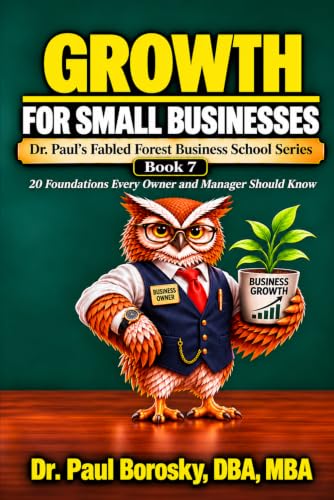
Book 7 of Dr. Paul’s Fabled Forest Business School Series. The forest owners built their ladders over the winter, and every one has the same word near the top: bigger. A raccoon walks around a truck for sale. A jaguar has a line twice around the fountain and no profit. A bee gets an offer from a whale to buy every jar she makes. Across the dock, a hawk buys three businesses in one week. Each chapter follows one owner through one growth decision and teaches one real idea by its real name, as Doctor Owl asks the question nobody else does: what breaks when you get bigger?
- 20 chapters in two parts: Growing Right and Growing Pains
- Every chapter tagged When, Where, Fund, or Hold, so you know which job it teaches
- Dr. Paul’s Nutshell after every chapter: what it is, why it matters, how to use it, and one question for you
- The Talon Way: seven growth shortcuts that make a business bigger and blinder, and what each one costs
- A plain-language glossary of about 70 growth terms
- Line 7 of the Owner’s Scorecard, to pick the first fix and measure it in 90 days
Terms like unit economics, customer concentration, working capital, step costs, and organizational growth stages are taught by their textbook names and tied to a story you can picture: two juice bars with long lines and no profit, a bee with half her cases going to one buyer, a hawk who can see only one of the three businesses he bought. That makes the book a plain-English companion for entrepreneurship, small business management, and strategic management courses. Teaching one and want to talk about using it? Call or text Dr. Paul at (321) 948-9588.
Book 7 of 10
Growth Is What the First Six Books Were For
The earlier books build a business that runs, counts, delivers, gets found, sells, and knows where it is going. Growth takes that business and makes it bigger without breaking it. Human Resources, out the same week, covers the people you will need to do it. Start anywhere in Dr. Paul’s Fabled Forest Business School Series.
Books 9 and 10 (Technology and AI, Survival) are coming next. See every current title on Dr. Paul’s business books page.
FAQ
What Do Owners Ask Before They Grow?
What is small business growth?
What are the four jobs of growth?
How do I know if my business is ready to grow?
How should a small business pay for growth?
Who is Growth for Small Businesses written for?
When is a small business big enough?
Check the four boxes with the book. Call before you sign anything big.
Dr. Paul Borosky, DBA, MBA
Business Consultant, Author & Educator | 14+ Years | 1,000+ Clients Served
Dr. Paul Borosky, DBA, MBA is a business consultant, author, and educator, and the founder of Quality Business Plan. He helps small business owners across the United States and Canada with business planning, financial modeling, fractional CFO and COO work, and the strategic plans lenders and partners ask for. His planning system, Organize-Plan-Grow™, is the backbone of his consulting work. He is the author of numerous books on Amazon and has published over 1,000 business videos on YouTube. He has taught as an adjunct college instructor and teaches in Florida public schools.
This page is for general educational purposes only. It is not legal, financial, tax, investment, or lending advice. Every business and market is different, so talk with a qualified professional before making major decisions about your own business. The Fabled Forest, its characters, and its businesses are fictional.