
Dr. Paul Borosky, DBA, MBA
Business Consultant & Fractional CFO
The Fee Is Never the Whole Cost. Price the Day in Orders.
A $500 festival fee is not automatically expensive, and it is not automatically a bargain either. It is a number you have to earn back before you keep a single dollar for yourself, and whether it gets earned back depends entirely on how many people buy food during the hours you are allowed to sell. Pay that fee for the right event and it can be one of the cheaper ways to put your window in front of a large crowd that came out specifically to eat. Pay it for the wrong one and you have bought a parking space, a very long day, a crew you owe for every hour of it, and no promise that the weather holds or that anybody walks to your end of the field. Food truck event fees are worth paying when a conservative order forecast covers the full cost of attending, leaves an acceptable contribution, and compares favorably with whatever else you would have done with that day.
Start by converting the event's costs into a number of orders you have to sell. Then ask the second question, which is whether the crowd, the competing vendors, and your own service capacity can realistically produce that number during your selling window. “Thousands of people expected” does not answer either question, because total attendance is not the same as buyers and a whole weekend is not the same as your four hours. A photograph of last year's line does not answer them either. You cannot tell from a picture how long that line took to form, which vendor it belonged to, whether it was moving or stalled, or whether it was the single busy moment of an otherwise quiet day. Organizers keep the good photograph. Nobody keeps the slow one.
You are committing real money before you know what you will sell, so treat the decision the way you would treat any other purchase of that size. The right calculation will not control the weather and it will not make a thin crowd thicker. What it will do is show you how much volume you need before the day is worth anything at all, how much you stand to lose if the day goes badly, and which of the organizer's promises need evidence attached to them before you sign.
Or call/text (321) 948-9588. Dr. Paul answers personally.
Last Updated: 9/7/2026 · Reviewed by Dr. Paul Borosky, DBA, MBA
Start Here
What do food truck event fees actually include?
The advertised vendor fee is only the first line.
Ask whether the event also charges for electricity, parking, extra credentials, trash service, overnight placement, or a required payment system. Find out whether the organizer takes a percentage of sales in addition to the flat fee. Confirm which sales figure that percentage uses.
Separate refundable deposits from actual charges. A deposit returned after an acceptable cleanup affects cash available before the event, even though it may not become an expense. A nonrefundable reservation payment creates a different risk. Record both the amount and the date the money leaves your account.
Read the operating requirements before estimating labor. A four-hour public event may require arrival three hours early and prohibit departure until an hour after closing. Add preparation, loading, travel, and cleanup. Paying people only for the advertised event hours is not a sound labor budget when the work takes longer.
List costs that arise because you accept this booking. Extra staff, event-specific ingredients, tolls, lodging, and a rented freezer belong in the decision. Monthly insurance that you pay either way still matters to the business, but it does not become a new event expense simply because the event occurs that month.
Keep those two views separate in your head, because they answer different questions. The attendance decision asks the narrow one: does this event bring in more money than the costs you would only have because you went? The business plan asks the wider one: does all of your work across the month, taken together, cover your overhead and pay you? Overhead is the set of costs you carry every month whether the truck rolls or not, things like insurance, storage, loan payments, phone service, and bookkeeping. An event can pass the first test and still fail the second. It can leave you a couple of hundred dollars ahead of where you would have been sitting at home, and still come nowhere near carrying its share of a month of overhead.
Food waste needs explicit treatment. If you forecast ingredient cost only on plates sold, add the expected cost of food that cannot be used afterward. Do not also charge the full event grocery purchase as an expense in the same calculation. One method follows consumption plus waste. The other needs an adjustment for usable inventory remaining. Mixing them double counts food.
Ask the organizer about any required permits or inspections and confirm the answer with the responsible agency. For example, New York City states that temporary event food service permitting applies across several setups and venue types, including private property and vehicles. See its temporary event food service guidance. Your event's jurisdiction determines your requirements.
The Arithmetic
How many orders will cover the event?
Use the average sale you expect at this specific event rather than your everyday average, and leave out both the sales tax you collect for the state and the tips that belong to your crew, because neither one is your money.
From that average, subtract the costs that rise with every single order, which are your ingredients, your packaging, and the fee your card processor takes. What is left on each order is called contribution, meaning the money that order contributes first toward the fixed costs of attending and then toward the business. Fixed costs here are the ones you owe simply for showing up, such as the vendor fee, the crew you scheduled, and the fuel to get there, and they do not move whether you sell a handful of orders or a full day's worth.
That point is your break-even for the event, meaning the level of sales at which the day has paid for itself and made you nothing. Break-even is a floor you have to clear, never a target to aim at.
The commission adds 31 orders to your target in this example. That is why “only ten percent” needs arithmetic before agreement. It does not take ten percent of the money left after your costs. Under this assumed arrangement, it takes ten percent of sales.
If your menu mix changes, your contribution changes along with it. Margin is simply the share of a sale you keep after the costs of making it, so a lower-margin item is one where more of the price goes straight back out the door in food and packaging. A festival dominated by a lower-margin bestseller can leave you less per order than an ordinary lunch on your regular route, even when the festival price is higher. Build the forecast from the mix you actually expect people to order. For a complete monthly target, use the food truck daily revenue calculation; keep this article's math focused on whether to buy this particular event slot.
The Crowd and the Window
Can the audience and the truck deliver those orders?
Ask for actual attendance from comparable past events, how that count is taken, the number of meal vendors, and the hours when food sales occurred, because a weekend total that includes reentries, staff, and visitors is not the same as unique diners present during your shift.
Dividing that crowd evenly by vendor count is only a starting point in Dr. Paul's experience, so ask for the planned vendor mix and whether the organizer can add trucks after you commit.
Request references from returning vendors. Ask about completed sales periods, required setup time, payment settlement, and whether the event matched the organizer's description. A vendor may reasonably decline to share revenue. You can still learn whether the queue moved, the site was accessible, and the organizer kept basic promises.
Capacity puts an upper limit on the opportunity. Suppose your contribution target requires 170 orders during a four-hour service period. That is 42.5 orders per hour on average. If most buyers arrive during two hours, the peak pace could be much higher. Compare the demand pattern with a pace your crew has actually demonstrated.
If the truck can produce only 30 complete orders per hour, an illustrative planning assumption rather than a measured rate, four hours at that pace yields 120 orders. That pace sits below the roughly 35 completed orders an hour a three-person crew reaches in normal service, because this event's setup, placement, and festival queue slow the handoff. At the example's $10.32 contribution, that leaves $88.40 after $1,150 of attendance costs. A larger crowd cannot fix the production limit. You would need a credible change in menu, workflow, crew, service time, or economics.
Watch where the line forms. A queue that extends across the ordering window can block new purchases. A distant pickup point can require another worker. A site with poor visibility may reduce your share of an otherwise good crowd. Ask for a map and your assigned placement before treating overall attendance as accessible demand.
Make three sales cases.
Low case
A low case shows the loss you can afford. With 80 orders in the example, contribution is $825.60 and the event loses $324.40 before monthly overhead.
Expected case
An expected case supports the booking decision. At 170 orders it leaves $604.40.
High case
A high case checks inventory and capacity. At 220 orders it leaves $1,120.40.
220 orders plainly requires a longer selling window or a larger crew than the four hour, 30 orders per hour case above. Neither positive figure is net profit either, since both sit before monthly overhead and owner compensation.
These are scenario results, not probabilities. Do not average three invented cases and call the result a forecast. Use your event history, vendor evidence, and actual service capacity to decide which case deserves the most weight. Then use the event prep guide to translate the supported forecast into food quantities.
The Contract
What terms change the downside before you sign?
Cancellation language decides who carries the weather risk.
Ask what happens if the organizer cancels, if the event proceeds with poor attendance, and if unsafe conditions prevent you from operating. Those are different situations. A general statement that the event is “rain or shine” does not explain every payment obligation.
Check whether the fee can move to another date, whether any refund has a deadline, and what documentation is required. Include your own nonrecoverable costs in the low case. Even a full vendor-fee refund may leave you with event-specific food and preparation labor you cannot recover.
Clarify sales reporting and settlement. If customers pay through the organizer's system, ask when you receive funds, which deductions apply, how refunds are handled, and what records you receive. A strong sales day can create a short-term cash problem if the organizer holds the money while your payroll and supplier bills come due.
Negotiate the term that affects your model most. If the fixed fee causes the weak-day loss, a smaller base fee may help. If the commission destroys contribution at higher sales, a cap may matter more. If too many similar vendors dilute demand, a defined vendor limit may be worth more than a modest discount.
Do not treat a promised minimum as collected money. If the host offers a sales guarantee, define the amount, what counts toward it, who pays the shortfall, and when payment occurs. Confirm the party making the promise has authority and a practical payment process. A vague assurance that vendors “always do well” has no place in the spreadsheet.
Also examine the opportunity cost. Suppose your regular Saturday location reliably contributes $444 after direct costs, which is the Location A result from the location comparison rather than a fourth invented figure. An event expected to contribute $600 improves the day by $156, not $600. Decide whether that improvement justifies the additional exposure, longer hours, and disruption to a recurring relationship.
So the honest comparison is never this event against nothing. It is this event against the day you gave up in order to work it.
An event that only ties your regular Saturday is not worth taking, because you put in a longer day in an unfamiliar spot, carried more risk, and ended up in the same place. There is one exception worth naming. A new event can be run deliberately as a limited experiment with a loss budget you set in advance, and that is a legitimate reason to accept a weaker number once. What should not happen is that the experiment quietly becomes your main business strategy because a busy festival feels more exciting than an ordinary profitable lunch.
The Rule
What decision rule should you use for the next event?
Set your approval rule before reviewing the organizer's promotional material.
Require resolved operating approval, written terms, a supported order forecast, and enough service capacity. Then require an expected contribution that meets your target and a low-case loss the business can absorb without delaying payroll or essential bills.
Treat exposure separately. If you are willing to spend money to reach new customers, state a marketing budget and define what you will measure. Track genuine inquiries, later bookings, or repeat purchases you can connect to the event. Do not call an operating loss a marketing success solely because people saw the truck.
Afterward, close the event record within two days while the details are fresh. Compare actual orders, average ticket, food used, waste, total crew hours, and every deduction with your estimate. Save the organizer's final settlement. Record whether the low outcome came from demand, capacity, placement, weather, or a wrong cost assumption.
That distinction changes the next decision. A sold-out truck with strong demand needs an inventory or capacity correction. A fully stocked truck that served few buyers needs a demand correction. Paying next year's deposit before identifying the cause repeats the risk with more confidence and no better evidence.
Put festival revenue into the projections event by event and month by month, never as one hopeful annual line. For each event, list the order count you assumed, the average ticket, the vendor charge and any commission on sales, and the crew hours the event requires. Keep confirmed bookings in one place and hoped-for bookings in another, clearly labeled as such. A sentence about attending local festivals cannot support a large revenue line when the plan never names the costs of attending or shows how many orders the truck is physically able to complete inside the selling window.
Do This
What Dr. Paul Would Do
Dr. Paul would run the required order count before filling out the vendor application, not after packing up.
For the illustrative $500 fee he would use the full $1,150 of attendance cost and the 170 order target, because treating the fee as the whole risk is what makes a bad event look survivable on paper. Then he would take a position most owners find uncomfortable. If the expected return only ties a regular Saturday, he would keep the Saturday. A tie is not a reason to work a longer day in an unfamiliar spot with a crowd nobody can describe, and the regular slot pays you again next week.
FAQ
Frequently asked questions
The four questions Dr. Paul gets most about paying to attend an event.
What is a reasonable festival fee?
Is a percentage fee safer than a flat fee?
What should I ask an organizer before I sign?
Should I return after one bad event?
Next Step
Review the Booking Before Buying the Risk
A full event calendar and a disappointing bank balance tend to show up together, and the cure is usually a written rule about which bookings you accept. To build one, review Dr. Paul's business consulting options. Bring event settlements, crew hours, and fee agreements from your last few events. The goal is a standard that supports the business described in your food truck plan.
Dr. Paul Directly
Consulting and Business Plan Writing
Dr. Paul writes every plan himself. No hand-offs, no junior staff. Fourteen plus years helping food truck and small business owners turn a busy operation into a profitable one.
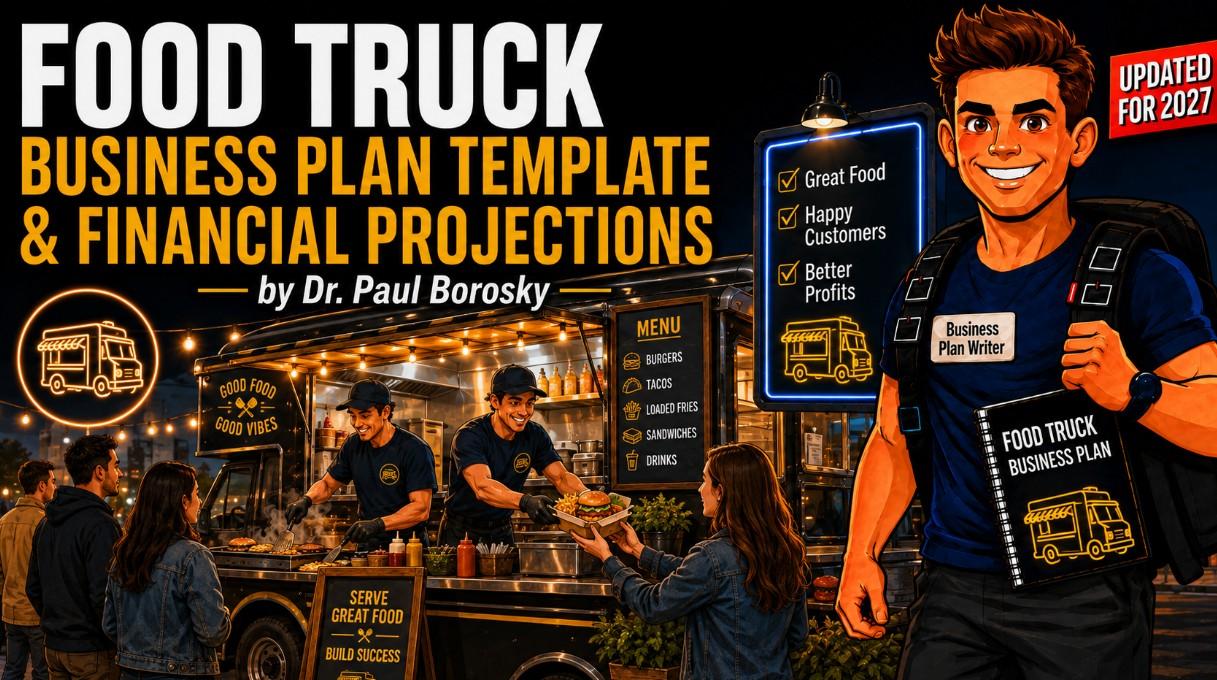
Food Truck Business Plan Template
An editable Word plan and an Excel financial model. Set your average ticket, your costs, and your volume, and it builds a 12 month profit and loss statement, a 5 year pro forma, a break-even analysis, and a valuation based on cash flow.

The Food Truck Business All-in-One Handbook
The full Organize-Plan-Grow system in book form. The eight steps before you buy anything, the five numbers that decide whether a truck makes money, and the growth decisions that come after.
Dr. Paul Borosky, DBA, MBA
Business Consultant & Fractional CFO | 14+ Years | 1,000+ Clients Served
Dr. Paul Borosky, DBA, MBA, business consultant and fractional CFO, is dedicated to making CEOs stronger, sharper, and more effective. He is the founder of Quality Business Plan, creator of Dr. Paul's Organize-Plan-Grow™ Strategy, author of numerous published books on Amazon including The Food Truck Business All-in-One Handbook, and publisher of over 1,000 business-focused videos on YouTube. For over 14 years, he has helped food truck, restaurant, and small business owners turn a busy operation into a profitable one.
Dollar figures on this page are illustrations used to show the calculation, not projections for your business. Vendor fees, order counts and service paces are planning assumptions, not measured results for your truck. Permit information is presented to the best of our knowledge based on publicly available information at time of publishing and may change over time. Source: New York City Department of Health and Mental Hygiene, Temporary Food Service Establishments. Always verify current details before making business decisions.