Foundation 5 of 20 · Report
What Is a Balance Sheet? Assets, Liabilities, and Equity
Profitable Is Not the Same as Healthy.
"How can I be making money and still owe everybody?" If the business makes money every month and you still owe everyone, you need a different page. Here is what a balance sheet is, how to build a quick one, and why lenders always ask for it.
Last Updated: 10/27/2026 · Written by Dr. Paul Borosky, DBA, MBA
The Short Answer
What Is a Balance Sheet?
Textbook Definition
A balance sheet is a financial statement that reports a company's assets, liabilities, and owner's equity at a specific point in time, based on the equation assets equal liabilities plus equity.
In Plain English
A balance sheet is a picture of the business on one day. On one side, everything it owns. On the other, everything it owes. What is left over is what the business is worth to you on paper.
Why It Matters
Why Can a Profitable Business Still Be in Trouble?
The income statement tells a story about one month. A month can be good while the business underneath it is buried in old bills. Unpaid suppliers, back rent, and loans do not show up as a loss. They just pile up, quietly, until a lender or a supplier finds them.
The balance sheet shows the pile. Assets are what the business owns: cash, inventory, and equipment. Liabilities are what it owes. The difference is owner's equity, your share after everyone else is paid. It always balances, because what you own equals what you owe plus what is yours.
Signs you have this problem:
- You are profitable on paper and behind on bills.
- You do not know the total of everything the business owes.
- You are planning to borrow, and you have only looked at your profit.
- Bills sit in a drawer until you "have the money."
- You give away product or discounts freely because the room is full.
- A lender asked for a balance sheet and you did not have one.
What It Looks Like
What It Looks Like When the Café Is Full and Worth Eight Coins
From the Fabled Forest · Chapter 5
Louie Waffles runs the friendliest café in the forest. Every table is full, and about a third of them are eating free waffles, because Louie prices by kindness. He did his first profit page and found twenty-five coins of profit. On the strength of that number, he was about to borrow for a second, bigger griddle.
Doctor Owl asked what the café owed. Louie said "a bit" to the flour mill and "a little behind" on rent. On the scroll, the café owned 248 coins of things and owed 240. Every table full, and the business was worth eight coins to Louie.
Before the loan review, a crow from Talon and Beak stopped by with advice: show the bank only the profit page. Louie had already tucked two unpaid bills into a drawer. He took them back out, paid the mill and the landlord first, and went to the bank to tell them himself.
Louie's story is Chapter 5 of Accounting and Finance for Small Businesses, Book 2 of Dr. Paul's Fabled Forest Business School Series.
The Fix
How to Build a Quick Balance Sheet in 5 Steps
Your accountant can prepare the formal version. This owner's version takes about an hour and tells you most of what you need.
Pick one day.
The last day of the month is standard. A balance sheet is always "as of" a single date.
List everything the business owns.
Cash in the bank and the till, inventory on the shelves, equipment, and money customers owe you. For a quick owner's picture, use what each item is worth today, and say so.
List everything the business owes.
Every unpaid supplier bill, back rent, credit card balance, loan balance, and tax owed. Include the bills in the drawer. Especially those.
Subtract to find owner's equity.
What you own minus what you owe. That is what the business is worth to you on paper today. It is not a check you would get at closing, because things rarely sell for exactly what the page says.
Do it again next month.
The single number matters less than the direction. Equity going up means the business is getting stronger. Equity going down while profit looks fine means something is leaking.
Dr. Paul's Insight
An accountant's balance sheet carries equipment at what you paid for it minus wear, called depreciation, while the owner's quick version often uses today's market value. The two numbers can differ a lot. Neither is wrong, but say which one you used, and never mix them on the same page. And when a lender asks for statements, give them both pages, not just the one that looks good.
Sample: An Owner's Quick Balance Sheet
Both sides on one page, as of one day. The totals must match.
| What it owns | Amount | What it owes | Amount |
|---|---|---|---|
| Cash | $800 | Supplier bills | $9,000 |
| Inventory | $3,000 | Back rent | $4,000 |
| Tables and plates | $6,000 | Equipment loan | $11,000 |
| Equipment | $15,000 | Total owed | $24,000 |
| Owner's equity | $800 | ||
| Total owned | $24,800 | Owed plus equity | $24,800 |
Sample for illustration, using today's value for equipment. An accountant's version would use cost minus depreciation.
The Shortcut That Costs More
Show the Lender Only the Good Page?
In the book, a company called Talon and Beak keeps offering owners shortcuts. Every one sounds reasonable. Every one works for a while. Every one costs more than it saves. Here is the one in Chapter 5.
Bring the lender the profitable month and say nothing about what you owe. Answer only what you are asked.
The bank sees a business that makes money and approves the loan.
The old bills are still there, and now a new loan sits on top of them. You hid the score from the one person who might have told you to wait, and from yourself.
A profit page shown alone is true. It is just half the picture. Lenders ask for a balance sheet for a reason, and you should look at yours before they do.
Watch
Video: How to Read a Balance Sheet
What Is a Balance Sheet? Assets, Liabilities, and Equity
Dr. Paul builds an owner's balance sheet from scratch and shows why it always balances.
From the Book
Every Table Full, and Worth Eight Coins
Chapter 5 · Balance Sheet
Rich on Paper: A Labrador's Snapshot
Louie looked at the eight for a very long time.
"Every table full," he said quietly. "And it's worth eight coins."
"Every table full," Doctor Owl agreed. "And a third of them are eating for free."
The bell over the door rang, and the café got a little colder.
Who just walked in, and what will he tell Louie to do before the loan review? Find out in Chapter 5. Book 2 of Dr. Paul's Fabled Forest Business School Series.
Get the Book on Amazon →FAQ
Balance Sheet Questions
What is the balance sheet equation?
What is the difference between a balance sheet and an income statement?
What is owner's equity?
Why do lenders ask for a balance sheet?
Keep Going
Related Foundations
The balance sheet connects to four other foundations, especially the ones about cash and debt. New to a term on this page? Every one is in the accounting and finance glossary.
Foundation 4 · Income Statement
The income statement shows the month. Read it alongside today's balance sheet.
Foundation 11 · Cash Flow
A healthy balance sheet still needs cash on the right days.
Foundation 13 · Cash Reserve
Cash set aside shows up as an asset, and it carries you through bad months.
Foundation 17 · Debt and Leverage
Know what you owe before you decide whether to borrow more.
Go Deeper
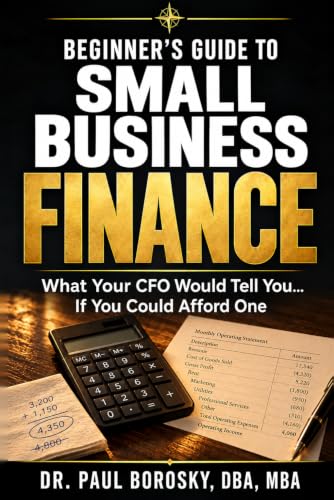
Beginner’s Guide to Small Business Finance
See a real balance sheet read line by line, from cash to retained earnings. For your own business, the small business finance guide shows what a CFO reads first.
Read the free small business finance guide →Written by Dr. Paul Borosky, DBA, MBA, business consultant, author, and educator with an MBA focused in finance. Getting ready to talk to a lender? See how fractional CFO services help.
This page is for general educational purposes only. It is not legal, financial, tax, accounting, or lending advice. Tax rules change by place and by year. Dollar figures are illustrations. The Fabled Forest and its characters are fictional. For decisions about your own business, consult a qualified professional.