
Dr. Paul Borosky, DBA, MBA
Business Consultant & Author
How to Read Financial Statements (Apple Example)
$416 billion in sales. $112 billion in profit. A current ratio below 1. Here is how to read every line.
Most beginners open an annual report, see a wall of numbers, and close it. You do not need an accounting degree. You need a real company and someone to walk you through it. This guide uses Apple’s actual fiscal 2025 statements to teach the income statement, the balance sheet, the cash flow statement, and the ratios that grade them.
Own a business and want your statements read? Call or text (321) 948-9588. Dr. Paul answers personally.
Last Updated: 10/27/2026 · Written by Dr. Paul Borosky, DBA, MBA
The Short Answer
What Are Financial Statements, and How Do You Read Them?
Financial statements are the three reports every public company publishes each year. The income statement shows whether the company made money over the year. The balance sheet shows what it owns and owes on one day. The cash flow statement shows where the cash actually went.
Reading them comes down to one habit: never look at a number alone. Compare it to last year. Compare it to a rival. Compare it to another line on the same page. That is how a figure turns into a story.
New to the terms? Start with the plain definitions: what an income statement is, what a balance sheet is, and why profit is not cash. Then come back here and read a real one. Every term on this page is defined in the financial statements glossary.
Find
Pull the company’s Form 10-K. It is free on SEC EDGAR or the investor relations page.
- Annual report
- Five years of numbers
Read
Walk the three statements top to bottom, one line at a time.
- Income statement
- Balance sheet
- Cash flow statement
Measure
Turn raw numbers into ratios you can compare across years and rivals.
- Liquidity and asset ratios
- Profitability and debt ratios
Grade
Weigh strengths against weaknesses and hand the company a grade.
- DuPont analysis
- Report card
A number only becomes meaningful when you put it next to something else.
From Beginner’s Guide to Understanding Financial Statements and Financial RatiosOne Real Company
Apple’s Three Statements on One Page (Fiscal 2025)
This is the company every guide on this page uses. Look at the numbers first. Then look at the three things below them that confuse almost every beginner.
Income Statement
Did it make money this year?
| Revenue | $416.2B |
| Cost of goods sold | 53.1% of sales |
| Research and development | $34.6B |
| Operating income (EBIT) | $133.1B |
| Net income | $112.0B |
Balance Sheet
What does it own, owe, and keep?
| Total assets | $359.2B |
| Cash | $35.9B |
| Long-term debt | $78.3B |
| Retained earnings | ($14.3B) |
| Total equity | $73.7B |
Cash Flow Statement
Where did the cash go?
| Cash from operations | $111.5B |
| Free cash flow | about $99B |
| Dividends, per year | about $15B |
| Buybacks, per year | $78B to $95B |
| Cash from financing | ($120.7B) |
Source: Apple Form 10-K, fiscal year ended September 2025, as analyzed in the book. Billions of dollars, rounded. Buyback range covers 2021 to 2025.
Negative retained earnings on a company that just earned $112 billion. Not losses. Buybacks. See guide 18.
A current ratio under 1 usually means trouble. For Apple, it does not. See guide 25.
The Guides
34 Guides: Every Line and Ratio, Explained
Six parts, in the same order as the book. Each guide answers one question students search for, with Apple’s real number as the example.
Part One: Foundations
Where the numbers come fromCommon Mistakes When Reading Financial Statements
Reading one number alone. Confusing profit with cash. Trusting a ratio that looks too good. Six traps that catch beginners, and how to sidestep them.
Read the guide →How to Read a 10-K Annual Report (Apple Example)
Where the numbers live. “Total net sales” means revenue. “Accumulated deficit” means retained earnings. Learn the translation and any 10-K opens up.
Read the guide →What Is the Accounting Equation?
Assets equal liabilities plus equity. Every transaction moves two sides. One equation sits under every statement Apple publishes.
Read the guide →How Are the Three Financial Statements Linked?
Net income feeds retained earnings. Cash ties the balance sheet to the cash flow statement. Follow one coffee shop sale through all three.
Read the guide →Part Two: The Income Statement
Did the company make money?How to Read an Income Statement (Apple Example)
Top line to bottom line. Apple turned $416.2 billion in sales into $112.0 billion of net income in fiscal 2025.
Read the guide →What Is Cost of Goods Sold on an Income Statement?
The direct cost of what was sold. Apple’s COGS fell from 58.2% of sales in 2021 to 53.1% in 2025.
Read the guide →Is R&D an Operating Expense? (Apple Example)
Yes. For a tech company, it is the expense you want rising. Apple spent $34.6 billion on research and development in 2025.
Read the guide →Operating Income vs. EBT: What’s the Difference?
Operating income is profit from the business itself. EBT comes after interest and other items. Apple’s operating income: $133.1 billion.
Read the guide →How to Calculate Effective Tax Rate (Apple Example)
Taxes divided by earnings before taxes. Apple’s rate jumped to 24.1% in 2024 on a one-time European charge, then fell to 15.6%.
Read the guide →How to Calculate Net Income (Apple Example)
Revenue minus every cost, interest, and tax. Apple’s net income jumped 19.5% in 2025 to a record $112.0 billion.
Read the guide →Part Three: The Balance Sheet
What does it own, owe, and keep?How to Read a Balance Sheet (Apple Example)
What a company owns, what it owes, and what is left, on one day. Apple: $359.2 billion in total assets.
Read the guide →Is Short-Term Investment a Current Asset?
Yes. Securities that turn into cash within a year are current assets. Here is why analysts add them to cash.
Read the guide →Is Accounts Receivable an Asset? (Apple Example)
Yes. It is money customers owe. Apple’s receivables reached $73.0 billion in 2025, counting vendor non-trade receivables.
Read the guide →What Is PP&E on a Balance Sheet? (Apple Example)
Property, plant, and equipment. Apple carries $49.8 billion of it, tiny next to $416 billion in sales.
Read the guide →Accounts Payable vs. Accrued Expenses
Payables are supplier bills already received. Accrued expenses are costs owed but not yet billed. Apple’s payables: $69.9 billion.
Read the guide →Short-Term vs. Long-Term Debt on a Balance Sheet
Due within a year, or later. Apple cut long-term debt from $109.1 billion in 2021 to $78.3 billion in 2025.
Read the guide →What Is Treasury Stock on a Balance Sheet?
Shares a company buys back and holds. Apple’s treasury line reads zero after billions in buybacks. Here is why.
Read the guide →What Are Retained Earnings? (Apple Example)
Profits kept in the business over time. Apple’s are negative, about ($14.3 billion). Not losses. Buybacks.
Read the guide →Part Four: The Cash Flow Statement
Where did the cash actually go?How to Read a Cash Flow Statement (Apple Example)
The most honest of the three. Operating, investing, financing. Apple brought in $111.5 billion from operations in 2025.
Read the guide →What Is Cash Flow from Operating Activities?
Cash the core business throws off. Apple’s ran between $104 billion and $122 billion a year from 2021 to 2025.
Read the guide →How to Calculate Free Cash Flow (Apple Example)
Operating cash flow minus capital spending. Apple kept about $99 billion of free cash flow in 2025.
Read the guide →Where Do Stock Buybacks Go on the Cash Flow Statement?
Financing activities, next to dividends. Apple spends $78 billion to $95 billion a year buying back its own stock.
Read the guide →Part Five: Financial Ratios
Turn raw numbers into a gradeFinancial Ratios Cheat Sheet: Formulas and Examples
Every formula on one page: liquidity, asset, profitability, debt, and market ratios, with Apple’s 2025 result beside each.
Read the guide →What Are Liquidity Ratios? (Apple Example)
Can the company pay what it owes this year? Current, quick, and cash ratios, plus net working capital.
Read the guide →Current Ratio vs. Quick Ratio (Apple Example)
With or without inventory. Apple’s current ratio is 0.89, below the “safe” line of 1. It is fine. Here is why.
Read the guide →How to Calculate Asset Turnover Ratio (Apple Example)
Sales divided by total assets. Apple produces $1.16 in sales for every dollar of assets.
Read the guide →How to Calculate Days Sales Outstanding
How long customers take to pay. Apple’s DSO crept from 52 days in 2022 to 61 days in 2025.
Read the guide →What Are Profitability Ratios? (Apple Example)
Gross, operating, and net margin, plus the return ratios. Apple keeps about 27 cents of net profit on every sales dollar.
Read the guide →ROA vs. ROE: What’s the Difference?
Return on assets vs. return on equity. Apple: 31% ROA, 152% ROE. One of those numbers needs a warning label.
Read the guide →ROIC vs. ROCE (Apple Example)
Two ways to measure the return on money invested in a business, and when each one tells you more.
Read the guide →How to Calculate Debt-to-Equity Ratio
Total debt divided by shareholder equity. Apple’s fell from 237% in 2022 to 134% in 2025.
Read the guide →How to Calculate Earnings Per Share (Apple Example)
Net income divided by shares outstanding. Apple’s EPS rose from $5.67 to $7.49, helped by a shrinking share count.
Read the guide →Part Six: Putting It Together
Grade the whole companyDuPont Analysis Explained (Apple Example)
Break ROE into margin, turnover, and leverage. It shows how much of Apple’s 152% comes from buybacks, not profit.
Read the guide →How to Do a Financial Statement Analysis, Step by Step
Pull the 10-K. Read the three statements. Run the ratios. Compare a rival. Grade it. The same method works on any company.
Read the guide →Read Before You Buy
Read the Introduction
If an annual report has ever made you close the tab, start here. This is how the book opens.
Introduction
Financial Statements Scare People
“You do not need an accounting degree to read a company’s financials.”
Financial statements scare people. Rows of numbers, cryptic labels, and ratios that sound like a foreign language. Most folks take one look at a company's annual report, feel a small wave of panic, and quietly close it. I do not blame them one bit. But here is the truth I have learned over years of teaching finance and working with business owners: you do not need an accounting degree to read a company's financials. You need someone to sit down next to you and explain it in plain English, one line at a time. That is exactly what this book does.
Most books on this subject are written by professors, for future professors. They are thorough, and they are also dry enough to put you to sleep by page ten. This book takes a different path. Instead of abstract examples and made-up companies, we are going to take a real business you already know, Apple, pull its actual financial statements straight from its public filings, and I am going to walk you through every important line and every key ratio the way I would with a client sitting across my desk. Then, like a real financial analyst, I am going to grade the company, section by section, right down to a final letter grade. By the time you reach the last page, you will be able to pick up almost any public company's financials and do the very same thing yourself.
Every line. Every key ratio. Then a final letter grade for Apple. The rest is in the book.
Keep Reading on Amazon →The Report Card
Apple’s Final Grade: A-
The book grades 51 line items and ratios, A to C, the way a financial analyst would. Here are six of them. Exceptional at making money. A few honest question marks on its short-term cushion.
Who This Is For
Student, Owner, or Raising Money? Same Three Statements.
Apple and a ten-person shop file the same three statements. The stakes are just different.
Students and New Investors
Learn it on a real company
Read Apple’s actual numbers line by line, check them against Microsoft, and finish able to grade any company from its 10-K. Plain English, start to finish.
Get the Book on Amazon →Business Owners
Your business has these statements too.
Most owners only read the bank balance. Dr. Paul works with owners as a part-time financial lead, reading the income statement, balance sheet, and cash flow with you every month. See fractional CFO services or call (321) 948-9588.
Starting or Funding a Business
Lenders read your plan like this.
A bank reads a business plan’s projected statements the same way this page reads Apple’s. Dr. Paul writes business plans with full financial projections: income statement, balance sheet, and cash flow.
Business Plan Writing Services →The Book
Beginner’s Guide to Understanding Financial Statements and Financial Ratios
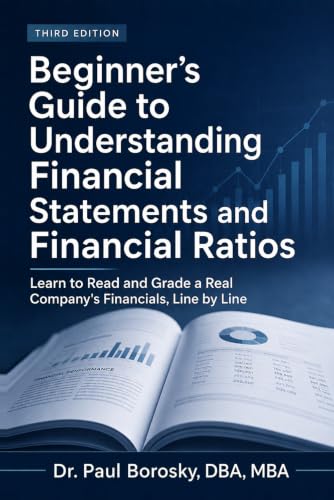
Third Edition. Most finance books use made-up companies and textbook numbers. This one uses Apple. Dr. Paul pulls Apple’s real financial statements from its public filings, walks through every important line and ratio in plain English, holds each one up against Microsoft, and grades the company section by section, right down to a final letter grade.
- The income statement, balance sheet, and cash flow statement, line by line
- 26 financial ratios: liquidity, asset, profitability, debt, and market measures
- Five years of Apple figures, 2021 to 2025, straight from the 10-K
- Apple vs. Microsoft at nearly every step, plus a one-page comparison
- How a single coffee shop sale becomes a financial statement
- The DuPont method, a 51-grade report card, and a plain-English glossary
Every ratio is taught by its textbook name, with its formula and a real result to check your math against. That makes the book a plain-English companion for intro accounting, corporate finance, and financial analysis courses. Teaching one and want to talk about using it? Call or text Dr. Paul at (321) 948-9588. More titles are on Dr. Paul’s business books page.
Beyond the Book
Put These Numbers to Work on Your Own Business
The book teaches you to read the numbers. These three take you from reading them to using them.
Business Plan Templates
Start with a proven plan. A Word business plan and an Excel financial model built for your industry.
See the Templates →Business Plan Writing
Need a plan a lender will read? Dr. Paul writes it, financials included.
See Plan Writing →Business Consulting
You can read the numbers. Now fix them, one-on-one with Dr. Paul.
See Consulting Options →FAQ
Common Questions About Reading Financial Statements
How do you read financial statements for beginners?
What are the three main financial statements?
Where can I find a company's financial statements for free?
Why is Apple's current ratio below 1?
Why is Apple's return on equity so high?
Who is the Beginner's Guide to Understanding Financial Statements and Financial Ratios for?
Learn to read a real company with the book. Call when you want your own numbers read.
Dr. Paul Borosky, DBA, MBA
Business Consultant, Fractional CFO & Author | 14+ Years
Dr. Paul Borosky, DBA, MBA is a business consultant, author, and educator, and the founder of Quality Business Plan. He has taught finance as an adjunct college instructor, helped build finance curriculum for a local college, and builds financial models, business plans, and budgets for small businesses across the United States and Canada. He has written financial projections behind more than $100M in funded projects, is the author of numerous books on Amazon, and has published over 1,000 business videos on YouTube.
This page is for general educational purposes only. It is not investment, financial, tax, accounting, or legal advice, and nothing here is a recommendation to buy or sell any security. Apple and Microsoft figures come from their public filings as analyzed in the book. Apple and Microsoft are trademarks of their respective owners, and this page is not affiliated with or endorsed by either company.