Foundation 4 of 20 · Report
What Is an Income Statement? How to Read a Profit and Loss
Busy Is Effort. Profit Is the Result.
"I'm busy every night. Every night. Why don't I feel rich?" If you judge the business by how full the room feels, you may be working hard for very little. Here is what an income statement is, how to read one in five minutes, and why it is not the same as cash.
Last Updated: 10/27/2026 · Written by Dr. Paul Borosky, DBA, MBA
The Short Answer
What Is an Income Statement?
Textbook Definition
An income statement, also called a profit and loss statement, reports a company's revenues, expenses, and resulting net income or net loss over a specific period of time.
In Plain English
An income statement is one page that answers one question: did the business make money this month? It lists what came in, what went out, and what was left. Some people call it a P&L.
Why It Matters
Why Do Owners Skip the One Page That Matters?
Because the room feels like the answer. Full tables, a line out the door, trucks out every weekend. But busy measures effort, not results. A business can be packed every night and keep almost nothing, and the only thing that tells you is a page with three parts on it.
Those parts are revenue, expenses, and net profit, the amount left after every cost. The page gets even more useful when you run it by location, product, or service. One big number can hide the part of the business that is losing money every month.
Signs you have this problem:
- You know your sales but not your profit.
- Your bookkeeper sends a monthly report and you do not open it.
- You say "we're doing great" and cannot name a number.
- You have more than one location, product, or truck and have never compared them.
- You were surprised at tax time by how much, or how little, you made.
- You make big decisions, like hiring or expanding, based on how busy it feels.
What It Looks Like
What It Looks Like When Nobody Reads the Page
From the Fabled Forest · Chapter 4
Fast Frankie the Fox runs a packed pizza restaurant and three food trucks. Every night is full. His register ferret, Dex, prepares a profit page on the first of every month. Frankie keeps all six of them under a coffee mug, unread. He can tell how the business is doing by how busy it feels.
Doctor Owl had him read the top page out loud. Six hundred thirty coins in. Six hundred out. Thirty coins of profit for a whole month, less than one cook earns.
Then Dex ran the same page four times, once for the restaurant and once for each truck. The truck on the far harbor road had lost money every month for half a year. Frankie moved it to the busy square next to truck one. The next month, profit was sixty-eight coins. Same restaurant, same cooks. He just read the page.
Frankie's story is Chapter 4 of Accounting and Finance for Small Businesses, Book 2 of Dr. Paul's Fabled Forest Business School Series.
The Fix
How to Read an Income Statement in 5 Steps
You do not need to build the statement yourself. You need to read it, every month, the same way.
Start with revenue.
Everything customers bought from you in the month, whether they have paid yet or not. Compare it to last month and the same month last year.
Read the expenses by category.
Materials, wages, rent, vehicles, everything it cost to earn that revenue. Look for any line that jumped. Your chart of accounts is what makes these lines readable.
Subtract to find net profit.
Revenue minus expenses. That is what the month actually left you. If it is negative, it is a net loss, and you want to know that now, not in April.
Run it by location, product, or service.
If you have more than one of anything, ask for a page for each. Put the shared costs, like the office and bookkeeping, on their own line. This is where the losers show up.
Remember that profit is not cash.
Sales you have not collected and bills you have not paid both move cash and profit apart. The income statement says whether you earned money, not whether it is in the bank.
Dr. Paul's Insight
The most common slip is reading the big number at the bottom and stopping. A whole-business profit of $3,000 can hide one location making $5,000 and another losing $2,000. The income statement does its best work when you split it. If your bookkeeper can only give you one page, ask for the same page by location or product line. It is usually the same data, sorted a second way.
Sample: A One-Page Income Statement
The three parts every month, in the order you read them.
| Line | Amount |
|---|---|
| Revenue (everything customers bought) | $63,000 |
| Food, sauce, cheese, boxes | $23,000 |
| Wages | $22,000 |
| Rent and utilities | $7,000 |
| Trucks: fuel and repairs | $8,000 |
| Total expenses | $60,000 |
| Net profit | $3,000 |
Sample for illustration. Ask your bookkeeper for the same page by location or product line.
Watch
Video: How to Read Your Profit and Loss Statement
What Is an Income Statement? How to Read a Profit and Loss
Dr. Paul reads a real-format P&L line by line, then splits it by location on screen.
From the Book
What Does Busy Feel Like?
Chapter 4 · Income Statement
The Page He Never Turned: A Fox's Profit
"How do you know the restaurant is making money?"
"I can feel it. The room's full. The line's out the door. The trucks are out every weekend." Frankie shrugged. "If we weren't making money, I'd feel it."
"What does it feel like?"
Frankie opened his mouth, and stopped, and for a moment looked honestly puzzled.
"Busy," he said.
What did the page under the coffee mug say, and which truck had been losing money for six months? Find out in Chapter 4. Book 2 of Dr. Paul's Fabled Forest Business School Series.
Get the Book on Amazon →FAQ
Income Statement Questions
What is the difference between an income statement and a P&L?
What are the main parts of an income statement?
How often should I read my income statement?
Why is profit not the same as cash?
Keep Going
Related Foundations
The income statement connects to five other foundations, from the categories underneath it to the cash it does not show. New to a term on this page? Every one is in the accounting and finance glossary.
Foundation 3 · Chart of Accounts
Clean categories are what make every line on the statement readable.
Foundation 5 · Balance Sheet
The income statement covers the month. The balance sheet shows today.
Foundation 7 · Cost of Goods Sold
Your biggest expense line is often what it costs to make what you sell.
Foundation 8 · Overhead and Profit Margin
Split your costs to see what each product leaves before and after overhead.
Foundation 11 · Cash Flow
Profit says what you earned. Cash flow says what you have, and when.
Go Deeper
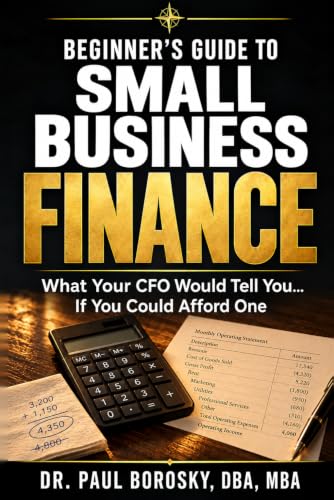
Beginner’s Guide to Small Business Finance
Want to read a real one? Walk Apple’s income statement line by line. When it is your own P&L, the small business finance guide shows what a CFO would do with it.
Read the free small business finance guide →Written by Dr. Paul Borosky, DBA, MBA, business consultant, author, and educator with an MBA focused in finance. Want help building monthly statements you will actually read? See fractional CFO services.
This page is for general educational purposes only. It is not legal, financial, tax, accounting, or lending advice. Tax rules change by place and by year. Dollar figures are illustrations. The Fabled Forest and its characters are fictional. For decisions about your own business, consult a qualified professional.