Foundation 12 of 20 · Decide
How to Get Customers to Pay on Time: Accounts Receivable
Done Is Not Paid. The Bill Is the Last Step of the Job.
"How do I get people to pay on time?" If you finish the work and the invoice waits until "you have a minute," your customers are holding your money. Here is how to get customers to pay on time, without feeling pushy.
Last Updated: 10/27/2026 · Written by Dr. Paul Borosky, DBA, MBA
The Short Answer
How Do You Get Customers to Pay on Time?
Textbook Definition
Accounts receivable are amounts owed to a business by customers for goods or services delivered on credit. Managing them involves prompt invoicing, clear payment terms, and systematic collection of overdue balances.
In Plain English
Send the bill the day the job is done. Put a clear due date on it. Then follow up on a schedule you decided in advance, and stop new work for customers who are too far past due. Most late payments are really late bills.
Why It Matters
Why Do Customers Pay Late?
Often because nobody asked on time. A finished job is not money. It is a promise of money, and it only becomes cash if someone sends the bill, someone follows up, and someone keeps track of who still owes. Skilled people are often terrible at this, because the work is the part they love and the bill feels like begging.
Every day an invoice sits unsent is a day added to when you get paid. And a bill with no due date tells the customer that any date is fine. Clear payment terms, like due in 30 days, give them a date to meet.
Signs you have this problem:
- You have finished jobs that were never invoiced.
- Your invoices do not say when payment is due.
- You do not have one list of who owes you and for how long.
- Customers have had to ask you for a bill.
- You keep doing new work for a customer who has not paid for the old work.
- You are busy, profitable on paper, and short on cash.
What It Looks Like
What It Looks Like When the Work Is Done and Nobody Asks
From the Fabled Forest · Chapter 12
Alton the Ant runs a repair shop with a chalkboard on the wall: JOBS FINISHED on the left, PAID on the right. The left side was full. The right side was empty. Doctor Owl had asked twice for the bill for his own clock repair and never received one.
Alton's apprentice, Pippa, had quietly kept her own ledger of every job since spring. Ninety-three coins were owed to the shop, more than a month of her wages. Twenty-five of it had never been billed at all. The largest single amount, forty coins, was from Talon and Beak, now ninety-five days late.
Alton made Pippa owner of billing, reminders, and one rule: past sixty days, no new work. When the crow from Talon and Beak arrived offering a job twice as big, Alton handed it back unread until the old bill was paid. It arrived nine days later.
Alton's story is Chapter 12 of Accounting and Finance for Small Businesses, Book 2 of Dr. Paul's Fabled Forest Business School Series.
The Fix
How to Get Customers to Pay on Time in 5 Steps
None of this is rude. It is a system, and customers respect a business that runs one.
Invoice the day the job is done.
Not when you have a minute. One slip: what you did, the date, the amount, how to pay, and when it is due. Same day, every time.
Put clear payment terms on every bill.
Due on receipt, due in 15 days, due in 30. Pick one and print it. A customer who knows the date is far more likely to meet it.
Keep one list of who owes what, and for how long.
Customer, amount, invoice date, days outstanding. Look at it every week. This list is your accounts receivable.
Follow up on a schedule you set in advance.
For example: a friendly note one day past due, a call at 15 days past due, a visit at 30. The schedule takes the emotion out of it. You are not chasing. You are following the process.
Decide your stop-work line before you need it.
Pick the point where new work stops until old work is paid, like 60 days. Give someone the authority to enforce it, even with a big customer. Then hold to it.
Dr. Paul's Insight
The customers who pay slowest are not always the small ones. Big companies sometimes stretch every supplier on purpose and call it policy. Taking more work from a customer who already owes you is how a small business ends up financing a large one, for free. Before you accept a big new job, ask one question: when will I be paid for it, based on how this customer has paid before?
Sample: A Weekly Receivables List
One list, updated weekly. Sort by days outstanding so the oldest is on top.
| Customer | Amount | Invoiced? | Days | Next step |
|---|---|---|---|---|
| Large corporate client | $4,000 | Yes | 95 | Stop new work. Visit. |
| Bakery: oven timer | $800 | Yes | 60 | Call today |
| Tour company: booking system | $2,000 | Yes | 45 | Second reminder |
| Library: lamp switches | $1,200 | No | 50 | Invoice today |
| Bank: door lock | $1,000 | No | 35 | Invoice today |
| Total owed | $9,000 |
Sample for illustration. Set your own reminder schedule and stop-work line.
The Shortcut That Costs More
Pay Everyone as Late as You Can?
In the book, a company called Talon and Beak keeps offering owners shortcuts. Every one sounds reasonable. Every one works for a while. Every one costs more than it saves. Here is the one in Chapter 12.
Pay every supplier as late as you possibly can and call it company policy. Use their money as a free loan.
Your cash looks strong, and small suppliers cannot afford to argue.
The best suppliers stop working for you first, because they can. The ones who stay charge you more. And when you need someone to wait for you, nobody will.
Your payment habits are your reputation with suppliers. And when a customer runs this play on you, your stop-work line is how you refuse to be the free loan.
Watch
Video: How to Get Paid Faster
How to Get Customers to Pay on Time: Accounts Receivable
Dr. Paul sets up an invoice template, payment terms, and a weekly receivables list on screen.
From the Book
Answer the Question That Was Asked
Chapter 12 · Accounts Receivable
Done Is Not Paid: An Ant's Unsent Invoices
"How many bills have you not written up?"
Alton opened his mouth. Then he closed it, because he was a technician, and technicians answer the question that was asked.
"I don't know," he said. "Pippa?"
Pippa did know.
How much was Alton owed, and what did he do when the biggest customer offered him more work? Find out in Chapter 12. Book 2 of Dr. Paul's Fabled Forest Business School Series.
Get the Book on Amazon →FAQ
Accounts Receivable Questions
What are accounts receivable?
What payment terms should a small business use?
When should I send an invoice?
What do I do when a customer will not pay?
Keep Going
Related Foundations
Accounts receivable connects four foundations, from the forecast to the reserve. New to a term on this page? Every one is in the accounting and finance glossary.
Foundation 11 · Cash Flow
Collected invoices are the cash in your weekly forecast.
Foundation 13 · Cash Reserve
Every dollar collected faster is a dollar you can move to your reserve.
Foundation 15 · Discounting and Contribution Margin
Know what each job leaves before you agree to wait 90 days for it.
Foundation 1 · Separate Business and Personal Finances
Collect into the business account, never your personal one.
Go Deeper
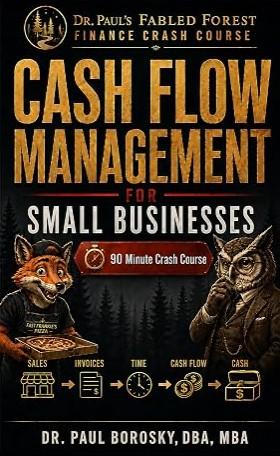
Cash Flow Management for Small Businesses
Slow payers drain cash before they drain profit. See what each day of waiting is worth in what is working capital, then fix the drawer with the cash flow crash course.
See the cash flow book →Written by Dr. Paul Borosky, DBA, MBA, business consultant, author, and educator with an MBA focused in finance. Want help setting up billing and collections that run without you? See fractional CFO services.
This page is for general educational purposes only. It is not legal, financial, tax, accounting, or lending advice. Tax rules change by place and by year. Dollar figures are illustrations. The Fabled Forest and its characters are fictional. For decisions about your own business, consult a qualified professional.