Foundation 16 of 20 · Decide
How to Compare Business Loans: The True Cost of Financing
The Fastest Money Is the Most Expensive Money.
"Where can I get money fast?" If a lender talks about the payment and not the total, the total is where the price is hiding. Here is how to compare business loans on what they really cost, and how to check that the payment fits your month.
Last Updated: 10/27/2026 · Written by Dr. Paul Borosky, DBA, MBA
The Short Answer
How Do You Compare Business Loans?
Textbook Definition
The cost of financing is the total expense of borrowing, including interest, origination and other fees, and penalties, typically compared across offers using the total repayment amount and an annualized cost measure such as the annual percentage rate.
In Plain English
Add up every payment you will make over the life of the loan, then subtract what you actually receive after fees. That number is what the money costs you. Compare offers on that number first, then check that the payment fits your month.
Why It Matters
Why Do Owners Sign Expensive Loans?
Because lenders advertise the parts that sound good: the amount you get and the payment you make. Both sound manageable. The total, the fees, and what happens if you miss a payment sit in the small print. Fast, no-questions money is almost always the most expensive kind, and it shows up exactly when you need it most.
The rules of a loan, how much, how often, how long, and what happens if you are late, are its terms. Read every line, or have someone read it to you. And remember that borrowing can be a bad idea even when the money is cheap, if what you are buying has never been proven.
Signs you have this problem:
- You know your loan payment but not what you will pay in total.
- You signed for money the same day it was offered.
- A fee was taken out before you received the money.
- You do not know what happens if you miss a payment.
- Payments come out weekly or daily from your account.
- You borrowed to fund an idea you have never tested.
What It Looks Like
What It Looks Like When the Terms Are "Flexible"
From the Fabled Forest · Chapter 16
Startup Steve's barbershop finally works. Now he wants to open bike rentals, and a large fin named Shannon from Undertow Capital offered him three hundred coins by tonight. No questions. The terms were "flexible." Steve had read the big number.
Barnaby the bookkeeper read the rest out loud. A twenty-coin fee taken up front, so Steve would receive 280. Fifteen coins every week for forty weeks: six hundred paid back. Miss two Fridays and it was all due at once. The bank's offer, for the same three hundred, cost sixty in total.
Then Steve found the second problem himself. Even the bank's payment would come out of the barbershop for a year, for bikes nobody had ever rented in the forest. He tore up Shannon's paper, decided to rent five bikes in spring as a test, and asked the bank what to bring when he came back.
Steve's story is Chapter 16 of Accounting and Finance for Small Businesses, Book 2 of Dr. Paul's Fabled Forest Business School Series.
The Fix
How to Compare Business Loans in 5 Steps
Do this with every offer, even the friendly ones. It takes ten minutes and a calculator.
Get every offer in writing.
Read every line, including the back page and the small type. If something is unclear, ask the lender to explain it in writing, or have someone you trust read it with you.
Write down what you actually receive.
The loan amount minus any fees taken up front. If you borrow $30,000 and a $2,000 fee comes off the top, you are borrowing $28,000 at the price of $30,000.
Add up every payment over the full term.
Payment times number of payments. Weekly and daily payments add up faster than they sound.
Subtract to find the total cost.
Total paid back minus what you received. That is the total cost of the money. Compare offers on this number first. Then ask your lender for the annual percentage rate to compare offers of different lengths.
Check the payment fits your month, and the bad case.
Can the business make the payment in a slow month without the new thing working yet? What does one late payment cost? What happens after two? If one missed payment can make the whole balance due, think hard.
Dr. Paul's Insight
The question "can I afford the payment?" comes second, not first. Plenty of expensive loans have small payments. And even a cheap loan is a bad idea if it funds something unproven. Test the idea small with your own money first, then borrow to grow what already works, and bring the lender real numbers. The lender who asks a hundred questions is usually the one offering the cheaper money.
Sample: A Loan Comparison Sheet
One column per offer. Compare the bottom lines before you look at the payment.
| Line | Fast lender | Bank |
|---|---|---|
| Amount borrowed | $30,000 | $30,000 |
| Fee taken at signing | $2,000 | $0 |
| Amount you actually receive | $28,000 | $30,000 |
| Payment | $1,500 weekly | $3,000 monthly |
| Number of payments | 40 | 12 |
| Total paid back | $60,000 | $36,000 |
| Total cost of the money | $32,000 | $6,000 |
| If a payment is late | Fee; two missed = all due at once | Late fee only |
Sample for illustration. Ask each lender for the annual percentage rate and the full fee list in writing.
The Shortcut That Costs More
Lend Fast and Let the Small Print Do the Rest?
In the book, a company called Talon and Beak keeps offering owners shortcuts. Every one sounds reasonable. Every one works for a while. Every one costs more than it saves. Here is the one in Chapter 16.
Lend fast to owners who are desperate, and bury the real cost in fees, weekly payments, and penalty clauses.
Desperate owners sign the same day, and the payment sounds small.
The owner pays for a year or more, often far more than they borrowed, and tells everyone they know who did it to them.
If an offer is fast, easy, and does not want to talk about the total, add up the total yourself. Then walk away and compare.
Watch
Video: How to Find the True Cost of a Business Loan
How to Compare Business Loans: The True Cost of Financing
Dr. Paul compares two real-format loan offers line by line on screen.
From the Book
He Read the Big Number
Chapter 16 · Cost of Financing
Cash Now, Terms Later: A Monkey and a Shark
"Shannon," he said. "Undertow Capital. He says the bank takes weeks and asks a hundred questions, and he can have three hundred coins in my paw by tonight. No questions." He beamed. "He said the terms are flexible. Limber, even."
Barnaby's pencil stopped moving.
"Did you read them?" asked Doctor Owl.
"I read the big number," said Steve. "Three hundred."
What did Shannon's "flexible" terms really cost, and what did Steve do instead? Find out in Chapter 16. Book 2 of Dr. Paul's Fabled Forest Business School Series.
Get the Book on Amazon →FAQ
Business Loan Questions
How do I compare two business loan offers?
What is the total cost of a loan?
What fees should I look for in a business loan?
Why is fast business funding so expensive?
Keep Going
Related Foundations
The cost of financing connects five foundations, from what you owe to what the money will earn. New to a term on this page? Every one is in the accounting and finance glossary.
Foundation 17 · Debt and Leverage
Once you know what debt costs, decide whether it will earn more than that.
Foundation 5 · Balance Sheet
Your balance sheet shows how much debt the business already carries.
Foundation 11 · Cash Flow
Put every loan payment into your 13-week cash flow forecast.
Foundation 12 · Accounts Receivable
Collecting what customers owe can sometimes replace a loan entirely.
Foundation 18 · Return on Investment
Compare what the loan costs to what the purchase will bring back.
Go Deeper
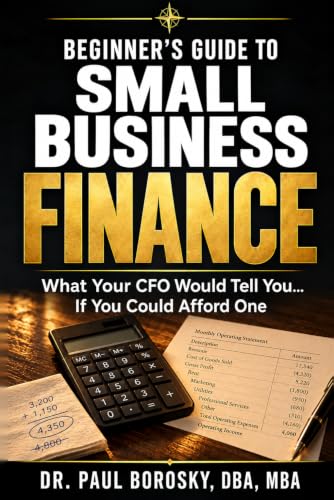
Beginner’s Guide to Small Business Finance
Before you compare loans, know where the money should come from. Read how to fund a small business, then the small business finance guide on borrowing to grow.
Read the free small business finance guide →Written by Dr. Paul Borosky, DBA, MBA, business consultant, author, and educator with an MBA focused in finance. Want a second set of eyes on a loan offer before you sign? See fractional CFO services.
This page is for general educational purposes only. It is not legal, financial, tax, accounting, or lending advice. Tax rules change by place and by year. Dollar figures are illustrations. The Fabled Forest and its characters are fictional. For decisions about your own business, consult a qualified professional.