Foundation 20 of 20 · Decide
How to Create a Small Business Budget and Forecast
A Budget Is a Plan for Your Money Before It Decides for Itself.
"How do I plan for a year I can't see yet?" If every offer sounds affordable, it is because you are comparing it to this month instead of next year. Here is how to create a small business budget with three scenarios, then track actual against plan every month.
Last Updated: 10/27/2026 · Written by Dr. Paul Borosky, DBA, MBA
The Short Answer
How Do You Create a Small Business Budget?
Textbook Definition
A budget is a quantitative plan of expected revenues and expenditures for a future period. Scenario planning prepares alternative budgets under different assumptions, and variance analysis compares actual results to the budget to guide revisions, producing a rolling forecast.
In Plain English
Write down what it costs to keep the doors open each month. Estimate what will come in three ways: a bad year, an expected year, and a good year. Decide in advance where the leftover goes. Then every month, write the actual number beside the plan and adjust.
Why It Matters
Why Does Every Big Offer Sound Affordable?
Because without a budget, you compare it to this month. This month went well, so the payment looks easy. A budget compares it to next year, including the bad months. It shows you what happens if things go wrong before they do, which is exactly when you need to know.
Most owners plan only for the good year, if they plan at all. Scenario planning means building three versions and asking whether you would still be open at the end of the bad one. Then the budget earns its keep by being checked every month, not written once in January and forgotten.
Signs you have this problem:
- You do not have a written plan for next year's money.
- You decide on big purchases based on how this month went.
- Your only plan is the good year.
- You wrote a budget once and never compared it to what happened.
- You do not know what your worst realistic month looks like.
- Someone has offered you a "pay later" deal and it sounded easy.
What It Looks Like
What It Looks Like When the Dream Has No Plan
From the Fabled Forest · Chapter 20
Visionary Veronica's studio, EleWell, is finally working, with a reserve building on the wall. Then Talon and Beak's crow handed her a brochure: fifteen hundred coins for Resort Two, nothing to pay until it opens, then sixty a month. EleWell leaves 120 a month. Easy. On the inside back flap, in small letters: forty-eight months. Two thousand eight hundred and eighty coins.
Doctor Owl asked to plan next year for EleWell as it is. Fern and Flora built three columns on the wall. In the bad year, nothing was left over at all. With the brochure's payment, a bad year would have cost EleWell itself.
But the expected year, followed to the end, put 765 coins into a Resort Two fund without borrowing a thing. Veronica pinned the drawing to the wall and recycled the brochure. In the first month, snow kept the drop-ins home. Flora wrote the actual beside the plan, and they adjusted.
Veronica's story is Chapter 20 of Accounting and Finance for Small Businesses, Book 2 of Dr. Paul's Fabled Forest Business School Series.
The Fix
How to Create a Small Business Budget in 5 Steps
Start with one page and three columns. You can add detail once the habit holds.
Write down what it costs to keep the doors open each month.
Wages, rent, loan payments, utilities, insurance. That is your floor, and it is the same in every scenario.
Estimate what will come in, three ways.
A bad year, an expected year, and a good year. Base them on what you know: last year's months, current customers, seasonal patterns. Be honest about the bad one.
Decide in advance where the leftover goes.
Reserve first, until it reaches its target. Then taxes, debt payments, and the next goal. Money with a plan does not wander off to the next good idea.
Every month, write the actual beside the plan.
Do not erase the plan. The gap between the two is the variance. Ask why it happened: weather, a lost customer, a new product that took off.
Update the rest of the year.
Write a new best guess for the months still ahead, next to the original. That turns the budget into a forecast: a plan you keep updating as the year tells you more.
Dr. Paul's Insight
The most common mistake is writing a budget in January and never looking at it again. A budget earns its value in the monthly comparison, not the writing. The second most common is building it by cutting whatever will not show up this quarter: repairs, training, the reserve. That makes this quarter look great and next year pay for it. A good budget protects the things that keep the business running.
Sample: A Three-Scenario Monthly Budget
One month, three versions. Then add the actual each month in a fourth column.
| Line | Bad year | Expected | Good year |
|---|---|---|---|
| Membership dues | $30,000 | $37,200 | $42,000 |
| Drop-in classes | $0 | $4,800 | $6,000 |
| Total coming in | $30,000 | $42,000 | $48,000 |
| Doors open: wages, rent, loans, utilities | $30,000 | $30,000 | $30,000 |
| Left over | $0 | $12,000 | $18,000 |
| To the cash reserve (until target) | $0 | $10,000 | $10,000 |
| To the next goal | $0 | $2,000 | $8,000 |
Sample for illustration. Each month, write the actual beside the expected column and revise the months ahead.
The Shortcut That Costs More
Cut Whatever Will Not Show Up This Quarter?
In the book, a company called Talon and Beak keeps offering owners shortcuts. Every one sounds reasonable. Every one works for a while. Every one costs more than it saves. Here is the one in Chapter 20.
Build the budget by cutting repairs, training, and the cushion for a bad year. None of it shows up this quarter.
The quarter looks wonderful, and everyone who sees only the quarter is impressed.
Next year pays for this one, with interest. The roof leaks, the staff do not know what they are doing, and there is no reserve when the bad month comes.
A budget that only protects this quarter is not a plan. Keep maintenance, training, and the reserve in every scenario, even the bad one.
Watch
Video: How to Build a Small Business Budget That You Will Actually Use
How to Create a Small Business Budget and Forecast
Dr. Paul builds a three-scenario budget and a monthly actual vs. plan check on screen.
From the Book
For How Long?
Chapter 20 · Budgeting and Forecasting
Flying Blind: An Elephant's Year Ahead
"Sixty a month..." said Fern.
"...for how long?" said Flora.
Veronica looked at the brochure. She had to turn it over twice to find it. It was on the inside of the back flap, in small letters.
"Forty-eight months," she said.
What did three columns on a frosty wall show Veronica about her dream? Find out in Chapter 20. Book 2 of Dr. Paul's Fabled Forest Business School Series.
Get the Book on Amazon →FAQ
Budgeting and Forecasting Questions
What is the difference between a budget and a forecast?
How do I create a budget for a small business?
What is scenario planning?
What is a budget variance?
Keep Going
Related Foundations
Budgeting ties five foundations together. It is where the score becomes next year's plan. New to a term on this page? Every one is in the accounting and finance glossary.
Foundation 11 · Cash Flow
The budget plans the year. The 13-week forecast manages the next season.
Foundation 13 · Cash Reserve
Fund the reserve first, in every scenario that leaves money over.
Foundation 4 · Income Statement
Your income statement is where the monthly actuals come from.
Foundation 18 · Return on Investment
Planned investments go in the budget only after their ROI is measured.
Foundation 9 · Tax Planning
Put quarterly tax payments into every month of the budget.
Go Deeper
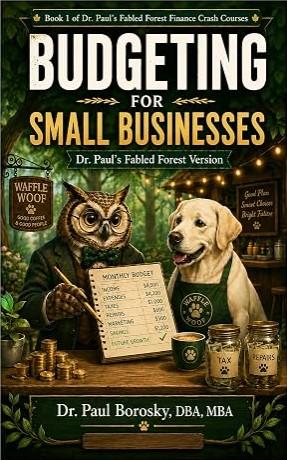
Budgeting for Small Businesses
Want the whole method in 90 minutes? The budgeting crash course comes in two editions, straight and Fabled Forest, with the same five steps.
See the budgeting book →Written by Dr. Paul Borosky, DBA, MBA, business consultant, author, and educator with an MBA focused in finance. Want help building a budget and forecast for next year? See fractional CFO services.
This page is for general educational purposes only. It is not legal, financial, tax, accounting, or lending advice. Tax rules change by place and by year. Dollar figures are illustrations. The Fabled Forest and its characters are fictional. For decisions about your own business, consult a qualified professional.