
Dr. Paul Borosky, DBA, MBA
Business Consultant & Author
Small Business Operations: 20 Foundations Every Owner Should Know
Growth does not break a business. Weak operations do. The orders double, the kitchen falls apart, deliveries run late, and the owner works nights to keep up. These 20 foundations cover how the work actually gets done, from standard work and capacity to scheduling, bottlenecks, and maintenance, in plain English.
Busy season coming? Call or text (321) 948-9588. Dr. Paul answers personally.
Last Updated: 10/25/2026 · Written by Dr. Paul Borosky, DBA, MBA
The Short Answer
What Are Small Business Operations?
Operations is how the work gets done: the steps, the supplies, the schedule, and the habits that keep it all running when the business gets busy. Management decides what should happen. Operations is the machine that makes it happen, every day, the same way. It comes down to four jobs.
Standardize
Do it the same way, on purpose, so every customer gets the same result no matter who is working.
- Standard work
- Consistency and service standards
- Process discipline
Supply
Have enough of what the work needs: hands, hours, stock, and suppliers you can count on.
- Capacity
- Suppliers and backup
- Inventory
Schedule
Decide when and in what order: real due dates, routes, run sheets, shifts, and clean hand-offs.
- Lead time
- Staff scheduling
- Order tracking
Improve
See the machine and make it better: count a few numbers, find the slow step, keep it safe and running.
- Operational metrics
- Bottlenecks
- Preventive maintenance
Good operations are boring on purpose. The same steps, the same result, the same quiet kitchen on the busiest night of the year. When the work runs on a system instead of on the owner's energy, the business can finally grow without breaking. That is the operations side of Dr. Paul's Organize-Plan-Grow™ Strategy.
Most businesses do not fail because nobody wants what they sell. They fail on the busiest day, when the machine was never built to handle it.
Dr. Paul Borosky, DBA, MBA, Operations for Small BusinessesThe 20 Foundations
Find the Step That Breaks When You Get Busy
Each foundation opens with a question a real owner asks. Start with the one that sounds like your week. The first ten build the machine: standards, capacity, and supply. The second ten keep it running: inventory, schedules, hand-offs, and maintenance. Need a term? The operations glossary defines 73 of them in plain English.
Part One: Delivering the Work, Building the Machine
Foundations 1 to 10What Is Standard Work? How to Standardize Custom Jobs
"Every job is different. How can I have a system for that?"Chapter 1 · Every Job Is Special: An Ant's Forty Snowflakes
Standard work is the part of a job done the same way every time, written down once so anyone trained can do it. Most custom jobs are mostly standard, with a custom piece in the middle.
Read the full guide →How to Keep Product Quality Consistent: Recipe Cards and Specs
"My customers say the waffles are different every time. Isn't that the charm?"Chapter 2 · The Waffle That Changed Daily: A Labrador's Recipe Card
Product consistency means a customer gets the same thing every time they order it. A written specification, portion control, and a recipe card make that possible.
Read the full guide →How to Improve Workflow: Prep Lists and Station Setup
"Why does my kitchen fall apart every time it gets busy?"Chapter 3 · Forty Minutes of Onions: A Fox's Kitchen
Workflow is the path work takes from start to finish. Prep is doing every step that does not need the customer before the customer arrives, with stations set so work moves one way.
Read the full guide →What Are Service Standards? Examples for Small Business
"How do I get my team to do it the way I would?"Chapter 4 · Good Is Whatever I Say Today: An Elephant's Spa
A service standard is a written description of what every customer receives, every time, from anyone on the team. It turns what good looks like into a checklist.
Read the full guide →What Is Lead Time? How to Give Customers Realistic Due Dates
"I never miss on quality. Why do I keep missing on dates?"Chapter 5 · Perfect, and Six Weeks Late: A Beaver's Bench
Lead time is how long it really takes from order to delivery. A promise date is built from your measured lead time, adjusted for the job, plus a buffer.
Read the full guide →What Is Process Discipline? Why Constant Changes Make Teams Worse
"I keep improving my process. Why does my team keep getting worse?"Chapter 6 · New Way Every Monday: A Monkey's Rearrangement
Process discipline is setting one standard way and sticking to it until there is a reason to change. You cannot judge an improvement until the old way has held still.
Read the full guide →What Is Capacity in Operations? How to Find Your Limit
"Hypothetically, what does a creature do when the whole forest wants her honey and she cannot make it fast enough?"Chapter 7 · Twice the Orders, Same Six Legs: A Bee's Ceiling
Capacity is the most your business can deliver in a given time with the people, hours, and equipment it has. The capacity gap is demand minus that number.
Read the full guide →What Is Capacity Planning? Booking Limits and Overbooking
"How many can I take before I'm taking too many?"Chapter 8 · Forty Tourists, One Trail: A Horse's Double Booking
Capacity planning works out how much you can deliver well and books around that number. A booking limit caps each slot. Overbooking sells more than you can deliver.
Read the full guide →What Is Supplier Management? How to Work With Suppliers
"They're my customers. Why would I tell them anything?"Chapter 9 · The Mole Who Never Called: A Delivery Nobody Expected
Supplier management is running the relationship between a business and the businesses it buys from or sells to, so both can plan: confirmations, a set day, and fast updates.
Read the full guide →Supply Risk Management: Backup Suppliers and Safety Stock
"What do I do when my only supplier runs out?"Chapter 10 · One Mill, One Mole, One Problem: A Labrador's Empty Sack
Supply risk is the chance something you need will not be there. The fix for any item you cannot open without is a backup supplier and a small, rotated safety stock.
Read the full guide →Part Two: Running the Machine, Keeping It Running
Foundations 11 to 20Inventory Management for Small Business: Par Levels and Reorder Points
"How can I be out of one thing and buried in another?"Chapter 11 · A Warehouse of Tape: An Octopus's Count
Inventory management is tracking what you have, what you use, and when to order. A par level is the fill-to line. A reorder point is the order-now line.
Read the full guide →How to Plan Delivery Routes for a Small Business
"I'm driving all day. Why am I not delivering all day?"Chapter 12 · Half a Truck, Twice the Trip: A Raccoon's Map
Routing decides which stops a vehicle makes and in what order. A load plan packs it last stop first. Delivery zones keep trucks from crossing the same ground twice.
Read the full guide →What Is a Run Sheet? How to Plan an Event Day Minute by Minute
"The event always comes together. Why does it almost not?"Chapter 13 · Nothing on the Clipboard: A Squirrel's Festival
A run sheet lays out an event or busy day on one page in time order: what happens, when, who owns it, and what must happen first. Also called a run of show.
Read the full guide →How to Make a Staff Schedule for a Small Business
"Why is scheduling my crew the hardest thing I do all week?"Chapter 14 · Nobody Knows Who Works Tomorrow: A Fox's Keys
Staff scheduling decides who works when, ahead of time, based on how busy you will be. Post it a week out and give one person the authority to change it.
Read the full guide →How to Track Customer Orders: Job Tickets and Clean Hand-Offs
"The order was right. The job was right. So how did it end up on the wrong building?"Chapter 15 · The Door on the Wrong Building: Two Crabs' Hand-Off
A hand-off is the moment work passes from one person to another, and the most common place for mistakes. A job ticket and one tracking board keep every order visible.
Read the full guide →What Is Service Recovery? How to Handle Customer Complaints
"The tour ended. Why am I still hearing about it?"Chapter 16 · The Tour That Got Rained Out: A Horse's Silence
Service recovery is how a business responds when something goes wrong for a customer, whether or not it was the business's fault. Apologize, offer something, follow up.
Read the full guide →What Are Operational Metrics? 3 to Track Every Day
"The honey house is running. How do I know if it's running well?"Chapter 17 · Three Dials on the Honey House: A Bee's Gauges
Operational metrics are numbers that show how well the work itself is going, separate from the money. Start with three: output per day, on-time rate, and defect rate.
Read the full guide →What Is a Bottleneck in Business? How to Find and Fix It
"I sped up everything. Why isn't anything faster?"Chapter 18 · Eight Arms, One Door: An Octopus's Slowest Step
A bottleneck is the slowest step in a process, also called the constraint. The whole process moves at its speed, so the pile of waiting work always sits right in front of it.
Read the full guide →How to Create a Workplace Safety Plan for a Small Business
"We've never had an accident. Why do I need a safety plan?"Chapter 19 · Measure Twice, Fall Once: A Beaver's Scaffold
Workplace safety is making sure everyone goes home unhurt. A daily safety checklist, a log of every near miss, and a crew allowed to stop work are the core of a plan.
Read the full guide →What Is Preventive Maintenance? Schedule and Checklist
"I fix everything the day it breaks. Why does everything keep breaking?"Chapter 20 · Fixed by Dinner, Broken by Breakfast: An Ant's Oven
Preventive maintenance is checking and servicing equipment on a schedule, before it breaks. Run-to-failure is fine for cheap things and costly for anything your busy hours need.
Read the full guide →Read Before You Buy
Read a Chapter: The Octopus Who Sped Up Everything but One Step
Otto hired more help, sped up the counter, and sped up packing. The line out the door got longer. If you have ever added people and gotten slower, read this. Here is how Chapter 18 begins.
Chapter 18 · The Bottleneck
Eight Arms, One Door: An Octopus's Slowest Step
"I sped up everything. Why isn't anything faster?"
Thelma had answered. Doctor Owl knew this because a card had come to the Lone Oak saying a parcel from the desert was waiting for him at Eight-Arm Errands, and because Thelma's parcels always arrived three weeks after you had stopped expecting them.
He went down on a Tuesday morning. That was a mistake, though he did not know it yet.
The shop looked better than he had ever seen it. The storeroom door stood open, and he could see boxes on the near shelves, in neat stacks, with a card on each stack and Tobias's numbers on the card. The tape was against the back wall, all four hundred rolls of it, out of the way. At the front counter, two of Otto's helpers were taking parcels in at a brisk pace, writing tickets, and passing them back. In the packing room behind, three more were boxing and wrapping and tying string, quickly, without bumping into each other.
And at the side of the shop, by a small door that led out to the loading dock, there was a line.
It was a long line. It went from the little door, along the side wall, past the counter, and out to the street. Everyone in it was holding a finished parcel: boxed, wrapped, tied, and ticketed, ready to go. Moss from the honey house was in it, with four crates of honey on a cart, looking patient in the way of a creature who has been patient every Tuesday for a month. Behind her was a hedgehog with a hatbox. Behind him, a vole with a package for the coast. They were all waiting for the same thing.
On the other side of the little door, a young helper stood at a scale. One scale. She weighed each parcel, carefully, wrote the weight on the ticket, worked out the postage on a slate, and passed the parcel through to the dock. Then she took the next one. She did not hurry. She did not slow down. She was, Doctor Owl thought, doing exactly the job she had been given, as well as anyone could do it.
His parcel from Thelma was in the line too, somewhere. He joined the end of it.
Otto found him there twenty minutes later, coming through the front with five arms full of papers and three free.
"Doctor Owl! You don't need to wait in that! I'll get yours." He reached over the counter. "I've got a hand for that."
"How long has that line been there?"
Otto looked at it. He looked at it the way you look at a piece of furniture that has always been in the room. "Tuesdays," he said. "It's always long on Tuesdays. The coast ferry goes at noon, so everyone comes at once." He brightened. "But look at the front! Look at the packing room! I hired two more helpers on the counter last month. And another one in packing. We're twice as fast as we were in the winter. Twice!"
"Are you sending twice as many parcels?"
Otto opened his mouth. Then he looked at the line again.
"No," he said slowly. "About the same. A few more." He frowned at the line, all eight arms going still. "I don't understand it. I made the counter faster. I made the packing faster. Why isn't the shop faster?"
This is the most surprising lesson in operations, and the one that took me the longest to really believe. A business is a chain of steps. Every order passes through all of them, one after another. And the whole chain can only go as fast as its slowest link. Not its average. Not its best. Its slowest. You can make every other step twice as fast, and if the slow one stays the same, nothing comes out the other end any faster. You've just built a quicker road to the same traffic jam.
"Otto," said Doctor Owl. "Where is it slow?"
"Everywhere, on Tuesdays," said Otto.
"Then let us find out where." Doctor Owl stepped out of the line. "Walk with me. From the front door to the dock. And look for one thing: where the work is waiting."
Otto added arms everywhere except the one place that mattered. Where was the work waiting, and what did the fix cost? The rest of Chapter 18 is in the book.
Keep Reading on Amazon →The 60-Second Self-Check
Will Your Business Hold Up on Its Busiest Day?
Four questions, one for each job. They come straight from line 3 of the Owner's Scorecard in the back of the book. Yes or no. Be honest.
- Standardize
Are my most common jobs written down, so someone else could do them the same way I would, and does every customer get the same result?
- Supply
Do I know how much my business can deliver in a normal week, and do I have a backup for anything I can't operate without?
- Schedule
Do customers get real dates, does my team see the schedule at least a week ahead, and does every job have one owner at every hand-off?
- Improve
Do I look at two or three operating numbers every week, and do I check my equipment before it breaks?
Scored 3 to 5
Build the missing foundation yourself
Pick your one "no," find its foundation in the 20 above, and build it with that chapter and its Nutshell before your next busy stretch. Score again in 90 days.
Get the Book on Amazon →Scored 1 or 2
You need a COO's eyes, not a full-time COO.
When the business only holds together because you are there every hour, the fix is hard to see from inside. Dr. Paul works with owners as a part-time operations lead: standards, capacity, scheduling, and the systems underneath. Call or text (321) 948-9588, or see fractional COO services.
The Book
Operations for Small Businesses
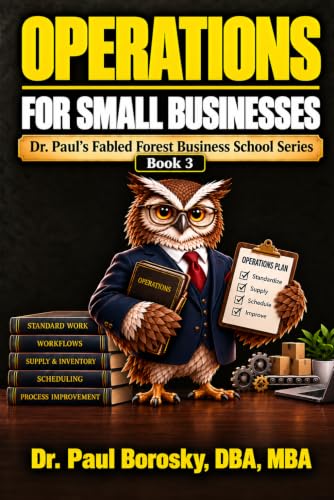
Book 3 of Dr. Paul's Fabled Forest Business School Series. The forest owners can run their businesses and read their numbers. Now the customers have found them, and the work is starting to break. Each chapter follows one owner through one operations problem and teaches one real operations idea by its real name. Doctor Owl still asks before he answers. This time, he walks the line first.
- 20 chapters in two parts: building the machine and keeping it running
- Dr. Paul's Nutshell after every chapter: what it is, why it matters, how to use it, and one question for you
- Doctor Owl's Wise Words and Mrs. Owl-Willow's Reminder: the lesson in one line, twice
- The Talon Way: seven shortcuts that look efficient and break on the busiest day
- A full glossary with every operations term defined
- Line 3 of the Owner's Scorecard, to pick the first fix and measure it in 90 days
Terms like capacity planning, lead time, throughput, and the bottleneck are taught by their textbook names and tied to a story you can picture: a kitchen, a delivery truck, a parcel shop. That makes the book a plain-English companion for intro operations management and small business courses. Teaching one and want to talk about using it? Call or text Dr. Paul at (321) 948-9588.
The Series
Every Book Adds a Line to the Scorecard
Every book in Dr. Paul's Fabled Forest Business School Series adds one line to the Owner's Scorecard. Management made the business run. Accounting showed whether it worked. Operations keeps it running when it gets busy.
See every title on Dr. Paul's business books page.
FAQ
Common Questions About Small Business Operations
What are small business operations?
What is the difference between management and operations?
What are the four main areas of operations?
Why does my business fall apart when it gets busy?
Who is Operations for Small Businesses written for?
Do I need operations systems if my business is small?
Build the machine with the book. Call when you want help building it.
Dr. Paul Borosky, DBA, MBA
Business Consultant, Fractional COO & Author | 14+ Years
Dr. Paul Borosky, DBA, MBA is a business consultant, author, and educator, and the founder of Quality Business Plan. He helps small business owners across the United States and Canada build the systems that let a business run without them: standard procedures, capacity and scheduling, and the financial models behind growth. He serves as a part-time operations and financial lead for owners who need that thinking without a full-time salary. He is the author of numerous books on Amazon and has published over 1,000 business videos on YouTube. He has taught as an adjunct college instructor and teaches in Florida public schools.
This page is for general educational purposes only. It is not legal, safety, employment, financial, or tax advice. Workplace safety and employment rules differ by place and by industry, so check with the agencies and professionals that cover your business. The Fabled Forest, its characters, and its businesses are fictional.