
Dr. Paul Borosky, DBA, MBA
Business Consultant & Author
What Is Motivation? Driver, Drive, and Why Passion Fades
Motivation is the personal reason that keeps you moving after the excitement is gone. Dr. Paul Borosky explains the four words people mix up, and why the one most people rely on is the one that quits first.
Last Updated: 10/28/2026 · Written by Dr. Paul Borosky, DBA, MBA
The Short Answer
What Is Motivation?
Motivation is the driving force behind why you want to do what you are about to do. It is personal. It is chosen. It keeps you moving after the excitement fades. Passion starts the day. Motivation finishes it.
This is the first rung of the ladder in Become Your Version of Rich by Dr. Paul Borosky, DBA, MBA, and the rung that holds the weight of the other four. It is also about your motivation. If you are trying to motivate a team, read how to motivate employees instead. Want to find your own reason now? Go straight to how to find your why. Everything here fits inside the Become Your Version of Rich guide.
Four Words People Mix Up
Driver, Motivation, Drive, and Passion
Most people use these four words as if they mean the same thing. They do not. Keep them apart and you will see why so many people stall.
The Why
Driver
The personal reason you want something. Family, health, proof, or a legacy. It is specific, and it is yours.
Ask yourself: Why do I want this?
The Force
Motivation
The force that gets you moving and keeps you pointed the right way. A named driver gives it something to hold on to.
Ask yourself: What gets me moving today?
The Habit of Moving
Drive
What motivation becomes once you keep acting on it. It looks like steady work, not a burst of feeling.
Ask yourself: What am I still doing a month from now?
The Spark
Passion
Enthusiasm. It helps, it flares, and it fades. It can feed your motivation. It cannot replace it.
Ask yourself: What do I enjoy right now?
Here is how Become Your Version of Rich puts it in Chapter 1.
From Chapter 1 of Become Your Version of Rich
Your driver is the personal reason you want something, the why underneath the work. Your motivation is the force that gets you moving and keeps you pointed in the right direction. Your drive is what motivation becomes once you sustain it through repeated action, day after day, until moving forward is simply what you do. And passion is enthusiasm; it can feed your motivation, but it cannot replace it.
Why Passion Fades
Passion Is a Flare. Motivation Is the Fuel Line.
Dr. Paul loves business. He will tell you that himself. But that love does not sit down and write a business plan for him on a Tuesday morning. It does not push him out the door to a client he would rather not drive to see. Then he walks into the room, the talk turns to their company, and the passion flares. The meeting is great. That is a flare, not a fuel line.
Passion is the fun part of the work. Motivation is what gets the rest of it done. Most advice says to find your passion. Dr. Paul says passion alone is not to be trusted, and the owners who rely on it are the ones who stall when the work gets dull.
The good news: your motivation does not have to be a reward. It can be built from pain. Missing your kid’s game tonight is an evening you never get back, and that ache can move you off the couch faster than any bonus. It can be aimed at your health, at a job that is only a bridge to the next one, or at the enough line you are drawing for your money. Choose it on purpose and life stops running you. You start running it.
What the Research Says
What Psychologists Say Keeps People Going
Psychologists Edward Deci and Richard Ryan built Self-Determination Theory around three basic needs. Autonomy is feeling that you choose your own path. Competence is feeling that you are getting good at something. Relatedness is feeling that your work connects you to people you care about. Money is not on the list. It matters, and financial security is a fair reason to work. On its own, though, it rarely builds the kind of motivation that carries a person through the hard years.
They also split motivation in two. Autonomous motivation is doing something because you value it and it feels like yours. Controlled motivation is doing it for an outside reward or to avoid a punishment. In a 2023 study of 651 STEM faculty at 10 U.S. universities, each step up in autonomous motivation went with roughly 12 percent more publications and 23 percent more citations over three years. Controlled motivation had limited effects. It is one study in one setting, so treat it as a signal, not a promise. It lines up with what Dr. Paul has seen across 1,000+ clients: the owner driven from the inside tends to outlast the one chasing only the money.
Sources: Ryan, R. M., & Deci, E. L. (2000), Self-determination theory and the facilitation of intrinsic motivation, social development, and well-being, American Psychologist. Stupnisky, R. H., Larivière, V., Hall, N. C., & Omojiba, O. (2023), Predicting research productivity in STEM faculty: the role of self-determined motivation, Research in Higher Education.
How This Helps a Business Student
Use the Four Words on the Exam and in Your Own Plan
Textbooks use “motivation” loosely. Once you can separate the four words, you can use them in three places that count.
On the Exam
Define it, then separate it
Give the definition first. Then show you know driver, drive, and passion are different things. Pair it with intrinsic and extrinsic rewards and you have a full answer.
In a Case Study
Ask which word was carrying the founder
Was it a driver, steady motivation, drive, or only passion? Energy with no finish line is a classic failure. See it in why WeWork failed.
In Your Own Plan
Write your driver before your plan
A business plan with no why stalls in week three. Name the driver first, then build the numbers. The driver statement method takes about twenty minutes.
One Honest Caution
When It Is Not a Motivation Problem
Sometimes lost motivation is really burnout, depression, grief, exhaustion, or a health problem. A motivation exercise will not fix any of those. They deserve real support, and sometimes professional support. This page is about the narrower case: a person who has lost their driver, or never found one.
Do This Tomorrow
Three Steps to Start Building Your Driver
- Before you get out of bed, take sixty seconds and picture your version of rich. Not the money. The life.
- Today, spend twenty minutes writing that vision out in full. Do not edit it. Get it on paper.
- Read it back and name the one reason it matters most. That reason is your driver.
You do not need to feel motivated to do this. You need a pen and twenty minutes. Starting is what builds motivation. For the full five-step method, including the three driver statements and the 30-day check, read how to find your why. Then see motivation at work in Madam C.J. Walker’s story.
The Book
Chapter 1 Goes Much Further
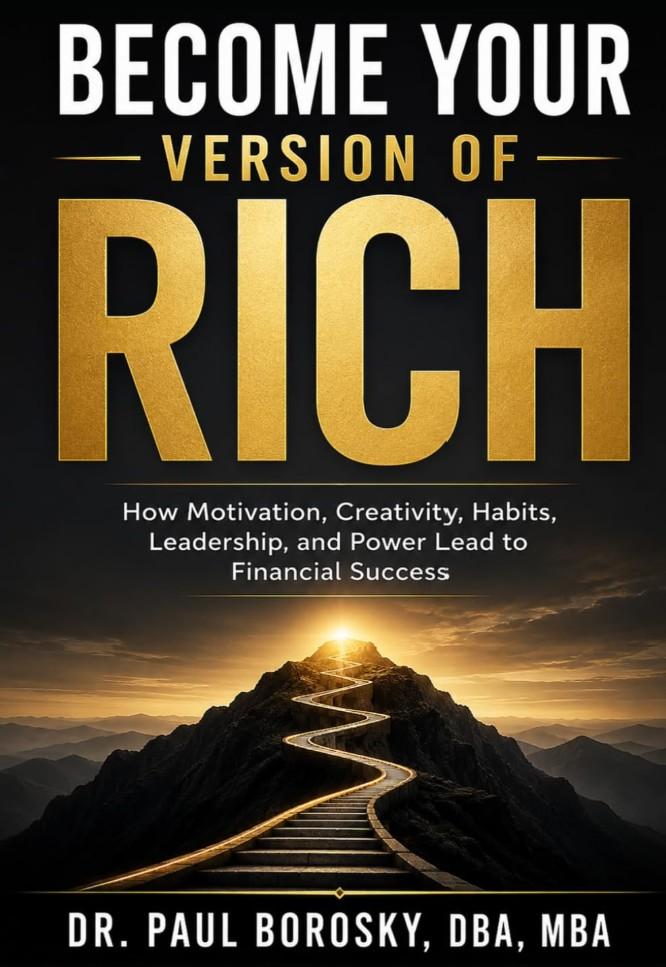
This page is one slice of Chapter 1 in Become Your Version of Rich. The chapter gives you the full method and the people who prove it works.
- The five-step method to build your driver, with three driver statements and a 30-day check
- Madam C.J. Walker and Benjamin Franklin, two people who built motivation on purpose
- Napoleon, and what happens when a driver has no finish line
- The WeWork cautionary tale
- Daily Actions you can start tomorrow, and a single page that grows into your whole version of rich
Go Further With Dr. Paul
Turn Your Why Into a Plan With Numbers
A driver tells you why. A business plan tells you how. Dr. Paul’s industry-specific business plan templates give you a formatted Word plan and an Excel financial model, built on 1,000+ client engagements. Fill in your own numbers and you are lender-ready.
Keep Going
More From Chapter 1 and the Next Rung
FAQ
Common Questions About Motivation
What is motivation in simple terms?
What is the difference between motivation and drive?
Is passion enough to build a business or a fortune?
Dr. Paul Borosky, DBA, MBA
Business Consultant, Author & Educator | 14+ Years | 1,000+ Clients Served
Dr. Paul Borosky, DBA, MBA is a business consultant, author, and educator, and the founder of Quality Business Plan. He helps small business owners across the United States and Canada with business planning, financial modeling, fractional CFO services, and the everyday problems of businesses that depend too much on their owners. He is the creator of Dr. Paul's Organize-Plan-Grow™ Strategy, author of numerous published books on Amazon, and publisher of over 1,000 business-focused videos on YouTube. He has taught as an adjunct college instructor and teaches in Florida public schools.
This page is for general educational purposes only. It is not investment, tax, legal, financial, or retirement advice, and it does not guarantee any particular financial result. The examples, figures, and calculations are illustrative planning tools, not recommendations. Before making significant financial decisions, consult a qualified professional.