
Dr. Paul Borosky, DBA, MBA
Business Consultant & Author
Madam C.J. Walker: From Washerwoman to Self-Made Millionaire
Madam C.J. Walker built a fortune, and then built something harder: an organization of thousands of women who ran their own patch of it. Dr. Paul Borosky reads her story as leadership, and pulls out four moves an owner can copy.
Last Updated: 10/28/2026 · Written by Dr. Paul Borosky, DBA, MBA
The Short Answer
How Did Madam C.J. Walker Build Her Business?
Madam C.J. Walker built her business by building people. She gave thousands of Black women a path to their own income, set a standard, let each agent run a patch, and rewarded service to the community as well as sales. That made success and service one thing.
This is a case study from Chapter 4 of Become Your Version of Rich by Dr. Paul Borosky, DBA, MBA. Her drive is the subject of what motivation really means. Here the lens is leadership, the trait that multiplies. For the how-to side, see how to motivate employees. Everything sits inside the Become Your Version of Rich guide.
The Proof
Philadelphia, August 1917
The book calls it practicing your values out loud. The 1917 convention is the clearest example.
The convention met at Union Baptist Church in Philadelphia on August 30 and 31, 1917. Walker gave prizes to the women who sold the most tins of her hair grower. She gave others to the local Walker clubs that contributed the most to charity. In one afternoon she told a room what the organization stood for, and she paid for it.
A. Lelia Bundles, Walker’s great-great-granddaughter and biographer, records one voice from the floor: Margaret Thompson, president of the Philadelphia Union of Walker Hair Culturists, said her income had risen from $5 a week as a servant to $250 a week. The final day’s theme was “Women’s Duty to Women.”
Sources: A’Lelia Bundles, Madam C. J. Walker’s First National Convention (August 30-31, 1917). National Archives, Madam C. J. Walker’s Rags to Riches Story.
The Four Moves
How She Led Without Standing Over Anyone
Dr. Paul sorts what she did into four moves. None of them needs her fortune.
Move one
Build a path
She did not simply hire a sales force. She gave thousands of women a route to their own income, independence, and dignity.
Ask yourself: What can a person in my business earn, and how do they get there?
Move two
Set the system and the standard
Each agent ran her own patch inside a clear system. Walker was not hovering over every sale.
Ask yourself: What does good look like, and is it written down?
Move three
Reward what you value
Prizes went to service as well as sales. A reward tells people what the company is for.
Ask yourself: What do my rewards say about what I care about?
Move four
Aim it down and outward
Her leadership went into lifting the people who worked for her, and into the community around them.
Ask yourself: Who gets stronger because I lead?
Dr. Paul draws the line between a boss and a leader this way in Become Your Version of Rich.
From Chapter 4 of Become Your Version of Rich
A boss extracts work from people. A leader increases what those people are capable of, and by every account Walker did the second, on a scale that reached well beyond her own company and is still studied today.
Where She Started
The Driver She Handed to Others
The National Archives records that Walker moved to St. Louis and worked as a laundress, sometimes earning as little as $1.00 a day. Years later, in a 1912 speech to the National Negro Business League, she described herself as a woman who came from the cotton fields of the South. The distance between those two points is the story most people tell.
Dr. Paul asks you to notice what she did with it. The same driver that got her off the bottom is what she handed, in usable form, to thousands of other women. That is why this page sits in the leadership chapter, not only the motivation chapter. A boss collects work from people. A leader raises what they can do.
What It Cost
The Easy Road Was Keeping the Profits
It would have been simpler to keep the money and skip the conventions and the giving. Dr. Paul is careful to say what the book can and cannot claim. Walker’s story is documented by her biographer and by archives, and accounts of any life differ at the edges. The lesson does not depend on any single number. It depends on what she chose to reward and what she aimed her leadership at.
Read it next to J.C. Penney, where a leader imposed a vision from above, and what power in business is, where Chapter 5 asks what you do with the influence leadership earns you.
What the Research Says
Leaders Who Build People Are a Studied Style
Robert Greenleaf coined the phrase servant leadership in a 1970 essay, arguing that the leader is a servant first and that the test is whether the people served grow. Researchers have since reviewed the style, and one review in the Journal of Management synthesizes how it has been defined and measured. Walker never read any of it. The match is a useful check, not proof that her results came from it.
Be careful not to stretch this. Servant leadership is one style among several, and the right style depends on the moment. For the range, see types of leadership styles.
Sources: Bundles, A. (2001), On Her Own Ground: The Life and Times of Madam C.J. Walker, Scribner. Greenleaf, R. K. (1970), The Servant as Leader, Greenleaf Center. Van Dierendonck, D. (2011), Servant leadership: A review and synthesis, Journal of Management, 37(4), 1228-1261.
How This Helps a Business Owner
Copy Her Moves Where Owners Actually Lead
You may not run thousands of agents. You likely run a handful of people, and the same four moves scale down.
For Your Team
Show the path, not just the task
Write what a person can earn and become in your business, and what it takes to get there. How to motivate employees covers what moves people beyond pay.
For Your Standards
Write good down
Agents ran their own patch inside a system. Yours needs the same thing on paper. An SOP lets people act without waiting for you.
For Your Rewards
Pay for what you say you value
If you say service matters, reward it in public and watch what people do next. Then check that your pay plan does not reward the opposite.
One Honest Caution
A Prize Does Not Replace a Sound Business
Rewarding service did not make Walker’s business work. She also sold a product people wanted and built a system to sell it. This page is general education about leadership, not a claim that charity prizes alone build companies. Pay, incentives, and sales commissions raise legal and tax questions, so ask a qualified professional before you change yours.
Do This Tomorrow
Three Steps for Tomorrow
- Write one paragraph on the path a person can follow in your business, from first day to their own patch.
- Choose one value you claim, such as service, and name one reward that shows it.
- Ask two people what stops them from running more of their own patch. Listen, then fix one thing.
Leadership starts with listening. When you hear the answer, test it with a small step, not a company-wide rollout. See what happens when a leader skips that in why J.C. Penney failed under Ron Johnson.
The Book
Walker Appears Twice in the Book
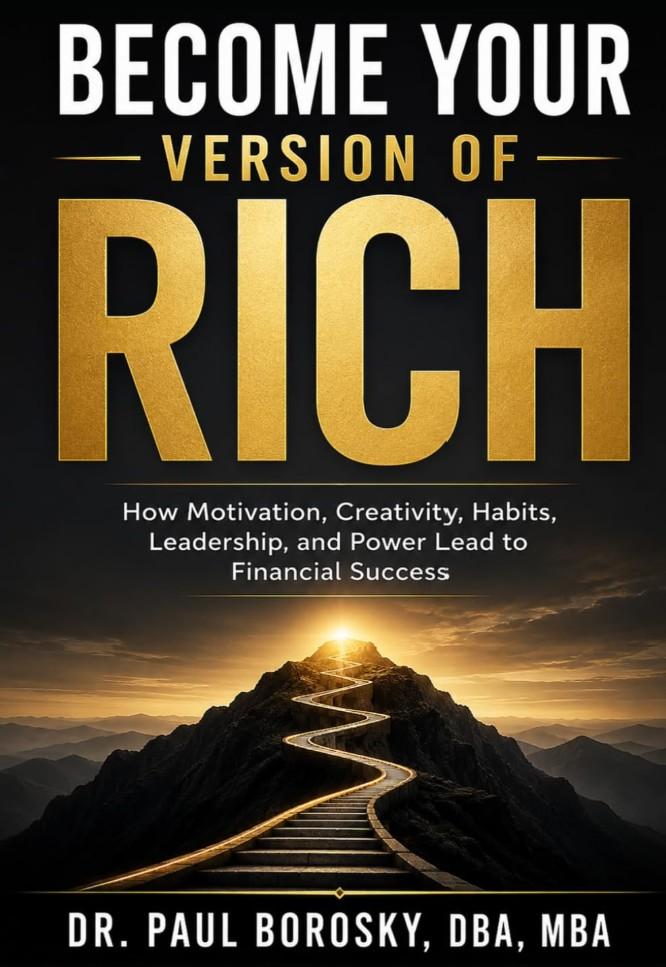
This page covers her leadership. Become Your Version of Rich tells the motivation half in Chapter 1 and the leadership half in Chapter 4.
- The five-step driver method from Chapter 1
- The seven-step leadership method from Chapter 4
- Benjamin Franklin, who led with no authority at all
- A quiet garlic farmer who kept good people for years
- Daily Actions and a 30-day way to check whether your standards hold through other people
Go Further With Dr. Paul
Write the Plan That Lets People Run Their Own Patch
Paths, standards, and rewards belong in a written plan, with roles and numbers a lender will read. Dr. Paul writes custom business plans built on 1,000+ client engagements, so your people and your finances line up.
FAQ
Common Questions About Madam C.J. Walker
How did Madam C.J. Walker become successful?
What happened at Madam C.J. Walker’s 1917 convention?
What can business owners learn from Madam C.J. Walker?
Dr. Paul Borosky, DBA, MBA
Business Consultant, Author & Educator | 14+ Years | 1,000+ Clients Served
Dr. Paul Borosky, DBA, MBA is a business consultant, author, and educator, and the founder of Quality Business Plan. He helps small business owners across the United States and Canada with business planning, financial modeling, fractional CFO services, and the everyday problems of businesses that depend too much on their owners. He is the creator of Dr. Paul’s Organize-Plan-Grow™ Strategy, author of numerous published books on Amazon, and publisher of over 1,000 business-focused videos on YouTube. He has taught as an adjunct college instructor and teaches in Florida public schools.
This page is for general educational purposes only. It is not investment, tax, legal, financial, or retirement advice, and it does not guarantee any particular financial result. The examples, figures, and calculations are illustrative planning tools, not recommendations. Before making significant financial decisions, consult a qualified professional.