
Dr. Paul Borosky, DBA, MBA
Business Consultant & Author
What Is Power in Business? Position Power vs. Earned Power
Power is not a trait you store. It lives in a relationship and changes with the situation. Dr. Paul Borosky defines it, sorts its sources into two families, and gives you two questions that show who really holds it.
Last Updated: 10/28/2026 · Written by Dr. Paul Borosky, DBA, MBA
The Short Answer
What Is Power in Business?
Power is your capacity to influence decisions, behavior, resources, and outcomes within a particular relationship or situation. It comes from your position, such as formal authority, and from what you have earned, such as expertise, reputation, and relationships.
This is the definition from Chapter 5 of Become Your Version of Rich by Dr. Paul Borosky, DBA, MBA. It follows leadership, because leadership earns the influence that power then uses. To put it to work, see how to build influence without authority. For the formal side, read what organizational structure is. All of it sits inside the Become Your Version of Rich guide.
The Definition
Power Is a Capacity, in a Relationship, Bounded by a Situation
Three words in the definition do the work: capacity, relationship, and situation.
Dr. Paul defines power in these words in Become Your Version of Rich.
From Chapter 5 of Become Your Version of Rich
Power is your capacity to influence decisions, behavior, resources, and outcomes within a particular relationship or situation. Notice three things packed in there. It is a capacity, not an act. It shows up in a relationship, not in a vacuum. And it is bounded by a situation, not carried everywhere you go.
The classic scholarly version says nearly the same thing: power is the ability to get someone to do something they would not otherwise have done. The book adds an ethical floor from the start. Ethical power pursues legitimate goals and respects that the people you influence have aims and values of their own. This is not about domination.
The Engine
Dependence and Alternatives
Here is the one practical idea that makes the rest usable. Your power in a relationship rises when the other side needs something you control and has few good alternatives to you. Their power rises when you need something they control and you have few alternatives to them. Ask two questions before any negotiation, pitch, or ask: what do I need from them, and what do they need from me? Then ask who has the better alternatives?
Sociologist Richard Emerson framed the same idea in 1962: one party’s power over another rests on the other party’s dependence. That is why a famous name can mean everything in one room and nothing in the next. Find it in the glossary as dependence and alternatives.
Sources: Dahl, R. A. (1957), The concept of power, Behavioral Science, 2(3), 201-215. Emerson, R. M. (1962), Power-dependence relations, American Sociological Review, 27(1), 31-41.
The Two Families
Position Power and Earned Power
Dr. Paul sorts every source of power into one of two families. Then he shows how to combine them.
Granted by a role
Position power
Formal authority, the ability to reward, and the ability to impose consequences. It can be granted faster than trust can be built. Poor conduct drains the legitimacy and honest information that make it work.
Ask yourself: Would people still follow if the title were taken away?
Built over time
Earned power
Expertise, reputation and the trust it carries, information, relationships, and a track record of results. It travels with you and does not vanish when the title does.
Ask yourself: What have I built that no title can buy?
Both, aimed at one vision
Aligned power
Position and earned power, directed by clear values toward a defined vision and held inside clear limits. Position alone is the weakest ingredient.
Ask yourself: Where am I leaning only on my title?
The German sociologist Max Weber separated authority that rests on the office from authority that rests on the person. Read that as useful background for why the two families behave so differently. Earned power is not only charisma. Expertise, results, and relationships matter just as much.
Sources: Weber, M. (1978), Economy and Society (G. Roth & C. Wittich, Eds.), University of California Press. (Original work published 1922.)
A Real Example
Why Goldman Sachs Needed Buffett’s Name
On September 23, 2008, Goldman Sachs announced that Berkshire Hathaway would buy $5 billion of preferred shares paying a 10 percent annual dividend, plus warrants to buy another $5 billion of common stock at $115 a share. Goldman had other places to raise money. What it could not easily buy was a public signal in a frightened market that a careful judge of value backed the firm.
Buffett held no formal authority over Goldman. He could not give an order. Yet his yes carried a premium, because of who he was and the alternatives the other side lacked. Move him into an unrelated field and the same man has little power at all. That is why power is situational. For the habits behind his reputation, see Warren Buffett’s daily habits.
Sources: Goldman Sachs, 2008 Buffett investment (company history).
The Ethical Floor
Persuasion, Manipulation, and Coercion
Earned does not automatically mean clean. Three ways of moving people are not equal.
Belongs in the book
Persuasion
Truthful information that leaves the other person a genuine choice.
Does not belong
Manipulation
Hiding facts or exploiting weaknesses to steer someone.
Does not belong
Coercion
Using threats to force someone.
All three can move people. Only the first belongs in the kind of power this book helps you build. The warning behind it is the power paradox: power can erode the very qualities that earned it. That is the subject of what went wrong at Uber.
How This Helps a Business Student
Use This Page to Answer Power Questions on Exams and in Cases
Power is easy to name and hard to apply. Three uses turn the definition into points on the page.
On the Exam
Define it, then sort the sources
State the definition, then list position power (authority, reward, consequence) and earned power (expertise, reputation, information, relationships, results). Add one example of each, and note the dependence and alternatives rule.
In a Case Study
Run the two questions on both sides
Ask what each party needs from the other, and who has the better alternatives. The answer usually predicts who wins the negotiation. Test it on Uber.
In Your Business Plan
Name who you depend on
A plan lists customers, suppliers, partners, and lenders. For each, write what they control and what they need from you. See organizational structure for the formal side.
One Honest Caution
Power Is Not Proof That Someone Is Right
Having power does not make a decision wise, fair, or legal. This page is general education, not legal or management advice. It describes publicly reported events, such as the 2008 Goldman deal, in terms the sources support. For the history of contested decisions in any firm, read primary sources, and ask a qualified professional before you apply these ideas to a negotiation that matters.
Do This Tomorrow
Three Steps for Tomorrow
- Pick one relationship that matters to a goal, such as a client, a boss, or a vendor.
- Write what you need from them and what they need from you. Then write who has the better alternatives.
- Name one honest thing you could do this week to add value to them, with no demand attached.
That is the start of a power map. To build the whole thing, follow how to build influence without authority. The business plan templates give you a place to write down who you depend on and what they need.
The Book
Chapter 5 Goes Further
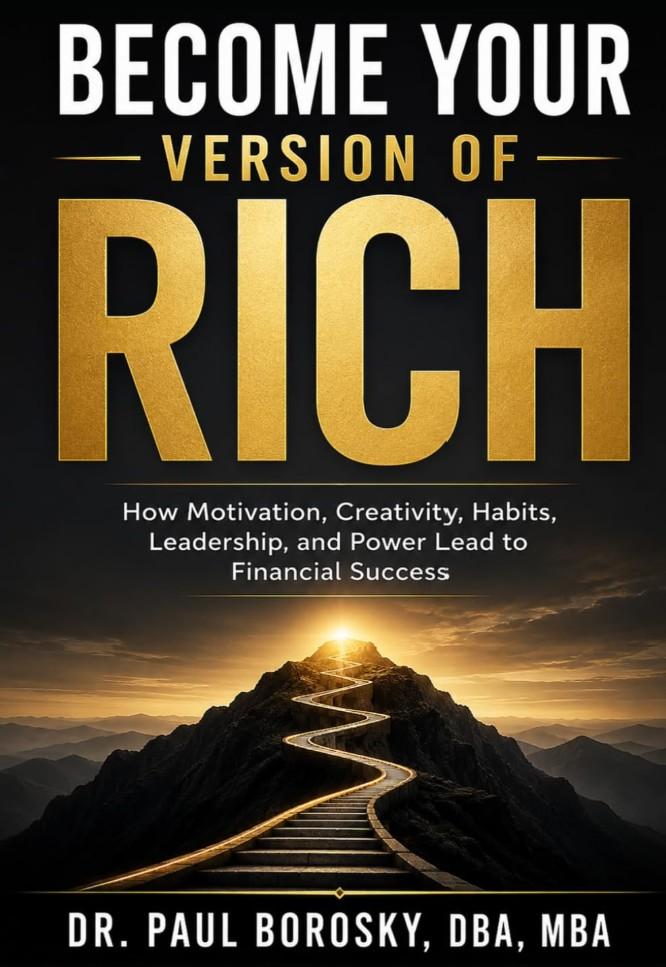
This page defines the term. Become Your Version of Rich gives you the seven-step method and the people behind it.
- The seven-step power method, from ethical boundaries to safeguards
- Warren Buffett and Benjamin Franklin, two people who held great power and kept it
- Napoleon at Notre-Dame and in Russia
- A day spa owner who built earned power before she opened
- The Uber cautionary tale and the full Daily Actions
Go Further With Dr. Paul
Write Your Stakeholders Into a Plan
A power map belongs in the business plan, next to the market and the numbers. Dr. Paul’s industry-specific business plan templates give you a formatted Word plan and an Excel financial model. Built on 1,000+ client engagements.
Keep Going
More From Chapter 5
FAQ
Common Questions About Power in Business
What is power in business?
What is the difference between position power and earned power?
What is the dependence and alternatives rule?
Dr. Paul Borosky, DBA, MBA
Business Consultant, Author & Educator | 14+ Years | 1,000+ Clients Served
Dr. Paul Borosky, DBA, MBA is a business consultant, author, and educator, and the founder of Quality Business Plan. He helps small business owners across the United States and Canada with business planning, financial modeling, fractional CFO services, and the everyday problems of businesses that depend too much on their owners. He is the creator of Dr. Paul’s Organize-Plan-Grow™ Strategy, author of numerous published books on Amazon, and publisher of over 1,000 business-focused videos on YouTube. He has taught as an adjunct college instructor and teaches in Florida public schools.
This page is for general educational purposes only. It is not investment, tax, legal, financial, or retirement advice, and it does not guarantee any particular financial result. The examples, figures, and calculations are illustrative planning tools, not recommendations. Before making significant financial decisions, consult a qualified professional.