
Dr. Paul Borosky, DBA, MBA
Business Consultant & Author
Small Business Sales: 20 Foundations Every Owner Should Know
The fair drew three hundred. A customer is standing right there, asking how much. And you hear yourself say, "We can talk about that." Most owners are great at the work and stuck on the last few feet. These 20 foundations cover asking for the sale honestly and keeping the customer once they say yes, in plain English.
Losing sales you should be winning? Call or text (321) 948-9588. Dr. Paul answers personally.
Last Updated: 11/02/2026 · Written by Dr. Paul Borosky, DBA, MBA
Sales in Plain English
What Is Small Business Sales?
Sales is turning someone who is interested into someone who buys, and then into someone who comes back. It is not begging, and it is not pressure. For a small business it comes down to four jobs: ask plainly, listen first, close honestly, and keep the customer you worked so hard to win.
Ask
Say the price plainly, ask for the order in one question, and let the customer answer.
- Sales mindset
- Value exchange
- Asking for the order
Listen
Find out what the customer came for before you say what you have, and turn away the bad fits.
- Discovery
- Solution selling
- Qualifying
Close
Put the number in writing, answer the worry truthfully, and sign the page when the job is big enough.
- The sales quote
- Objection handling
- The sales agreement
Keep
Write every possible sale down, follow up on a date, and build a process someone else can run.
- Sales pipeline
- After-sales service
- Sales process
Small businesses do not need a sales floor or a script. They need an honest way to say the number, ask the question, and follow up, written down so it works on a busy Saturday and on the week the owner is away. That is the sales side of Dr. Paul's Organize-Plan-Grow™ Strategy, and it picks up right where small business marketing leaves off. Marketing gets the right people to find you. Sales turns them into customers.
A price said plainly is not a demand. It is the answer to a question they were already asking.
Doctor Owl, Sales for Small BusinessesThe 20 Foundations
Find Where Your Sales Are Slipping Away
Each foundation opens with a question a real owner asks. Start with the one that sounds like you. The first ten are the conversation at the counter: the mindset, the listening, the quote, and the close. The second ten are the system that keeps selling when you are not in the room: the pipeline, follow-up, agreements, and a process someone else can run. Need a term? The sales glossary defines every one in plain English.
Part One: The Ask, Face to Face With a Customer
Foundations 1 to 10What Is a Sales Mindset? How to Stop Feeling Like You're Begging
“Asking a creature to pay for my work feels like begging. How do I do it without turning into Sunny?”Chapter 1 · Forty Names, No Number: A Squirrel’s Price
Your sales mindset is how you think about the moment you ask someone to buy. Selling as helping means you help them decide, and the price is information they need, not a favor you beg for.
Read the full guide →What Is a Value Exchange? How to Charge Friends and Regulars
“They’re friends by the second visit. How do I charge a friend?”Chapter 2 · On the House, Again: A Labrador’s Gift
A value exchange is a trade both sides chose. The customer gets something worth more to them than the money, and you get money worth more to you than what you hand over.
Read the full guide →What Is Discovery in Sales? Questions to Ask Before You Pitch
“I’ve got the best pitch in the forest. Why does everybody leave with the pitch and not the bottle?”Chapter 3 · Eleven Minutes, No Question: A Monkey’s Tonic
Discovery is finding out what the customer needs before you say what you have. Ask open questions first, because the reason they walked in is often not the one you expected.
Read the full guide →What Is Solution Selling? Sell the Outcome, Not the Gears
“I answer every question completely. Why do they leave before they’ve heard the answer?”Chapter 4 · Twenty Minutes of Gears: An Ant’s Answer
Solution selling is selling what your product does for the customer, in their words, not how it works. Answer the question they asked, and put the outcome before the mechanism.
Read the full guide →How to Write a Sales Quote Customers Can Say Yes To
“They always ask what it costs before I’ve finished describing it. Why are they so fixed on the number?”Chapter 5 · An Experience, No Number: An Elephant’s Gift Certificate
A sales quote is the written answer to two questions: what do I get, and what does it cost. A good one also says what is not included and how long the price stands.
Read the full guide →How to Qualify a Sales Lead Before You Quote
“I quote everybody who calls. Isn’t that what you’re supposed to do?”Chapter 6 · Three Quotes, One Truck: A Raccoon’s Saturday
Qualifying is deciding, before you spend time selling, whether this customer can buy, will buy, wants work you actually do, and whether you can deliver it on the day you promise.
Read the full guide →What Is Consultative Selling? Sell Like You Would Advise a Friend
“We tell them the truth about the danger and they buy. Why don’t they come back?”Chapter 7 · Four Locks, One Door: Two Crabs and an Otter
Consultative selling is selling the way you would advise a friend. You ask what they have and what they need, then recommend what you would buy if the money were yours.
Read the full guide →How to Negotiate Price Without Giving Away Your Margin
“I bid, they pick, I build. Where in that is there anything to negotiate?”Chapter 8 · Lowest by a Third: A Beaver’s Bid
Negotiation is two sides trading until both can say yes. You trade on scope, time, and price, ask for something back whenever you give, and know your floor before you start.
Read the full guide →How to Ask for the Sale, Then Stay Quiet
“I say the price now. Then there’s this silence. What am I supposed to do in the silence?”Chapter 9 · Then She Waited: A Squirrel’s Yes
Asking for the order is the plain question at the end of the conversation, like "Shall I put you down?" Then you stay quiet. The silence belongs to the customer.
Read the full guide →Closing Techniques That Don't Feel Pushy
“Shannon closes everybody. Why can’t I just do what she does, but nice?”Chapter 10 · Today Only, Every Day: A Monkey’s Shark
Closing techniques help a customer move from maybe to yes. The honest close says back what they want, offers a choice of two, and asks. The pressure close invents a clock.
Read the full guide →Part Two: The System, Selling When You Are Not in the Room
Foundations 11 to 20What Is a Sales Pipeline? How to End Feast and Famine
“Catering comes in waves. That’s just how it is. Isn’t it?”Chapter 11 · Three Saturdays, Then Nothing: A Fox’s Calendar
A sales pipeline is every possible sale written down by stage (asked, quoted, deciding, booked, done) and looked at on a set day, so the calendar stops swinging from feast to famine.
Read the full guide →How to Follow Up After Sending a Quote
“I sent the quote. They didn’t answer. That means no, right?”Chapter 12 · The Quote That Went Quiet: A Raccoon’s Second Note
Sales follow-up is a second contact on a planned date, with a reason, after a customer goes quiet. Silence does not mean no. It means you do not know yet.
Read the full guide →How to Handle Sales Objections
“If they’ve got a worry, they’ve got a worry. Who am I to argue a customer into something?”Chapter 13 · Probably Too Much Trouble: A Labrador’s No
Objection handling is how you respond when a customer raises a worry. Most worries are a request for one more piece of information. Hear it, answer it truthfully, check it, and ask again.
Read the full guide →How to Handle Price Objections Without Discounting
“They said it was a lot. It is a lot. What was I supposed to say?”Chapter 14 · That Seems a Lot: A Camel’s Rope
A price objection is a reaction to the number, like "that seems a lot." It is usually a question about what is in it. Explain the price, hold it, and trade something else if you must.
Read the full guide →What Should a Sales Agreement Include?
“We shook on it. In this forest, that means something. Doesn’t it?”Chapter 15 · Forty Seats, No Paper: A Horse’s Handshake
A sales agreement is a written record of what both sides agreed: who, what, when, how much, the deposit, and what happens if someone cancels. A handshake is not a record.
Read the full guide →What Is Overselling? Why Promising Too Much Loses Customers
“I closed both! Closing is the hard part. Why is everyone upset?”Chapter 16 · The Whole Resort, Twice: An Elephant’s Weekend
Overselling is promising more than your business can deliver to win the sale. Check every promise against what you actually have before you make it, because the quote is the promise.
Read the full guide →What Is After-Sales Service? The Sale Is Not Over at the Counter
“The parcel left my counter in perfect shape. What happens after that is the ferry’s problem. Isn’t it?”Chapter 17 · It Left Here Fine: An Octopus’s Parcel
After-sales service is what you do once the money has changed hands. To the customer, the sale is over when the thing arrives and works, so you ask "Did it arrive whole?" on purpose.
Read the full guide →Upselling vs. Cross-Selling: Examples for Small Business
“They order what they order. Offering them more feels like Sunny. Doesn’t it?”Chapter 18 · The Same Case Every Tuesday: A Bee’s Candles
Upselling offers the bigger or better version of what a customer is buying. Cross-selling offers something that goes beside it. Both work when you only suggest what fits this customer.
Read the full guide →What Is Sales Management? How to Manage a Salesperson
“I hired a salesman so I wouldn’t have to sell. Why am I now doing both?”Chapter 19 · Forty Bookings, Nineteen Surprises: A Horse’s Salesman
Sales management is making sure the people who sell for you sell the way you would. Hire well, train in order, and pay for the number that shows a sale that stayed sold.
Read the full guide →What Is a Sales Process? How to Write One Anyone Can Run
“Nobody can sell it like I can. That’s a good thing. Isn’t it?”Chapter 20 · Asleep in Truck Two: A Fox’s Playbook
A sales process is the steps of a sale written down in order, so anyone trained can run them the same way. One name owns each customer, and the sale stops depending on the owner.
Read the full guide →Chapter 1, Free
Read a Chapter: The Squirrel Who Would Not Say the Price
Hazy Hazel has forty creatures who want a painting and forty blank cards to write to them. What she does not have is a number on any of them. If you have ever said "we can talk about that," this one is for you. Here is how Chapter 1 begins.
Chapter 1 · Sales Mindset
Forty Names, No Number: A Squirrel’s Price
“Asking a creature to pay for my work feels like begging. How do I do it without turning into Sunny?”
The stationer’s shop on the square smelled of ink and cedar, and on the Thursday after the workshop Doctor Owl had been standing at its counter for twenty-five minutes, holding two sample cards up to the window, one in each wing.
They were business cards. His own were four years old and he had decided, in the night, that they were no longer right, though he could not have said what was wrong with them. The first sample was set in a plain serif face. The second was set in the same face, very slightly narrower. He turned them over. He turned them back. The stationer, a small, patient mouse with ink to her elbows, had stopped offering opinions at about the fifteenth minute and was sorting nibs.
“The second one has more air in it,” he said.
“It does,” said the stationer.
“The first has more weight.”
“It does.”
“I cannot decide whether I want to be heavy or airy.”
“Doctor Owl,” said the stationer, kindly, “you are an owl.”
He put both cards down, and was about to pick them up again when the door opened behind him and let in the smell of the square and a rustle of birch bark, and a squirrel with mismatched acorn earrings went past his elbow to the next counter, and said, quietly, “Forty, please. Blank.”
He knew it was Hazel before he turned. She had a basket on her arm, and in the basket was a bark roll, and on the counter she set down a small flat case, and opened it, and took out a sheet of tracing paper covered in drawings no bigger than a thumbnail.
“Blank,” said the stationer. “Cream stock? No printing on the front?”
“No printing at all. Just a little room on the back.” Hazel slid the tracing sheet across. “I’m going to draw on the front. One each. This is the heron’s dock at dawn, for the family from Gull Point. This is the mill bridge, for the badger’s cousin. The ridge for the ranchers.” She slid them out one at a time, and each one, in three lines, was exactly the painting that creature had asked for, and Doctor Owl, from the next counter, with a business card in each wing, saw the stationer look at the drawings and put down her nibs. “Forty names. Forty cards. I’m going to take them round by hand.”
“And the back?”
“I’ll write a note.” Hazel hesitated. “Something friendly. I’ve been thinking about your painting. That sort of thing.”
“With the price?” said the stationer, as she would have asked about the weather.
Hazel’s paw stopped on the tracing sheet.
“I’ll see what happens,” she said.
The stationer wrote 40, cream, blank on a slip and said they would be ready Monday. Hazel paid, exactly, in coins counted twice. Then she turned around, and saw the owl, and the two cards, and went the color of a strawberry under her fur.
“Doctor Owl. I didn’t see you.”
“I am choosing a font.”
“It’s going well?”
“It is not.” He set down both cards. “Hazel. May I ask what you are going to write on the back?”
“Something friendly.”
“And where in it is the number?”
She looked at the case, and at the stationer, who was suddenly very busy with the nibs, and then at him. She did not answer, and it was the longest she had gone without answering anything since the day he had met her.
Forty names, forty cards, and no number on any of them. What is Hazel really afraid will happen when she says it? The rest of Chapter 1 is in the book.
Keep Reading on Amazon →Score Yourself in a Minute
Would You Win the Sale If They Asked Tomorrow?
Four yes-or-no questions, one per job. They are line 5 of the Owner's Scorecard in the back of the book. Answer for how you sold last week, not how you mean to sell.
- Ask
Can I say my price out loud, ask for the order in one plain question, and then stay quiet long enough for the customer to answer?
- Listen
Before I say what I have, do I find out what this customer came for, and do I turn away or refer the ones who aren't a fit?
- Close
Does every customer get a written quote with the number first, an honest answer to their worry, and a signed page when the job is big enough to need one?
- Keep
Do I write down every possible sale and look at the list each week, follow up on a date, ask every customer how it went, and could someone else run the whole sale if I were away for a week?
Scored 3 to 5
Build the missing foundation yourself
Pick your one "no," find its foundation in the 20 above, and work through that chapter and its Nutshell steps this month. Most of these fixes cost nothing but a sentence said out loud. Score again in 90 days.
Get the Book on Amazon →Scored 1 or 2
Get a second set of eyes on how you sell.
When the phone rings and the sales still do not close, the fix is usually in the quote, the follow-up, or the price you keep giving away. Dr. Paul works with owners one-on-one on what to say, what to write down, and what to stop discounting. Call or text (321) 948-9588, or see business consulting and prices.
The Book
Sales for Small Businesses
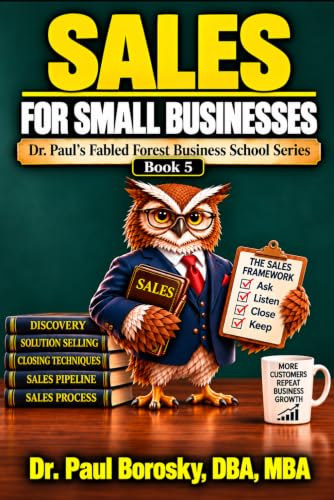
Book 5 of Dr. Paul's Fabled Forest Business School Series. The forest owners can run the work, read the numbers, and finally get found. Now a customer is standing in front of them asking how much, while a hawk opens a brand-new Sales Floor across the square. Each chapter follows one owner through one selling problem and teaches one real sales idea by its real name.
- 20 chapters in two parts: the conversation at the counter and the system behind it
- Dr. Paul's Nutshell after every chapter: what it is, why it matters, how to use it, and one question for you
- Doctor Owl's Wise Words and Mrs. Owl-Willow's Reminder: the lesson in one line, twice
- The Talon Way: seven high-pressure shortcuts that win the sale and lose the customer
- A full glossary with every sales term defined
- Line 5 of the Owner's Scorecard, to pick the first fix and measure it in 90 days
Terms like discovery, qualifying, consultative selling, and the sales pipeline are taught by their textbook names and tied to a story you can picture: forty blank cards, a waffle given away three times, a fox asleep in his own truck. That makes the book a plain-English companion for intro sales and small business courses, and a first-week guide for anyone starting a sales job. Teaching one and want to talk about using it? Call or text Dr. Paul at (321) 948-9588.
Book 5 of 10
Sales Is Line 5 of the Owner's Scorecard
Management, accounting, operations, and marketing built a business that runs, counts, holds up, and gets found. Sales is where the people who find you become customers who come back. Each title in Dr. Paul's Fabled Forest Business School Series has its own free guide.
Books 7 to 10 (Growth, Human Resources, Technology and AI, Survival) are coming next. See every current title on Dr. Paul's business books page.
FAQ
Sales Questions Owners Ask Dr. Paul
What is small business sales?
What are the four jobs of selling?
How do I get comfortable telling customers my price?
How many times should you follow up after sending a quote?
Who is Sales for Small Businesses written for?
Is selling the same as being pushy?
Learn to ask for the sale with the book. Call when you want help with your quotes and follow-up.
Dr. Paul Borosky, DBA, MBA
Business Consultant, Author & Educator | 14+ Years | 1,000+ Clients Served
Dr. Paul Borosky, DBA, MBA is a business consultant, author, and educator, and the founder of Quality Business Plan. He helps small business owners across the United States and Canada with business planning, financial modeling, fractional CFO and COO work, and the growth decisions that come after the business runs, including pricing, quoting, and the sales process that brings customers back. He is the author of numerous books on Amazon and has published over 1,000 business videos on YouTube. He has taught as an adjunct college instructor and teaches in Florida public schools.
This page is for general educational purposes only. It is not legal, financial, or other professional advice. Contract, deposit, and consumer protection rules vary by state and industry, so talk with a qualified professional before you put a sales agreement in writing. The Fabled Forest, its characters, and its businesses are fictional.