
Dr. Paul Borosky, DBA, MBA
Business Plan Writer & Financial Projections
Small Business Human Resources: 20 Foundations Every Owner Should Know
Making the first hire is easy. Keeping the right one is the hard part. Most owners hire whoever walks in, pay whatever they ask, and train by letting them watch. Then a good person leaves and it gets blamed on money. These 20 foundations cover the whole people side of a small business, from writing down what the job is to having someone ready for every key seat.
About to make your first hire, or your next one? Call or text (321) 948-9588. Dr. Paul answers personally.
Last Updated: 11/08/2026 · Written by Dr. Paul Borosky, DBA, MBA
HR Without the Department
What Does HR Look Like Without an HR Department?
Short Answer
Human resources covers hiring, paying, developing, and holding onto your team. In a big company it is a department. In a small business it is usually the owner. It comes down to four jobs: choose the right person, make them better at the work, pay them fairly and by the rules, and give them reasons to stay.
Small business HR = Choose + Develop + Pay + Keep
Doctor Owl, in Plain English
“You already have an HR department. It is you, at nine at night, with the payroll sheet. Let us make that easier.”
How This Guide Works
Need the answer fast? Read the Short Answer above and the four jobs below. Want the full picture? Each of the 20 foundations links to its own page, and each page follows one owner from Dr. Paul’s Fabled Forest Business School Series through one people problem. The stories show up in short gold notes. The math sits in one marked section on each page.
The four jobs, in order:
Hire
Know what the job is, decide what good looks like before you meet anyone, and check what candidates really did.
- Job analysis
- Behavioral interviewing
- Reference checks
Train
Write the rules down, review the work against clear standards, and give every key job a backup.
- Employee handbook
- Performance reviews
- Cross-training
Pay
Set ranges you could explain to the whole team, offer more than money, and follow the employer rules where you are.
- Pay ranges
- Total rewards
- Employee or contractor
Retain
Make what you praise match what you value, learn what could pull your best people away, and let go of decisions you hand off.
- Workplace culture
- Stay interviews
- Decision rights
Most owners are experts at the work and beginners at managing the people doing it. They hire whoever walks in, pay whatever that person asks, train by letting them watch, and blame the money when someone good leaves. The people side is the Organize step in Dr. Paul’s Organize-Plan-Grow™ Strategy, and it is the part lenders read in the management section of a business plan. The rules on pay, records, and letting someone go differ by place, so check yours.
How Do You Want Help With Your People Problems?
Work it through with Dr. Paul, build it yourself, or learn the basics first. Start wherever your team is today.
Business Consulting
FeaturedFor owners stuck on hiring, pay, or a team that keeps turning over. Dr. Paul helps you set the roles, the pay, and the rules.
See consulting options →Business Plan Writing
When a lender or investor needs it, Dr. Paul writes the plan, including the management and staffing sections lenders read closely.
Start your plan →Business Plan Templates
An industry Word plan and Excel model with the staffing and payroll lines already built in.
Browse templates →Small Business Education
Free guides, videos, and the Fabled Forest Business School books on hiring, training, pay, and keeping good people.
Start learning →The 20 Foundations
Which People Problem Is Costing You the Most?
Each foundation starts with the kind of people question owners bring to Dr. Paul. Start with the one that sounds like this week. The first ten build the team: defining the role, choosing well, verifying, paying, and following employer law. The second ten keep it together: culture, a way to speak up, honest reviews, tough conversations handled right, and a path forward. Every term is defined in the HR glossary.
Part One: Building the Team
Foundations 1 to 10 · The job, the choice, the pay, the rulesWhat Is Job Analysis? Define the Job Before You Hire
I keep hiring help. Why does nobody last past the first week?Chapter 1 · Helper Wanted, Must Be Helpful: A Squirrel’s Notice
Job analysis writes the job down before you advertise it. Track your own tasks, time each one, and set aside the work that truly needs you. Everything else becomes the role, ranked as required or bonus.
Read the full guide →What Is Workforce Planning? Find Help Before the Rush
The busy season always catches us short. How do I plan for it?Chapter 2 · One Camel, Six Caravans: A Camel’s Harvest
Workforce planning sets forecast labor hours beside the hours your team can actually give. Where they don’t match, you hire, cross-train, borrow, or reshape the schedule.
Read the full guide →How to Avoid Hiring Bias in a Small Business
Shouldn’t I just hire someone I already trust?Chapter 3 · The Cousin in the Second Chair: A Monkey’s Saturday
Hiring bias creeps in when something other than the work sways the choice, like shared background or a good gut feeling. A scorecard written before interviews keeps it fair.
Read the full guide →What Does Hiring for Fit Mean? Behaviors, Not Feelings
She looks perfect on paper. Why aren’t customers warming to her?Chapter 4 · The Best Record on the Coast: An Elephant’s Saturday Room
Fit is about behavior, not chemistry. Write down the three or four ways people at your business treat customers and each other, then hire for those.
Read the full guide →What Is a Behavioral Interview? Questions That Get Real Answers
I spend an hour on every interview. Why do I still pick wrong?Chapter 5 · Forty Minutes on Alloys: An Ant’s Interview
A behavioral interview asks for real examples from past jobs. Stories about what someone did predict more than answers about what they would do.
Read the full guide →How to Check References Before You Hire
The candidate has a glowing letter. Is that enough?Chapter 6 · The Finest Driver on the Coast Road: A Raccoon’s Letter
Checking references means verifying dates and duties, then asking former bosses questions that need more than a yes, like whether they would rehire this person.
Read the full guide →How to Set Pay Ranges for Small Business Employees
An employee asked for a raise. How do I know what is fair?Chapter 7 · The Talk About the Title: A Fox’s Payroll
Pay ranges sort roles into a handful of levels with a floor and ceiling for each, set by what the role is worth to you and the local market rate.
Read the full guide →What Are Total Rewards? How a Small Business Competes on Pay
A bigger company offered my best person more money. Can I compete?Chapter 8 · Six Coins More: A Bee’s Counteroffer
Total rewards counts the whole package: paid time off, training, room to advance, a meaningful title, a steady schedule, and input on how the work gets done.
Read the full guide →What Goes in an Employee Handbook?
I explain the rules every day. Why don’t they stick?Chapter 9 · Twenty-Three Notes: A Raccoon’s Rules
An employee handbook puts workplace policies on paper: schedules, paydays, leave, attendance, and behavior. It covers how you work together, not how to do each task.
Read the full guide →What New Employers Need to Know Before the First Hire
I’m about to hire my first employee. What rules apply to me now?Chapter 10 · The Mayor’s Own Guides: A Horse’s Paperwork
Compliance starts with classifying workers correctly. The way someone works, who sets their hours and tools, usually makes them an employee or contractor, no matter the label.
Read the full guide →Part Two: Keeping the Team
Foundations 11 to 20 · Reasons to stay and room to growWhat Is Workplace Culture? How Your Business Really Behaves
Why does one shift run smoothly and another fall apart?Chapter 11 · The Board in the Back Hall: An Elephant’s Saturdays
Culture is how your team actually behaves when you aren’t watching. It is shaped by what you reward, what you pay for, and what you let slide.
Read the full guide →What Is Employee Voice? Why a Quiet Team Is a Warning
My team never complains. Is that a good sign?Chapter 12 · Questions? No? Good.: A Beaver’s Morning Meeting
Employee voice gives staff a safe way to raise ideas and problems, and proof that someone acted on them. Silence usually means nobody thinks speaking up helps.
Read the full guide →How to Write a Performance Review People Can Use
How do I review someone without the talk going sideways?Chapter 13 · Thirty Years, No Word: A Mole’s Mill Crew
A performance review is a scheduled conversation comparing one person’s work to the role’s standards. Keep it to a single page and end with one clear goal.
Read the full guide →How to Manage an Underperforming Employee
How do I tell a good person they are falling short?Chapter 14 · Nine Burnt a Day: A Labrador’s Kind Silence
Managing underperformance means stating the gap plainly, setting targets and a deadline together, providing support, and making a decision when the deadline arrives.
Read the full guide →How to Fire an Employee Fairly
Can I let someone go today?Chapter 15 · Keys on the Counter: Two Crabs’ Night Guard
Ending employment fairly depends on the reason. Poor performance usually gets a documented plan first, misconduct follows a different path, and your remaining team notices how you handle both.
Read the full guide →What Goes in a Partnership Agreement?
My partner’s name is on the door. What else needs to be written down?Chapter 16 · And Assistant: An Ant’s Sign
A partnership agreement records ownership shares, contributions, decision authority, profit splits, and the exit plan if one partner wants out.
Read the full guide →Why Do Employees Quit? Turnover, Exit and Stay Interviews
I pay fairly. Why do people keep leaving?Chapter 17 · Five in July, One in September: A Bee and a Junebug
Turnover rate compares departures with average headcount. Every exit costs money, and exit interviews plus stay interviews tell you why it keeps happening.
Read the full guide →What Are Decision Rights? Putting Someone in Charge for Real
I put someone in charge. Why am I still making every call?Chapter 18 · Three Calls, Three Changes: A Horse’s Second Groups
Decision rights spell out, area by area, who makes the call, who gets consulted, and who simply gets informed. They only work when the owner leaves those calls alone.
Read the full guide →Training vs Development: Giving Every Employee a Next Step
Why does work stall when one person calls in sick?Chapter 19 · Nobody to Pin: An Octopus’s Next Jobs
Training builds skill in a current role. Development prepares someone for a bigger one. Cross-training makes sure no critical task depends on a single person.
Read the full guide →What Is Bench Strength? Who Steps In When You Can’t
Who runs things if I can’t?Chapter 20 · Nobody Behind the Baton: A Fox’s Relay
Bench strength means a ready backup for every critical role, the owner’s included. A one-page chart shows who could step in today and who needs more time.
Read the full guide →From Dr. Paul’s Fabled Forest
Meet the Fabled Forest: Whose Team Is This?
Some lessons stick better as a story. Dr. Paul’s Fabled Forest Business School Series teaches business through a forest full of small business owners: bakers, haulers, shopkeepers, and crews who run into the same problems real owners face. Doctor Owl, a dry-witted consultant who lives in the Lone Oak, asks them the question nobody else does. Each chapter page in this guide follows one of them.
Book 8 opens with Hazy Hazel, a squirrel painter whose studio has grown past what she can do alone. She has hired two helpers in a short stretch, and neither lasted the week. Her help-wanted card is lovely to look at and tells a candidate nothing about the work. Doctor Owl starts with a simple question: what is the job? See her story on What Is Job Analysis?
In the Fabled Forest
Hazel could not describe her own day, so nobody else could step into it. Most of this book starts in the same place: the people problem turns out to be a missing piece of clarity from the owner.
Quick Scorecard Check
Would Your Best Employee Stay Another Year?
Line 8 of the Owner’s Scorecard asks four questions, one for each job. A yes counts only if every part is true. Have not hired yet? Answer for your plan for the first hire.
- Hire
Before my latest hire, did I put the role on paper, set a scorecard before the first interview, ask for real examples of past work, and call a former boss?
- Train
Can every employee find our policies in one place, do they know how their work gets judged, and could someone cover each critical task tomorrow?
- Pay
Could I defend every wage on the team out loud, does my offer go beyond the paycheck, and am I meeting the employer requirements in my state?
- Retain
Do the things I reward match the values I talk about? Have I sat down with my best people to learn what might pull them away? Once I delegate a call, do I keep my hands off it?
Scored 3 to 5
Close the gap on your own
Pick your one “no,” find its foundation above, and work it this month with the chapter’s Nutshell steps. Write it down so the next person can follow it. Score again in 90 days.
Get the Book on Amazon →Scored 1 or 2
Build the people side with help.
When every hire is a gamble and every departure is a surprise, an outside view saves months. Dr. Paul works with owners on job lists, pay ranges, reviews, and the bench behind the owner, and writes the management section when a lender needs it. Call or text (321) 948-9588, or see business consulting and prices.
A Consultant’s View
What Does a Business Consultant See in Small Business Teams?
Most owners Dr. Paul works with are excellent at their trade and are learning the people side as they go. The pattern repeats across industries. The job is never written down, so the hire is a guess. Pay is set one request at a time, so it feels unfair. Nobody asks the good people what would make them leave until they already have. None of this needs an HR department. It needs a few written pages: a job list, pay ranges, a one-page review, and a bench chart. Owners who put those in place usually spend less time hiring and more time running the business.
The Book
Twenty Foundations, One Paperback
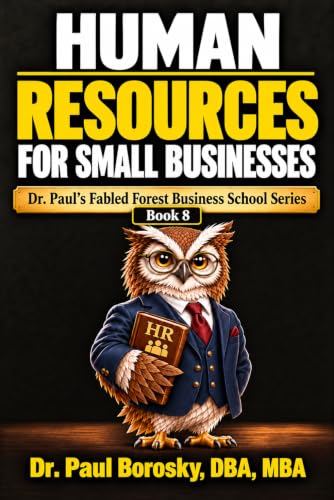
Book 8 of Dr. Paul’s Fabled Forest Business School Series. The forest grew. Now every owner has a team, and every team has a problem. A squirrel cannot keep a helper past Friday. A bee loses her best worker to a hawk with a bigger purse. A beaver’s crew never says a word. Across the dock, a hawk tries to outbid every rival for talent rather than grow it. Each chapter follows one owner through one people problem and teaches one real idea by its real name, as Doctor Owl asks who to hire, what to pay, and why the good ones stay.
- 20 chapters in two parts: Building the Team and Keeping the Team
- Every chapter tagged Hire, Train, Pay, or Retain
- Dr. Paul’s Nutshell after every chapter: what it is, why it matters, how to use it, and one question for you
- The Talon Way: seven ways to fill a seat fast, and who is still in it by the end
- A plain-language glossary of human resources terms
- Line 8 of the Owner’s Scorecard, to pick the first fix and measure it in 90 days
Job analysis, workforce planning, the halo effect, total rewards, and bench strength are taught by their textbook names and tied to a story you can picture: a helper card that says nothing, a counteroffer from a hawk, a crew that stopped talking. That makes the book a plain-English companion for human resource management, organizational behavior, and small business management courses. Teaching one and want to talk about using it? Call or text Dr. Paul at (321) 948-9588.
Book 8 of 10
Every Book Before This One Needed People
The first seven books build a business worth working for: it runs, counts, delivers, gets found, sells, knows where it is going, and grows without breaking. This one is about the people who make all of that happen. Start anywhere in Dr. Paul’s Fabled Forest Business School Series.
Books 9 and 10 (Technology and AI, Survival) are coming next. See every current title on Dr. Paul’s business books page.
FAQ
What Do Owners Ask About Managing a Team?
What is human resources in a small business?
What are the four jobs of human resources?
When should a small business write down its HR policies?
How can a small business compete with bigger companies for workers?
Who is Human Resources for Small Businesses written for?
Is this book legal advice?
Build the team with the book. Call when you want help putting it on paper.
Dr. Paul Borosky, DBA, MBA
Business Consultant, Author & Educator | 14+ Years | 1,000+ Clients Served
Dr. Paul Borosky, DBA, MBA is a business consultant, author, and educator, and the founder of Quality Business Plan. He helps small business owners across the United States and Canada with business planning, financial modeling, fractional CFO and COO work, and the strategic plans lenders and partners ask for. His planning system, Organize-Plan-Grow™, is the backbone of his consulting work. He is the author of numerous books on Amazon and has published over 1,000 business videos on YouTube. He has taught as an adjunct college instructor and teaches in Florida public schools.
This page is for general educational purposes only. It is not legal, employment, tax, or financial advice. Employment rules on pay, records, classification, and ending employment differ by place, so check the rules where you operate or talk with a qualified professional. The Fabled Forest, its characters, and its businesses are fictional.