
Dr. Paul Borosky, DBA, MBA
Business Consultant & Author
What Went Wrong at Uber Under Travis Kalanick? Power Without Safeguards
Uber built enormous power by treating rules as obstacles. Dr. Paul Borosky reads what happened at the level of the decision, and shows why the founder lost his job and the company survived: an outside check existed.
Last Updated: 10/28/2026 · Written by Dr. Paul Borosky, DBA, MBA
The Short Answer
What Went Wrong at Uber Under Travis Kalanick?
Uber chose to grow at nearly any cost and treated rules and regulators as obstacles. Once winning justified breaking rules, that logic became the culture and reached its own people. In 2017, under investor pressure, Kalanick resigned as CEO. The company survived because outside accountability existed.
This is the cautionary tale in Chapter 5 of Become Your Version of Rich by Dr. Paul Borosky, DBA, MBA. It follows what power in business is and the method in how to build influence without authority. For the lesson in the same chapter about holding power well, see Franklin vs. Napoleon. All of it sits inside the Become Your Version of Rich guide.
What Happened
From Bulldozing Rules to a Forced Resignation
Dr. Paul begins with a warning: the lesson lives at the level of the decision, not the person.
- Early yearsUnder co-founder and CEO Travis Kalanick, Uber chooses to grow at nearly any cost and to treat rules, regulators, and norms as obstacles. It launches in cities without permission and dares officials to shut down a service the public already likes.
- About 2014 to 2017The company uses a tool known as Greyball. According to a New York Times report summarized by TechCrunch, it flagged users the company believed were violating its terms of service, including code enforcement and city officials, and denied them rides.
- 2017Public accounts of a toxic workplace and other scandals and governance failures follow.
- June 20, 2017After five major investors step up pressure, Kalanick resigns as CEO.
Sources: TechCrunch, Uber uses a software tool to identify and sidestep code enforcement officials (March 2017). Quartz, Travis Kalanick has resigned as CEO of Uber (June 2017). Isaac, M. (2019), Super Pumped: The Battle for Uber, W. W. Norton.
Uber has said the program denied rides to users who violated its terms of service and protected drivers from people seeking to harm them, competitors, and opponents working with officials on sting operations. Read both accounts, then judge the decision, not the people.
The Mechanism
Once Winning Justifies Breaking the Rules, It Becomes the Culture
The strategy resembled what the Silicon Valley playbook called blitzscaling: grow so fast you dominate a market before anyone can stop you. In pure power terms it was breathtakingly effective. But a decision made for regulators does not stay with regulators. If winning excuses bending a rule outside, it excuses bending one inside. The same approach shaped how the company treated its own people.
That is the sense of the book’s warning that power cut loose from values and from any check creates the conditions for its own destruction. The power built by ignoring limits was torn apart by the absence of them.
Sources: Hoffman, R., & Yeh, C. (2018), Blitzscaling, Currency.
The Difference
Why the Founder Lost His Job and the Company Survived
Napoleon had dismantled every check, so only reality stopped him. Uber was different. A board and investors existed who could act, and they did. Kalanick was not destroyed. He stayed wealthy and went on to other ventures. But he lost the top job and much of his control. The company survived. The unchecked version of his power did not.
Set that beside Warren Buffett, who kept his influence for decades by tying it to a settled purpose and real restraint. The pattern is not that two men were good and two were bad. It is each person’s relationship with reputation, ambition, accountability, and restraint.
What the Research Says
The Power Paradox Is a Tendency, Not a Law
Psychologist Dacher Keltner calls it the power paradox: people often gain power through qualities that serve others, such as empathy and generosity, and the experience of power can then erode those very qualities. Earlier work by Keltner and colleagues proposed that power tends to increase action and reduce inhibition, which helps explain why powerful people can act on impulse. It is a tendency, not an iron law.
What decides the outcome is what most powerful people skip. Values set the course. Accountability keeps you from fooling yourself, because power is good at convincing you that what you want is also right.
Sources: Keltner, D. (2016), The Power Paradox: How We Gain and Lose Influence, Penguin Press. Keltner, D., Gruenfeld, D. H., & Anderson, C. (2003), Power, approach, and inhibition, Psychological Review, 110(2), 265-284.
The Fix
Four Brakes to Build Before Your Power Grows
Dr. Paul calls these safeguards. Build them while you are small, and they keep working as you grow.
Brake one
Transparency
Make decisions and numbers visible to people who can question them.
Brake two
People who can say no
Give at least two people the standing to challenge you safely.
Brake three
Real consequences
Misconduct has a price, including when the person is a top performer.
Brake four
Your own review
Judge results on the objective and on what your methods did to trust.
Here is how Become Your Version of Rich puts it.
From Chapter 5 of Become Your Version of Rich
Power built on abandoned values and no accountability sits on a fault line, and the bigger it grows, the harder it eventually falls. Build it the other way: keep it tied to your values and open to challenge the whole way up, so that when it grows large, it holds.
How This Helps a Business Owner
Spot Your Smaller Version Before It Grows
Few owners will run a company like Uber. Many will meet the same decision at a smaller size.
When You Are in a Hurry
Notice the corner you cut
You cut the corner a competitor cut, or treat an employee or customer as an obstacle because time is short. It feels efficient. Write down the rule you bent and who bore the cost.
When Standards Slip
Write them down and enforce them
Unwritten standards are the first thing a fast-growing company loses. Put them in SOPs and hold everyone to them, including top performers.
When Nobody Says No
Make it safe to disagree
If every meeting ends in agreement, your information is filtered. Learn how to give honest feedback, and ask for it in return.
One Honest Caution
Describing Events Is Not Judging People
This page summarizes publicly reported events as general education. It is not a verdict on any person, and it is not legal advice. Companies and executives often dispute reports, and facts can change as new information appears. If you face a real governance, compliance, or regulatory question, ask a qualified attorney or adviser.
Do This Tomorrow
Three Steps for This Week
- Write down one rule or standard you have bent or ignored in the last month, and who bore the cost.
- Name two people who may challenge you, and tell each of them they are safe to do it.
- Put one safeguard in writing, such as a second signature on large spending or a quarterly review of your own decisions.
Safeguards cost a little speed today and save a lot of damage later. Once your power is held by values and checks, you can decide what it is for. That is the subject of the next chapter, starting with how to calculate your financial independence number.
The Book
The Full Story Is in Chapter 5
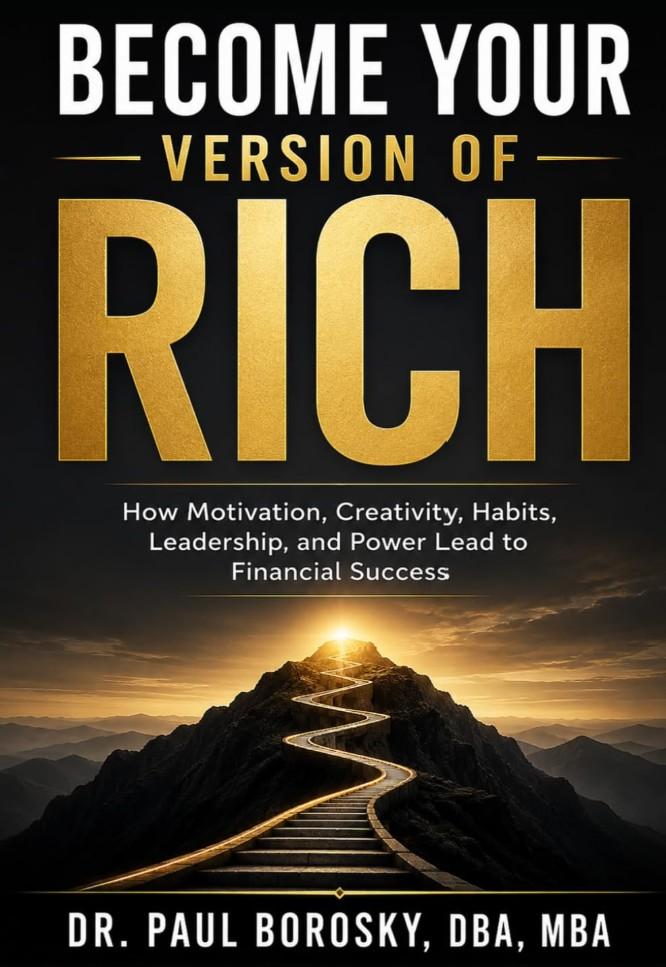
This page covers one cautionary tale. Become Your Version of Rich places it beside three people who held great power in very different ways.
- The seven-step power method, from ethical boundaries to safeguards
- Warren Buffett and Benjamin Franklin, two people who held great power and kept it
- Napoleon at Notre-Dame and in Russia
- A day spa owner who built earned power before she opened
- Daily Actions and a 30-day check on whether your influence holds without your title
Go Further With Dr. Paul
Build Safeguards Into Your Growth Plan
Dr. Paul’s business growth plan consulting helps owners set decision rights, review rhythms, and checks that keep growth honest. It works best before the pressure arrives. Built on 1,000+ client engagements.
Keep Going
More From Chapter 5
FAQ
Common Questions About Uber and Travis Kalanick
What went wrong at Uber under Travis Kalanick?
Why did Travis Kalanick resign from Uber?
What is the power paradox?
Dr. Paul Borosky, DBA, MBA
Business Consultant, Author & Educator | 14+ Years | 1,000+ Clients Served
Dr. Paul Borosky, DBA, MBA is a business consultant, author, and educator, and the founder of Quality Business Plan. He helps small business owners across the United States and Canada with business planning, financial modeling, fractional CFO services, and the everyday problems of businesses that depend too much on their owners. He is the creator of Dr. Paul’s Organize-Plan-Grow™ Strategy, author of numerous published books on Amazon, and publisher of over 1,000 business-focused videos on YouTube. He has taught as an adjunct college instructor and teaches in Florida public schools.
This page is for general educational purposes only. It is not investment, tax, legal, financial, or retirement advice, and it does not guarantee any particular financial result. The examples, figures, and calculations are illustrative planning tools, not recommendations. Before making significant financial decisions, consult a qualified professional.