
Dr. Paul Borosky, DBA, MBA
Business Consultant & Author
Small Business Strategy: 20 Foundations Every Owner Should Know
Every week is full. The year is flat. If you cannot say where your business will be in five years, busy is filling the space where a direction should be. These 20 foundations cover deciding where the business is going and getting everyone pointed there, from your vision and mission to a one-page plan with names and dates.
Busy, but not sure where it is going? Call or text (321) 948-9588. Dr. Paul answers personally.
Last Updated: 11/02/2026 · Written by Dr. Paul Borosky, DBA, MBA
Strategy Without the Jargon
What Is Small Business Strategy?
Strategy is deciding where your business is going, then lining up the work so it gets there. It is not a forty-page binder, and it is not a slogan on the wall. For a small business it comes down to four jobs: picture where you are going, line every level up behind it, look honestly at what is changing, and turn the plan into names and dates.
Envision
Picture where the business will be in five years, and say in one sentence what it does, for whom, and why.
- Strategic thinking
- Vision statement
- Mission statement
Align
Step objectives down from five years to this month, so every rung points at the one above it.
- Gap analysis
- Long and short-term objectives
- Strategic alignment
Assess
Look honestly inside the business and outside it, and change a rung when the look says so.
- SWOT analysis
- Environmental scanning
- Competitive analysis
Execute
Give every strategy an objective and every step a name, a date, and a cost. Then review it.
- Functional strategy
- Action plan
- Strategy review
Strategy is not only for big companies with planning departments. A small business can do it on one page: a five-year picture, a few objectives at each level, an honest look around, and this month's steps with names on them. It is the Plan in Dr. Paul's Organize-Plan-Grow™ Strategy, and when a lender or partner needs the full version, it becomes a written business plan.
A full calendar tells you that you are moving. It does not tell you where.
Doctor Owl, Strategy for Small BusinessesThe 20 Foundations
Find the Rung Your Business Is Missing
Each foundation opens with a question a real owner asks. Start with the one that sounds like you. The first ten are about where you are going: the picture, the objectives that step down from it, and getting everyone pointed the same way. The second ten are about how you get there: the honest look, the strategies, the plan with names and dates, and the page that holds it all. Need a term? The strategy glossary defines every one in plain English.
Part One: Where You Are Going
Foundations 1 to 10What Is Strategic Thinking? Working On vs. In Your Business
“Every tour is full, every week. Why does it feel like we’re going nowhere?”Chapter 1 · Every Tour Full, Going Nowhere: A Horse’s Year on the Floor
Strategic thinking is stepping back from the daily work to ask where the business is going and why. It means working on the business, not just in it, because a full schedule is not the same as direction.
Read the full guide →How to Write a Vision Statement for a Small Business
“I have a hundred ideas and I love all of them. How do I know which way to go?”Chapter 2 · A Hundred Sketches, No Destination: A Squirrel’s Someday Box
A vision statement is one or two sentences about where your business will be in five years: where, who, what, and how much. You use it as a filter for every new idea.
Read the full guide →How to Write a Mission Statement, With Examples
“Everything I make sells. Why can’t I say what my business is?”Chapter 3 · Nine Products, No Sentence: A Bee’s One Line
A mission statement is one plain sentence about what your business does, for whom, and why, today. The vision is where you are going. The mission is what you check before you say yes.
Read the full guide →What Is a Gap Analysis? Where You Are vs. Where You Want to Be
“I have five resorts planned, every one of them. Why am I no closer to any of them?”Chapter 4 · Five Resorts, Five Distances: An Elephant’s Measuring Tape
Gap analysis is measuring the distance between where your business is now and where your vision says it will be, in four plain things: money, people, customers, and time.
Read the full guide →How to Set Long-Term Business Objectives
“I pick a new goal every month, and I mean every one. Why don’t I ever get anywhere?”Chapter 5 · Twelve Goals, No Ladder: A Monkey’s Five Years
Long-term objectives are the few measurable results your business must reach in three and five years to make the vision real. About three per rung is a practical limit.
Read the full guide →How to Set Short-Term Business Goals That Get Done
“We’ve got forty things to lock down this year. Why can’t we finish one?”Chapter 6 · Forty Locks on One List: Two Crabs and a Year
Short-term objectives are the few results you mean to reach in the next year and the next six months. Each one climbs a long-term rung, and fewer is stronger.
Read the full guide →What Is Operational Planning? Turning Goals Into Monthly Targets
“I know where the shop should be in five years. Why does every day still go to whatever walks in the door?”Chapter 7 · A Lathe on the Wall, a List on the Counter: An Ant’s Month and Day
Operational planning turns six-month objectives into this month's targets and today's short list. The team owns the bottom rungs. The owner owns the top.
Read the full guide →What Is Strategic Focus? How to Say No to Good Ideas
“Everybody wants a tour. How do I say no when I’m the mayor?”Chapter 8 · Fourteen Tours, One Horse: A Mayor’s Five Lines
Strategic focus is choosing a few things to do well and saying no on purpose to the rest, with your five-year picture as the filter for every request.
Read the full guide →What Is Strategic Alignment? Getting Everyone Pointed the Same Way
“The plan’s in my head. Isn’t that where it’s supposed to be?”Chapter 9 · A Plan in His Head, a Truck on the Wrong Road: A Fox’s Kitchen Wall
Strategic alignment means every level of the business points at the same vision, and each person can say back, in their own words, what their rung is this month.
Read the full guide →What Is Strategic Drift? Signs Your Business Is Falling Behind
“Best gym in the jungle. Where’d everybody go?”Chapter 10 · Full for Ten Years, Empty by Four: A Gorilla’s Hours
Strategic drift is the slow gap between what your business does and what the market now needs. It happens while you keep doing exactly what used to work.
Read the full guide →Part Two: How You Get There
Foundations 11 to 20How to Do a SWOT Analysis for a Small Business
“Everything’s going great. Why would I go looking for what’s wrong?”Chapter 11 · Eleven Strengths, No Weaknesses: A Fox’s Four Boxes
A SWOT analysis is a four-box look at your business: strengths and weaknesses inside, opportunities and threats outside. It is only as useful as the honesty you put into it.
Read the full guide →What Is Environmental Scanning? Watching What Changes Outside
“I build it right, every time. Why did three jobs go to somebody else this season?”Chapter 12 · Stone on the Board, Timber in the Bid: A Beaver’s Friday Look
Environmental scanning is a regular look at what is changing outside your business, from rules and prices to customers and competitors, before it reaches your door.
Read the full guide →What Is the Industry Life Cycle? The Four Stages Explained
“I stock what the caravans need. I always have. Why is there less every year?”Chapter 13 · Forty Caravans, Then Fourteen: A Camel’s Notched Post
The industry life cycle is the pattern most markets follow: introduction, growth, maturity, and decline. Knowing your stage tells you whether good service alone can still win.
Read the full guide →How to Do a Competitive Analysis for a Small Business
“Nobody else in the forest makes waffles. Who would I even be competing with?”Chapter 14 · A Jaguar in the Window, a Waffle on the Griddle: A Labrador’s Morning Coin
Competitive analysis is comparing your business honestly to everyone who wants the same customer's money, on the things that customer actually compares, even if they sell something different.
Read the full guide →What Is Functional Strategy? Operations, Sales, and Finance
“I know where I’m going. What do I actually change in the honey house, at the stall, and in the ledger?”Chapter 15 · A Ladder on the Wall, Three Jobs on the Bench: A Bee’s Monday
Functional strategy is a plan for each main part of the business, usually operations, sales, and finance. Each one names the objective it is there to reach.
Read the full guide →What Is Opportunity Cost? Examples for Small Business
“Somebody offers me steady work. Isn’t it crazy to say no?”Chapter 16 · A Good Offer, a Bad Trade: A Raccoon’s Truck-Days
Opportunity cost is what you give up when you choose one thing over another, measured by the next best use of the hours, trucks, or money. Saying no is a strategy.
Read the full guide →How to Write an Action Plan With Owners and Dates
“I decide things. Good things. Why don’t they ever get done?”Chapter 17 · A Label Under the Sugar Jar, Six Lines on the Wall: A Labrador’s Hatch
An action plan turns a strategy into steps for this month. Every step gets one person's name, a specific date, a cost, and a check date when you look at every line.
Read the full guide →What Is Pilot Testing? Test Small Before You Bet Big
“I already know it’ll work. Why would I test it?”Chapter 18 · Six Rooms, Four Weekends: An Elephant’s Trial Run
Pilot testing is trying an idea small before you commit to the full version. Write down the question the test must answer, and what success looks like, before any results come in.
Read the full guide →How to Review Your Business Strategy
“I made a plan in the spring. It’s still on my wall. What else am I supposed to do?”Chapter 19 · Pinned in Spring, Read in Winter: An Octopus’s Second Look
A strategy review is a scheduled look at your plan that compares what happened to what you intended, then decides for each part whether to keep it, change it, or drop it.
Read the full guide →How to Write a One-Page Strategic Plan
“My plan is ten years old and forty pages long. Do I have to write all of it again?”Chapter 20 · Forty Pages, One Page: A Beaver’s Plan for the Bank
A strategic plan brings your vision, mission, objectives, outside look, strategies, and near-term actions into one document. The most useful version fits on one page anyone can read.
Read the full guide →Sample Chapter
Read a Chapter: The Horse With Fourteen Full Tours
Commander Colt has fourteen tours, every one of them full, and a fifteenth on the way. His goose has the ledger. If your calendar is full and your year feels flat, this one is for you. Here is how Chapter 1 begins.
Chapter 1 · Strategic Thinking
Every Tour Full, Going Nowhere: A Horse’s Year on the Floor
“Every tour is full, every week. Why does it feel like we’re going nowhere?”
The printer had pegged next year’s calendars on a line across the shop, and Doctor Owl wanted the plainest one there was.
Forty calendars swayed on the line, each open to the first month of the coming year: paintings of the ridge, a different bird for every month, which he examined with professional suspicion, a recipe on every page, a proverb on every day.
“I want twelve months,” said Doctor Owl, “and a square for each day, and nothing else.”
“Nothing else?” said the printer. She was a grey rabbit with ink to her elbows.
“No ridge. No birds. No wisdom. Especially no wisdom. I have to supply my own.”
She went into the back to look. While she looked, he walked the length of the line, and at the end of it, by the press, he found a stack of calendars already wrapped in brown paper and tied with string. Each had a slip tucked under the string, and each slip said FOREST TRAILS and the name of a tour.
Ridge Sunrise. Ferry Dawn. Mill Bridge. Dry Wash Ride. Creek Walk. Skating. He counted. There were fourteen.
“The mayor’s,” said the printer, coming back with a plain grey calendar in her paws. “One for every tour. He likes each guide to have their own.” She set the grey one on the counter. “He asked me to leave room for more.”
“Room,” said Doctor Owl.
“Blank ones. He said he might need another two by spring.” She tied off his string. “He always needs another two by spring.”
The bell over the door went before he could answer, and Colt had come in at a canter. He had snow on his mane and a booking slip in his teeth, and he took the slip out and beamed at the room.
“Doc! Good, you’re here, I’ll only be a minute.” He turned to the printer. “Fifteen. I need a fifteenth. Library history walks, Thursdays, starting in the new year. The librarian asked me on the steps this morning.” He pawed the floor, once, the way he did when he was pleased with himself. “Just a bit more horsepower.”
“You said that about the skating,” said the printer.
“And the skating’s full!”
Doctor Owl picked up his plain grey calendar and tucked it under his wing. He looked at the stack of fourteen, and at the fifteenth slip in the printer’s paw, and at the horse, who had already turned to go and was explaining to the doorframe that he would send Greta for them on Friday.
“Colt,” said Doctor Owl. “Have you a quarter of an hour?”
“For you, Doc? Always.” Colt checked the clock over the press. “Well. Ten minutes. I’ve got the creek walk at noon.”
The Forest Trails office was over the stable at the end of the square, and it smelled of hay and wet wool and the stove. Greta had the booking board on the wall, the one she had built when the tours were overbooked and nobody knew who was where. Every line on it was full, every day of the week, fourteen tours across and seven days down, chalked in her firm square hand.
“Every tour, every week,” said Colt, and his whole chest went up with it. “Full.”
Greta, at the desk, said nothing. She was a large grey goose with a pencil tucked into her wing feathers and a ledger at her elbow, and she had stopped saying things to Colt about the board some time in the autumn.
“And how is the year?” said Doctor Owl.
“Best year we’ve had,” said Colt.
Greta made a small noise in her throat.
“Greta,” said Doctor Owl. “May I see the year?”
She opened the ledger without a word and turned it round on the desk, and put one wing tip on the bottom of two columns.
Last year. Nine tours. Coins in: 4,800. Coins out: 4,200. Kept: 600.
This year. Fourteen tours. Coins in: 6,000. Coins out: 5,400. Kept: 600.
Colt looked at it over the owl’s shoulder.
“That’s the same,” he said.
“It is the same,” said Greta.
Five more tours, twelve hundred more coins in, and the same six hundred kept. Where did a whole year of work go? The rest of Chapter 1 is in the book.
Keep Reading on Amazon →Quick Scorecard Check
Could You Say Where Your Business Is Going?
Line 6 of the Owner's Scorecard asks four questions, one for each job. A yes counts only if every part of the question is true today.
- Envision
Can I describe where my business will be in five years (where, who, what, and how much), and say in one plain sentence what it does, for whom, and why?
- Align
Do I have objectives at every rung, from five years down to this month, each one pointing at the one above it, and could each person on my team tell me their rung for this month in their own words?
- Assess
In the last three months, have I looked honestly at my weaknesses, my customers, my competitors, and what's changing outside my business, and changed a rung when the look said I should?
- Execute
Does each of my operations, sales, and finance strategies name the objective it serves, does every step of this month's plan have one name, one date, and one cost, and do I review the plan on a date I set and actually keep?
Scored 3 to 5
Build the missing foundation yourself
Pick your one "no," find its foundation in the 20 above, and build that rung this month with the chapter's Nutshell steps. Start near the top of the ladder if you can. Score again in 90 days.
Get the Book on Amazon →Scored 1 or 2
Get help building the plan.
When the business is busy and nobody can say where it is going, an outside view saves months. Dr. Paul helps owners build the picture, the objectives, and the one-page plan, and writes the full business plan when a lender or partner needs it. Call or text (321) 948-9588, or see business plan writing and prices.
The Book
Strategy for Small Businesses
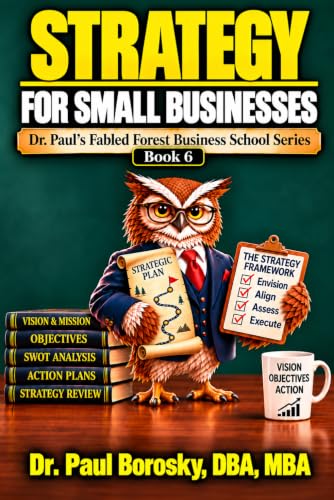
Book 6 of Dr. Paul's Fabled Forest Business School Series. The forest owners have fixed what was broken. The tours are full and the trucks are out, and nobody can say where any of it is going, while a hawk unveils a sixty-page plan across the square. Each chapter follows one owner through one strategy problem and teaches one real idea by its real name, as Doctor Owl builds a ladder from five years down to today.
- 20 chapters in two parts: where you are going and how you get there
- Dr. Paul's Nutshell after every chapter: what it is, why it matters, how to use it, and one question for you
- Doctor Owl's Wise Words and Mrs. Owl-Willow's Reminder: the lesson in one line, twice
- The Talon Way: seven big-plan shortcuts that start at the top of a ladder with nothing underneath
- A full glossary with every strategy term defined
- Line 6 of the Owner's Scorecard, to pick the first fix and measure it in 90 days
Terms like gap analysis, SWOT, environmental scanning, and the industry life cycle are taught by their textbook names and tied to a story you can picture: fourteen full tours that kept the same six hundred coins, a gym that was full for ten years, a forty-page plan nobody had read. That makes the book a plain-English companion for strategic management, capstone, and small business courses. Teaching one and want to talk about using it? Call or text Dr. Paul at (321) 948-9588.
Book 6 of 10
Strategy Ties the First Five Books Together
The earlier books fix the parts. Strategy points them in one direction, so the management, the numbers, the operations, the marketing, and the sales all climb the same ladder. Start anywhere in Dr. Paul's Fabled Forest Business School Series.
Books 7 to 10 (Growth, Human Resources, Technology and AI, Survival) are coming next. See every current title on Dr. Paul's business books page.
FAQ
What Owners Ask About Strategy
What is small business strategy?
What are the four jobs of strategy?
What is the difference between a vision statement and a mission statement?
Does a small business need a strategic plan?
Who is Strategy for Small Businesses written for?
How often should a small business review its strategy?
Build the ladder with the book. Call when you want help turning it into a plan.
Dr. Paul Borosky, DBA, MBA
Business Consultant, Author & Educator | 14+ Years | 1,000+ Clients Served
Dr. Paul Borosky, DBA, MBA is a business consultant, author, and educator, and the founder of Quality Business Plan. He helps small business owners across the United States and Canada with business planning, financial modeling, fractional CFO and COO work, and the strategic plans lenders and partners ask for. His planning system, Organize-Plan-Grow™, is the backbone of his consulting work. He is the author of numerous books on Amazon and has published over 1,000 business videos on YouTube. He has taught as an adjunct college instructor and teaches in Florida public schools.
This page is for general educational purposes only. It is not legal, financial, tax, or lending advice. Every business and market is different, so talk with a qualified professional before making major decisions about your own business. The Fabled Forest, its characters, and its businesses are fictional.