
Dr. Paul Borosky, DBA, MBA
College Professor · Business Plan Writer · 1,000+ Businesses Served
How to Write a Business Plan Section by Section, in the Order That Actually Works
Most people start a business plan with the executive summary. Then they stall. Dr. Paul has worked with 1,000+ businesses, and he writes every plan in ten steps, in a set order, with the summary last. Follow the same steps below. Each one links to a guide, a video, and a short note on where AI helps and where it burns you.
Last Updated: 11/09/2026 · Written by Dr. Paul Borosky, DBA, MBA
Watch First
Watch: How to Write a Business Plan
The Short Answer
How Do You Write a Business Plan?
Write it in ten steps, in this order: (1) describe the company, (2) define the target market, (3) study the market, (4) introduce the management team, (5) draw the org chart, (6) build the marketing plan, (7) run the financials, (8) write the funding request, (9) only then, write the executive summary, and (10) finish with the appendix.
Why that order? The executive summary is a short version of everything else. You cannot summarize a plan you have not written. Owners who start with it rewrite it five times. Owners who save it for last write it once.
"A plan is the business written down. Write what you know first. Summarize it last." Doctor Owl, Dr. Paul's Fabled Forest Business School
Each step below says what to include, gives one tip from Dr. Paul's client work, and shows where AI helps. The steps follow the Plan stage of Dr. Paul's Organize-Plan-Grow™ method.
Beatrix the Bee ran her whole honey business from memory. Every recipe, every order, every number lived in her head. Doctor Owl's first assignment: write it down, one section at a time, summary last.
Want Help With Your Plan?
Step 1
How Do You Write the Company Description?
The company description explains what the company will do, how it will do it, and where. It is the only section devoted to the inner workings of the business, so it carries a lot of weight.
What to include:
- Company summary: who, what, where, when, and how, in one or two paragraphs
- Competitive advantages
- Products or services
- Business model
- Future plans, objectives, and a timeline
- Mission and vision statements
- Keys to success
Keep the company summary to a paragraph or two. A plan documents the business. Too much detail locks you into choices the market will change anyway.
Write a rough summary yourself first, even a few bullet points. Then give AI that draft with your business type and city, and ask it to tighten it into two paragraphs that answer who, what, where, when, and how. Cut it back and make sure every word is true. AI drafts. You decide what stays.
Read the company description guide →
Watch: How to Write a Business Plan, Step by Step: Company Description (50:37)
Step 2
How Do You Define Your Target Market?
The target market is the specific group of people who need or want what you sell. Not everyone. The people who will buy.
What to include:
- Primary target market: age, income, job, location, habits
- Secondary target market
- Why these buyers need your product now
Dr. Paul sets a scene with every client. A person walks toward you, and you know they will buy. What do they look like? Describe that person in detail. That is your primary market.
Once you can picture your buyer, AI can turn that sketch into a full profile and estimate market size and growth. Ask it to show its math. Then confirm every number against a real source like the U.S. Census, because AI will invent figures.
Read the target market guide →
Watch: Primary and Secondary Target Markets in a Business Plan (1:56)
Step 3
How Do You Write a Market Analysis?
The market analysis covers everything outside the business: the industry, the competition, and the economy around it.
What to include:
- Industry overview: the main industry and the sub-industry you compete in
- Industry statistics: total sales, growth rate, trends
- Competitor review
- SWOT analysis: strengths, weaknesses, opportunities, threats
Narrow the industry. A food truck is part of the restaurant industry, but lenders want food truck numbers. Find the sub-industry with real data and build from there.
This is where AI saves the most time and does the most damage. Ask it for industry size, growth, and sourced statistics, plus a SWOT draft. Never paste a statistic without opening the source and checking it yourself.
Read the SWOT analysis guide →
Read the market analysis guide →
Watch: How to Write the Industry Analysis Section of a Business Plan (7:36)
Step 4
How Do You Write the Management Section?
This section shows who runs the business and who does what.
What to include:
- Management summary: a short bio for the founder and each leader
- Job responsibilities for each position
Step 5
How Do You Build the Org Chart?
The org chart shows who reports to whom, in one picture. Draw a box for every role, even the ones you fill yourself today, and connect each box to its boss.
Keep each bio to a paragraph. Investors worry about a business that lives and dies with one person, so show a team. And use the chart. Most readers skip the job descriptions, but they stop and study a chart.
Paste your resume or LinkedIn text and ask AI for a tight, investor ready bio. Let it draft job duties, then trim each role to the four or five that matter. For the chart, hand AI your roles and ask for the reporting lines, then check that every role reports somewhere.
Read the management section guide →
Watch: How to Write the Organizational Structure of a Business Plan (5:44)
Step 6
How Do You Write the Marketing Section?
The marketing section explains how the business will reach its target market and turn them into customers.
What to include:
- Marketing objectives and keys to success
- Traditional marketing
- Internet marketing: website, search, email
- Social media marketing
Show it visually. Dr. Paul uses a simple chart: each objective, then the specific actions that hit it. A reader gets the whole plan in ten seconds.
Tell AI your industry, customer, and budget. Ask for a channel mix, sample posts, ad copy, and a simple Google Business Profile plan. Test every suggestion against what you have seen work. Never let it pick your channels on autopilot.
Read the marketing section guide →
Watch: How to Write the Marketing Section of a Business Plan (7:13)
Step 7
How Do You Write the Financial Section?
The financials are the hardest part for most owners, and the part lenders read first.
What to include:
- Financial assumptions
- Financial summary
- Startup or expansion costs
- Loan payment calculation
- Profit and loss for twelve months
- Income statement and balance sheet
- Financial ratios
Your projections will be wrong. Every plan's are. In 14+ years of writing plans, Dr. Paul has never seen a forecast land exactly. Lenders want assumptions that make sense and math that ties together, so build every sheet off one information tab.
Ask AI to explain and build the formulas: loan payment, growth roll forwards, ratios in plain English. The line is non negotiable: AI helps with structure, you own the numbers. Check every calculation.
See financial projections for a business plan →
Watch the pro forma tutorials →
Watch: What Should Be in a Financial Projection Section of a Business Plan? (9:47)
Step 8
How Do You Write a Funding Request?
The funding request tells the lender or investor exactly what you need and how they get paid back.
What to include:
- Potential funding sources: banks, investors, grants, crowdfunding
- Funding terms: amount, term, rate
- Use of funds
- Repayment plan
Answer all four parts every time. A request without a repayment plan reads like a wish, not a deal.
Have AI compare your options, such as an SBA loan, a bank loan, investors, grants, and crowdfunding, and draft your use of funds table from costs you already calculated. Rates and programs change, so confirm any current numbers.
Read the funding request guide →
Watch: How to Write a Business Plan Funding Request (6:55)
Step 9
How Do You Write an Executive Summary?
The executive summary comes first in the plan and last in the writing. It is a short version of the whole plan.
What to include:
- Company and product
- What makes the business different
- Financial outlook
- Funding needed and what it is for
Dr. Paul copies the company summary and product description under the executive summary heading, then deletes lines until only the essentials are left. Fast, consistent, and it always matches the plan.
The best job in the plan to hand to AI. Paste in the finished plan and ask for a one page summary. Then read it aloud and edit it into your own voice. It is the first page a lender reads.
Read the executive summary guide →
Watch: How to Write an Executive Summary (16:18)
Step 10
What Goes in the Appendix?
The appendix holds the charts, documents, and proof that support the plan.
What to include:
- Owner resume
- Supporting charts and graphs
- Quotes, leases, licenses, and letters of intent
Almost every plan Dr. Paul writes includes the owner's resume. Skip the photo and the fancy fonts. The reader wants experience and education tied to this business.
Use AI to format your resume, draft citations for your statistics, and build a checklist of supporting documents. Then confirm every document the plan mentions is actually attached.
By Industry
How Do You Write a Business Plan for Your Industry?
The ten steps stay the same. The numbers change. A daycare plan runs on licensed seats and staff ratios. A restaurant plan runs on covers and food cost. A trucking plan runs on cost per mile. Pick your industry for a guide built around the numbers lenders in that field check.
Most read:
- How to Write a Restaurant Business Plan
- How to Write a Trucking Company Business Plan
- How to Write a Daycare Business Plan
- How to Write a Coffee Shop Business Plan
- How to Write a Hair Salon and Barbershop Business Plan
- How to Write a Construction Company Business Plan
- How to Write a Cleaning Company Business Plan
- How to Write a Moving Company Business Plan
Show all 39 industry guides
Food and Drink
Retail
Personal and Pet Services
Construction and Trades
Automotive and Transportation
Lodging, Care, and Licensed Services
Property and Real Estate
AI and Your Plan
Can You Use AI to Write a Business Plan?
Yes, as a helper. Never as the final word. AI turns a week of research into an afternoon and writes a solid first draft of almost any section. It also invents statistics that look completely real. Here is the method from the Fifth Edition:
- 1
Read the step
Know what the section has to prove before you write a word.
- 2
Draft that section
Write it yourself, even rough. Your facts, your numbers.
- 3
Use AI as a helper
Drafts, formulas, and research leads. Never the final word.
- 4
Verify everything
Every number, source, and claim, checked by you.
- 5
Model it on a sample
When all ten sections are drafted, compare against a sample plan and template.
A confident wrong number is the fastest way to lose a lender. AI drafts. You decide what stays.
Real World Use
How Did a Columbus Moving Company Use These Steps?
A $248,000 plan for investors and a lender at once
A Columbus moving company was busy at home. New residents kept the trucks booked. The owners wanted to cover more of Ohio.
Dr. Paul planned each new city as its own market, with trucks, crews and a launch budget. That is Steps 2, 3 and 7 doing the heavy lifting. The funding request, Step 8, spoke to two readers. Investors saw the growth. The lender saw a steady home market paying the bills while new cities ramped up.
Read the full story on the Columbus business plan writer page.
Questions
Business Plan Questions Owners Ask
How long should a business plan be?
What is the most important part of a business plan?
Can I use a template to write my business plan?
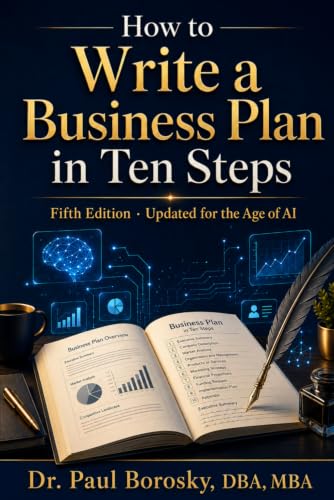
Ten steps. One book. Every sample included.
How to Write a Business Plan in Ten Steps, Fifth Edition walks you through each section in the same order as this page, with a full sample plan, a fill in template, and a Using AI box in every step.
Written by Dr. Paul Borosky, DBA, MBA, current college professor, business consultant, and author with 14+ years and 1,000+ businesses served.
This page is for general educational purposes only. It is not financial, investment, legal, or tax advice.