
Dr. Paul Borosky, DBA, MBA
Business Consultant & Fractional CFO
Small Business Survival: 20 Foundations Every Owner Should Know
Small businesses rarely close because the owner was foolish. Most close because something hit that nobody planned for, and the decision fell on one tired person at the kitchen table. A rival opens at half your price. The biggest customer leaves. The roof gives out. Which of those would sink you this year? Write the answer down while the month is quiet, because that written answer is what keeps the doors open.
Facing a hard month right now? Call or text (321) 948-9588. Dr. Paul answers personally.
Last Updated: 11/15/2026 · Written by Dr. Paul Borosky, DBA, MBA
Built to Last
What Does It Take for a Small Business to Survive?
Short Answer
For a small business, survival means staying open through events you never picked: a slow season, a giant competitor, a lost account, storm damage, a legal fight, a partner heading for the exit. Even a well-run business can take a hit. Survival is about the choices you make before it lands, while it lands, and afterward.
Small business survival = Protect + Endure + Unite + Last
Doctor Owl, in Plain English
“Fourteen of you got the same letter, and every one of you planned to answer it alone. That is the first thing we fix.”
How This Guide Works
Need the answer today? Start with the Short Answer above and the four jobs below. Ready to dig in? Each of the 20 foundations has its own page, and each page follows one owner from Dr. Paul’s Fabled Forest Business School Series through one hard winter. Chapters that touch contracts, debt, or selling a business stay basic and say when to get help.
The four jobs, in order:
Protect
Shore things up before trouble shows. Know what the business is worth, write a bad-year plan, and give someone else signing power.
- Business valuation
- Continuity planning
- Key person risk
Endure
Ride out the thin months intact. Keep prices above cost, watch cash by the week, and trim what customers never notice.
- Price wars
- Cash crisis management
- Retrenchment
Unite
Lean on others instead of deciding alone. Use your partner agreement, pool purchases, and form alliances with neighbors.
- Partnership disputes
- Cooperative buying
- Strategic alliances
Last
Make choices for the business you want a decade from now. Invest when rivals can’t, and plan how you’ll eventually step away.
- Succession planning
- Exit strategy
- The long game
Most owners write a bad-year plan only after the bad year starts. In good times it feels like tempting fate, and in bad times there’s no room to think, so choices get made in a rush. Survival is the Plan step in Dr. Paul’s Organize-Plan-Grow™ Strategy, put on paper early, and it is the risk section lenders look for in a SWOT analysis for a business plan. Contracts, debt, and business sales come with legal and tax rules that vary by place, so check yours.
Where Do You Want Backup Before the Hard Month?
Talk it through with Dr. Paul, put a plan in front of the bank, or learn the moves first. Start with the threat closest to your door.
Business Consulting
FeaturedFor owners facing a price war, a lost account, a cash squeeze, or an offer to sell. Dr. Paul helps you see the numbers and pick the next move.
See consulting options →Business Plan Writing
When the bank wants a turnaround plan, a refinancing case, or a buyer wants a clean story, Dr. Paul writes the plan and the projections.
Start your plan →Business Plan Templates
An industry Word plan and Excel model to run your own bad-year and best-year numbers before you need them.
Browse templates →Small Business Education
Free guides, videos, and the Fabled Forest Business School books on cash, risk, partners, and planning ahead.
Start learning →The 20 Foundations
Which Threat Is Closest to Your Door?
Each foundation opens with the sort of hard question owners bring to Dr. Paul. Begin with the one that’s already costing you sleep. Foundations 1 to 10 cover outside threats and how a business absorbs them. Foundations 11 to 20 cover staying upright after the blow. Every term is defined in the small business survival glossary.
Part One: The Threats
Foundations 1 to 10 · What hits a business, and how it takes the hitHow Much Is My Business Worth? A Plain-English Valuation
Someone offered to buy my business. How do I know if it’s a good price?Chapter 1
Value comes from three angles: what the business owns, the yearly profit it leaves the owner, and what buyers pay for that profit. For most small firms, profit matters most.
Read the full guide →How to Survive a Price War Against a Bigger Competitor
A rival just opened across the street at half my price. Do I go lower?Chapter 2
Work out your price floor, the true cost of each sale at normal volume, and don’t go under it. Compete on what a bigger rival can’t copy: speed, trust, and a personal touch.
Read the full guide →What to Do When You Lose Your Biggest Customer
If my biggest customer left tomorrow, where would I even start?Chapter 3
Size the real gap first: sales that left, less only the costs that left with them. Then fill the open capacity with several smaller buyers, not one new giant.
Read the full guide →How to Prepare a Small Business for a Recession
Sales are slipping. What should I do before it gets worse?Chapter 4
Recession planning picks an early warning number, the levels where you will act, and the exact action at each level. You write it while things are calm.
Read the full guide →How to Cut Costs in a Small Business Without Losing Customers
Money is tight. What should I cut first?Chapter 5
Cut first what neither serves customers nor protects the business. Protect what customers buy you for, and keep bookkeeping, maintenance, and insurance. Order beats size.
Read the full guide →What Is Business Continuity Planning? Staying Open After a Disaster
What happens to the business if the building goes?Chapter 6
A continuity plan answers four questions: which work can’t stop, where else it could be done, who must be told, and where your backup copies are kept.
Read the full guide →How to Handle a Contract Dispute as a Small Business
I got a notice saying I’m in default. What do I do now?Chapter 7
Reread the actual terms, write down facts and dates, answer in writing with exactly what you owe, and try to settle by talking, with a neutral third person if needed.
Read the full guide →Who Can Sign for My Business If I’m Suddenly Out?
If I couldn’t come in tomorrow, what would happen to the business?Chapter 8
This is about permission, not just skill. Who else can sign checks, approve payments, log in, talk to the bank, and find the recipes, prices, and passwords?
Read the full guide →What to Do When Your Business Runs Out of Cash
The money won’t cover what’s due Friday. Who gets paid first?Chapter 9
List every payment in and out, week by week. Pay what keeps the doors open first, usually people and supplies. Chase what you’re owed, and call lenders before you miss.
Read the full guide →How to Resolve a Partnership Dispute Without Losing the Business
My partner and I want different things. Who decides?Chapter 10
Reread the partnership agreement together, work from a written list of issues, bring in a neutral party you both trust, and use the buyout terms if one partner truly wants out.
Read the full guide →Part Two: Standing
Foundations 11 to 20 · What keeps a business up for the next ten yearsShould You Invest in Your Business During a Recession?
I’ve saved for years. Is a downturn the time to spend it?Chapter 11
Buy in a downturn only if three tests hold: your reserve still covers several months, the purchase pays off at half the expected sales, and it sits close to your core business.
Read the full guide →What Is Cooperative Buying? How Small Businesses Buy Like Big Ones
The big chain buys by the wagon and I buy by the box. How do I compete?Chapter 12
Several small businesses combine orders for big-buyer prices. Each stays independent and pays its own share. They buy together, and never agree on what they charge.
Read the full guide →When Should a Small Business Pivot?
Ticket sales are a tenth of last year. Do I cancel the event?Chapter 13
A pivot changes how the business makes money while keeping what it does well. Look at your real strength, apart from the product, and at what customers will pay for now.
Read the full guide →How to Add a Second Income Stream to Protect Your Business
My one product carries everything. Should I sell something else?Chapter 14
A second leg should sit close to what you do well, reach a different customer or season, start small, and have a cap so it doesn’t drain the main business.
Read the full guide →How to Manage Business Debt When Sales Slow Down
Work slowed down. How do I keep up with the loan?Chapter 15
Never miss a payment, keep several months of fixed costs in reserve, prepay only from cash above that reserve, and call your lender early when anything changes.
Read the full guide →What Is a Strategic Alliance for a Small Business?
Every owner in town got the same offer. Why are we answering alone?Chapter 16
A strategic alliance is a written deal among independent businesses to refer, bundle, buy, or decide together, while each sets its own prices and keeps its own books.
Read the full guide →How to Create a Succession Plan for a Small Business
Who takes over when I put the tools down?Chapter 17
A succession plan names who will run or own the business next, when, how they’ll learn the gaps, and how they’ll pay if buying. It unfolds over years, in stages.
Read the full guide →What Is an Exit Strategy? Your Four Ways Out
Someone wants to buy my place and I don’t want to sell. Should I?Chapter 18
Every owner eventually leaves by one of four doors: an outside sale, a handoff to staff, a handoff to family, or closing. Choose one, set a timeline, and build toward it.
Read the full guide →What Is a Retrenchment Strategy? When to Close a Location
Two of my four locations lose money. Do I close them?Chapter 19
Retrenchment shrinks the business on purpose to protect it. Judge each location or product on its own, cut the losers, treat affected staff well, and put money where it earns.
Read the full guide →What Is Long-Term Thinking in Business? Playing the Long Game
The money is there to open three more at once. Why open only one?Chapter 20
Long-term thinking means deciding for the business you want ten years out: grow at a carryable pace, know each addition’s break-even, hold a reserve, and keep control.
Read the full guide →From Dr. Paul’s Fabled Forest
Meet the Fabled Forest: Who Got the Letter?
A hard winter is easier to plan for when you have watched someone else live through one. Dr. Paul’s Fabled Forest Business School Series teaches business through a forest full of small business owners who run into the same problems real owners face. Doctor Owl, a careful old consultant who lives in the Lone Oak, asks them the question nobody else does. Every chapter page in this guide picks up one owner and one letter.
Book 10 opens in the hardest winter the forest can remember. Fourteen owners get the same sealed letter on the same morning, an offer to buy them out, and each plans to answer it alone. Beatrix the Bee asks first, with her envelope still sealed in her lap: how would you even know if a price was fair? She has never worked out what her honey house is worth. See her story on How Much Is My Business Worth?
In the Fabled Forest
Beatrix didn’t need a buyer to have a problem. She needed her own number before anyone else named one. Most of this book starts the same way: the threat is outside, and the weak spot is a decision nobody made while things were calm.
The Final Scorecard Line
Could Your Business Take a Hard Hit This Year?
Line 10 closes out the Owner’s Scorecard with a question per job. Count a yes only when the entire question is true. Haven’t opened yet? Score your written plan. Finished the whole series? Score all ten lines and total them.
- Protect
Could I name a rough value for my business, do I have a written fallback if my building or main system went down for weeks, and could another person sign checks and open the doors if I couldn’t be reached?
- Endure
Is there a written plan with stepped actions for a slow season, and do I hold enough cash to cover a few months of the bills that keep coming when sales stop?
- Unite
If I have a partner, is there a written way to settle disputes and handle a departure? And is there a local business I could team up with, refer to, or buy alongside?
- Last
Have I chosen how I’d eventually leave, by sale, handover, or closing, and do I know what that path requires, such as a successor, a business a buyer would want, or an orderly wind-down?
Scored 3 to 5
Shore it up on your own
Choose the line you scored lowest, go to its foundation above, and put the Nutshell steps to work over the next few weeks. Write the plan while the month is quiet. Score again in 90 days.
Get the Book on Amazon →Scored 1 or 2
Build the bad-year plan with help.
When a hit is already landing, a second set of eyes on the numbers saves the decisions made in a panic. Dr. Paul works with owners on cash plans, price floors, valuation, partner agreements, and succession, and writes the plan when a bank needs one. Call or text (321) 948-9588, or see business consulting and prices.
A Consultant’s View
What Does a Business Consultant See When Hard Times Hit?
The calls Dr. Paul gets in a bad month sound alike. A competitor dropped prices, or a big account left, or the bank called, and the owner has already made two moves in a panic. Usually one of them was cutting the thing customers came for. The businesses that come through tend to share three habits. They know their numbers before anyone asks. They keep a few months of fixed costs in reserve. And they don’t decide alone: they call a lender early, talk to a partner, or line up with a neighbor business. None of it is complicated. It just has to be written down before the hard month, not during it.
The Book
The Final Book: Twenty Ways to Stay Standing
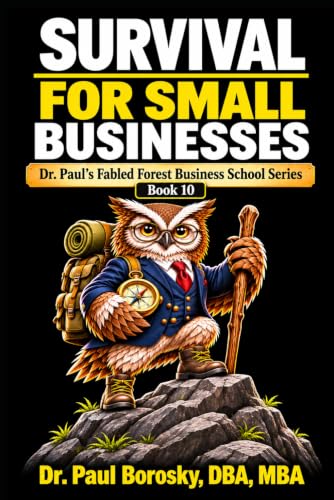
Book 10 and the finale of Dr. Paul’s Fabled Forest Business School Series. The hardest winter anyone can remember arrives, and so do the letters: every owner is offered a buyout on the same morning. A bee doesn’t know her number. A fox is in a price war he can’t win by fighting. An elephant’s roof is gone. A horse is mayor of a forest that has stopped spending. Meanwhile, a hawk is betting they’ll each decide alone. Each chapter follows one owner through one hard decision and teaches one real idea by its real name, as Doctor Owl asks why they are answering alone.
- 20 chapters in two parts: The Threats and Standing
- Every chapter tagged Protect, Endure, Unite, or Last
- Dr. Paul’s Nutshell after every chapter: what it is, why it matters, how to use it, and one question for you
- The Talon Way: seven shortcuts a big competitor uses to pick off small owners one at a time
- A plain-language glossary of survival and finance terms
- The Owner’s Scorecard, now complete: all ten lines, to score the whole business
Business valuation, business continuity planning, key person risk, retrenchment, and succession planning are taught by their textbook names and tied to a story you can picture: a sealed buyout letter, a roof gone in the rain, a fox who can’t sign from a hospital bed. That makes the book a plain-English companion for small business management, entrepreneurship, risk management, and strategy courses. If you teach one of those courses, Dr. Paul is glad to talk about it: (321) 948-9588.
Book 10 of 10
What Do All Ten Books Add Up To?
A business has to be built before it can be defended. Books 1 through 9 lay the groundwork: systems, numbers, customers, people, plans, and the right tools. This final book is what all that groundwork is for, and each chapter draws on something an earlier book put in place. Together they make up the full Dr. Paul’s Fabled Forest Business School Series.
Read all ten? Go back to the Owner’s Scorecard, find your lowest line, and start there. Every current title is on Dr. Paul’s business books page.
FAQ
What Do Owners Ask About Surviving a Hard Year?
Why do most small businesses fail?
What are the four jobs of small business survival?
How much cash reserve should a small business keep?
What should I do first if a bigger competitor moves in?
Who is Survival for Small Businesses written for?
Is this book legal or financial advice?
Write the bad-year plan with the book. Call when the hit is already coming.
Dr. Paul Borosky, DBA, MBA
Business Consultant, Author & Educator | 14+ Years | 1,000+ Clients Served
Dr. Paul Borosky, DBA, MBA is a business consultant, author, and educator, and the founder of Quality Business Plan. He helps small business owners across the United States and Canada with business planning, financial modeling, fractional CFO and COO work, and the strategic plans lenders and partners ask for. He is the author of numerous books on Amazon and has published over 1,000 business videos on YouTube. He has taught as an adjunct college instructor and teaches in Florida public schools.
This page is for general educational purposes only. It is not legal, tax, accounting, or financial advice. Contracts, debt, partnerships, valuations, and the sale or transfer of a business carry rules that differ by place, so check the rules where you operate or talk with a qualified professional. The Fabled Forest, its characters, and its businesses are fictional.