
Dr. Paul Borosky, DBA, MBA
Business Consultant & Fractional CFO
Small Business Finance for Beginners: What Your CFO Would Tell You
Most businesses don’t run out of customers. They run out of cash.
Big companies pay a CFO six figures to watch the gap between profit and cash. You get a bank balance and a tax bill. This guide covers what a CFO would walk you through: what it costs to start, where the money comes from, how to read your statements, what to charge, what to pay yourself, and how to see a cash crunch 13 weeks before it hits.
Cash tight and the numbers make no sense? Call or text (321) 948-9588. Dr. Paul answers personally.
Last Updated: 10/27/2026 · Written by Dr. Paul Borosky, DBA, MBA
The Short Answer
What Is Small Business Finance?
Small business finance is how the money in your business actually works: what it costs to start, how you pay for it, what you earn, where the cash goes, and how much is safe to spend, borrow, and take home. Accounting keeps the score. Finance uses the score to decide what to do next.
Most owners run the business off one number, the bank balance. High feels good. Low feels sick. That is how a great year ends with no cash and a tax bill on money you never saw. The fix is not a finance degree. It is five habits, in order. If accounting terms are new to you, start with the 20 accounting and finance foundations.
Start
Know what it costs to open and to stay open, and where the money comes from.
- Startup budget
- Break-even
Keep Score
Set up the books and read three reports every month.
- Income statement
- Balance sheet
- Cash flow
Make Money
Price from the margin you need and know which customers pay off.
- Markup vs. margin
- Customer profit
Manage Cash
Close the gap between profit and cash before it closes you.
- Working capital
- Cash reserve
Grow
Pay yourself right, plan taxes, and look 13 weeks ahead.
- Owner pay
- 13-week forecast
One Business, Start to Finish
Meet Mike and Dale
The book teaches through one fictional business, built from patterns Dr. Paul has seen across more than 1,000 clients. Every number adds up to the dollar.
The Owner Who Asks First
Mike, Ridgeline Landscaping
Nine years running a crew for someone else. $30,000 saved. Before he quits, he meets Dr. Paul at a coffee shop with his numbers on a napkin. Over five years and 21 chapters, Ridgeline grows to three crews and $1.2 million in sales, one money question at a time.
Owner Warning
Dale, Across Town
Same spring, same trade. Dale buys a new $58,000 truck on a seven-year loan, prices his mowing to beat the guy down the street, and opens with nothing set aside. Dale shows up in every chapter as the owner who learns each lesson the hard way, so you do not have to.
| Stage | Revenue | Profit | Cash at year-end | Owed on the line |
|---|---|---|---|---|
| Opening day | n/a | n/a | $16,500 | n/a |
| Year 1 | $145,000 | $66,500 | $6,000 | n/a |
| Year 2 | $360,000 | $83,000 | $8,000 | n/a |
| Year 3 | $680,000 | $73,000 | $31,500 | $15,000 |
| Year 4 | $1,050,000 | $72,000 | $26,500 | $20,000 |
| Year 5 | $1,200,000 | $85,000 | $22,000 | $60,000 |
Ridgeline Landscaping, opening day to Year 5. Fictional business from the book.
The Guides
The 21 Chapters, Mapped
Seven parts, in the book’s order. Each card opens a free guide on that topic. Guide pages follow Ridgeline. Owner Basics pages teach the foundation in plain English. Apple Example pages show the same idea on a real public company.
Part 1: Before You Open
Chapters 1 to 4What It Really Costs to Start
Three buckets, and why you budget to stay open, not just to open.
Where the Money Comes From
Your money vs. other people’s, and what a loan really costs.
Will This Business Work?
Break-even with and without your own pay, before opening day.
Setting Up Your Books
Separate the money, connect the bank, and run a monthly close.
Part 2: How to Read Your Financial Statements
Chapters 5 to 8How to Read an Income Statement
What the business earned, and the two lines that confuse every new owner.
How to Read a Balance Sheet
What you own, what you owe, and what equipment is really worth.
How to Read a Cash Flow Statement
Where the cash actually went, in three sections.
How the Three Fit Together
Profit, the balance sheet, and cash, tied into one picture.
Part 3: Where Your Cash Goes
Chapters 9 and 10Profit vs. Cash
Why a profitable year can end with an empty bank account.
What You Actually Keep From Each Sale
What each job leaves after its own costs.
Part 4: Pricing and Profit
Chapters 11 and 12Markup vs. Margin
Two numbers that sound the same and price very differently.
Which Customers Make You Money
Score every customer on profit, time, and how fast they pay.
Part 5: Borrowing and Credit
Chapters 13 and 14Borrowing to Grow
When debt builds the business and when it buries it.
Receivables, Payables, and Inventory
Working capital, and what each day of waiting costs you.
Part 6: Spending and Saving
Chapters 15 to 18How Much Cash to Keep
Measure your reserve in months, not dollars.
Paying Yourself
A real wage first, then distributions by formula.
Buy, Lease, or Finance
Four ways to pay for equipment, compared over its life.
Building a Budget You’ll Use
A budget you check against actual every month.
Part 7: Staying Solvent
Chapters 19 to 21 and the CloseWhat Growth Really Costs
The growth cash gap, and four go or no-go rules.
Paying Taxes Without the April Panic
Set money aside as you earn it, not when the bill comes.
The 13-Week Cash Forecast
The forecast that warns you before the cash runs out.
AI as Your Junior CFO
What an AI assistant can do with your numbers, and when to get help.
Read Before You Buy
Read the Opening: The Kitchen Table
Every owner has had this conversation, or will. Here is how the book begins.
Introduction
Why Good Businesses Run Out of Money
“What happens if the money runs out?”
It’s 11:15 on a Tuesday night in early December. Mike Ridgeline and his wife, Jen, are at their kitchen table with a legal pad between them.
Mike has run a crew for somebody else’s landscaping company for nine years. He knows how to bid a job, fix a mower in a parking lot, and keep three guys moving in August heat. He’s good at it. And for about two years he’s been thinking the same thought every time he hands over a job his boss bills at three times what Mike gets paid: I could do this myself.
The legal pad says what he has. $30,000 in savings, built up over six years. A listing for a used truck: $32,000. A list of fourteen names, neighbors and side-job customers who said they’d follow him if he went out on his own.
“I can do this,” Mike says.
“I know you can do the work,” Jen says. “That’s not what I’m asking.”
“Then what are you asking?”
“What happens if the money runs out?”
Mike opens his mouth, then closes it. He has an answer for everything about the work. He doesn’t have one with numbers in it.
That night, Mike emails a stranger. The reply sets up a 7 a.m. meeting and five years of answers. The rest is in the book.
Keep Reading on Amazon →The Five-Question Self-Check
Do You Know Your Numbers, or Just Your Balance?
Straight from the front of the book. Answer yes or no. Nobody is grading this but you.
- Question 1
Do you know how much money you need to open, and to stay open until customers start paying you?
- Question 2
Do you know the difference between your profit and the cash in your bank account, and why they’re almost never the same?
- Question 3
Do you know how much you need to sell each month just to cover your bills?
- Question 4
Do you know how much you’ll pay yourself, and how much to set aside for taxes?
- Question 5
Do you know how much cash you’ll have in the bank 13 weeks from now?
Scored 2 or More
Close the gap yourself
Find the chapter behind each “no,” work its Show the Math and Your Move this month, and take the check again in 90 days.
Get the Book on Amazon →Scored 0 or 1, or Short on Time
Get a CFO’s eyes without a CFO’s salary.
Dr. Paul works with owners as a part-time financial lead: a monthly read of the three reports, a 13-week cash forecast, and the pricing, borrowing, and hiring decisions in between. Call or text (321) 948-9588, or see fractional CFO services.
Go Deeper
One Problem Keeping You Up at Night?
Two chapters have their own 90-minute crash course. One topic has a full Apple walkthrough.
Starting or Borrowing?
Need a Plan or a Lender Package?
A lender reads your startup budget, your break-even, and your projected statements before it reads anything else. Those are the same numbers this guide teaches. When you need them built for a bank, an SBA loan, or an investor, Dr. Paul writes business plans with full financial projections: income statement, balance sheet, cash flow, and break-even, tied to your real costs.
The Book
Beginner’s Guide to Small Business Finance
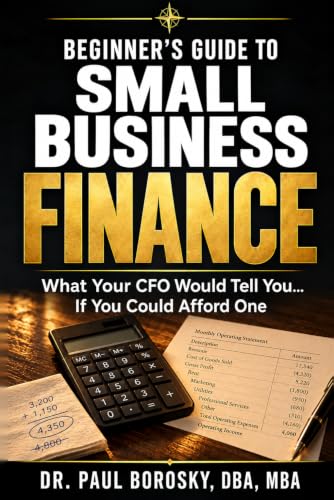
What Your CFO Would Tell You If You Could Afford One. Big companies get a chief financial officer. Small businesses get a bookkeeper and a CPA, and neither job is to sit with you and explain what the numbers mean for next Friday’s payroll. This book does that job. Seven parts take you from the kitchen table to a growing company, and every chapter ends with something to do this week.
- Show the Math: every calculation on Ridgeline’s numbers, step by step
- In Plain English: each new term translated the first time it shows up
- Owner Warning: what Dale’s mistake costs, in dollars
- Real-World Case: real events from real businesses, researched and cited
- Ask the AI: a prompt to run the chapter on your own numbers
- Dr. Paul’s Bottom Line and Your Move: the one line a CFO would tell you, and this week’s to-do
- Appendices: finance terms, the 10 financial ratios, and Ridgeline’s full statements
Starting a business: read Chapters 1 through 9 in order. Already running one: start at Chapter 5, read through 9, then jump to the chapter that matches the problem keeping you up at night. Every chapter stands on its own.
Beyond the Book
From Reading Statements to Building a Business
Same skills, real stakes. Pick the level of help that fits where you are.
Business Plan Templates
Fill in the blanks. Plan, projections, and statements set up for your type of business.
See the Templates →Business Plan Writing
Bank-ready plans with real projections, written by Dr. Paul.
See Plan Writing →Business Consulting
Turn your financial statements into a growth plan with Dr. Paul.
See Consulting Options →FAQ
Common Questions About Small Business Finance
Why do profitable businesses run out of cash?
How much cash should a small business keep?
How much should I pay myself as a small business owner?
What is the difference between markup and margin?
What does a fractional CFO do?
Who is the Beginner’s Guide to Small Business Finance for?
Learn what a CFO would tell you. Call when you want one in your corner.
Dr. Paul Borosky, DBA, MBA
Business Consultant, Fractional CFO & Author | 14+ Years
Dr. Paul Borosky, DBA, MBA is a business consultant, fractional CFO, author, and educator, and the founder of Quality Business Plan. He has worked with more than 1,000 small-business owners across all 50 states and Canada, from first-time founders writing a plan to owners running $5 million companies. He has written financial projections behind more than $100M in funded projects, is the author of numerous books on Amazon, and has published over 1,000 business videos on YouTube. He has taught finance as an adjunct college instructor.
This page is for general educational purposes only. It is not legal, financial, tax, accounting, or lending advice. Tax rules, payroll rates, and lending terms change and vary by state. Ridgeline Landscaping, Mike, and Dale are fictional, and their figures are illustrations from the book, not projections for your business. Before a major decision, talk with a qualified CPA, attorney, or financial professional.