
Dr. Paul Borosky, DBA, MBA
College Professor · Business Consultant
Finance Formulas Explained Step by Step, With Excel
Twelve core finance formulas, each with a video lesson, a worked example, and the exact Excel formula to check your answer. Pick the question you are trying to answer and Dr. Paul walks you through it.
Last Updated: 10/30/2026 · Written by Dr. Paul Borosky, DBA, MBA
The Short Answer
What Are Finance Formulas Used For?
Finance formulas answer money questions that involve time and risk. What is money today worth later? What is a future payment worth now? Is this investment worth the cost? What should this stock or bond sell for? Every lesson below answers one of those questions with a formula, a worked example, and Excel.
Students get stuck in the same place: not the math, but knowing which formula fits the problem. Dr. Paul has taught these formulas in college classrooms and used them with 1,000+ business clients. The groups below are sorted by the question you are trying to answer.
Want the Numbers to Make Sense?
Group One
What Is the Time Value of Money?
Money today is worth more than the same money later, because today's money can earn interest. These two formulas are the foundation for everything else on this page.
Group Two
How Do You Decide if an Investment Is Worth It?
Capital budgeting answers the big question: should you spend the money? Start with what your money costs, then test the project against it.
Group Three
How Do You Measure Investment Returns?
These lessons measure what an investment earned, what it should earn, and how a mix of stocks behaves together.
Group Four
How Do You Value Stocks and Bonds?
Valuation turns future cash, dividends or coupons, into a price today. These lessons cover common stock, preferred stock, dividends, and interest rates.
Put It to Work
How Do Real Companies Use These Numbers?
Formulas click faster when you see them on real annual reports. Dr. Paul walks through public company financials, ratio by ratio, the way an analyst grades them.
Quick Finder
Which Finance Formula Do I Need?
| If your question is... | Use this lesson |
|---|---|
| What will my savings grow to? | Future Value Formula |
| What is a payment I get later worth today? | Present Value Formula |
| Should the business buy this equipment? | NPV, IRR and Payback Period |
| What return should a project have to beat? | WACC Formula |
| What return can I expect given different outcomes? | Expected Rate of Return |
| How much did I actually make on a stock I sold? | Holding Period Return |
| How much of my portfolio is in each stock? | Portfolio Weights and Returns |
| How risky is my portfolio compared to the market? | Portfolio Beta |
| What is a stock with growing dividends worth? | Constant Growth Stock Valuation |
| What is a fixed dividend share worth? | Preferred Stock Price |
| How much cash does a stock pay me per dollar of price? | Dividend Yield |
| Do long bonds pay more than short bonds right now? | Yield Curve |
Look for the clue words. "Grow to" or "worth in the future" means future value. "Worth today" means present value. "Should we invest" means NPV. "Dividend never changes" means preferred stock. "Dividend grows" means constant growth. Find the clue, and the formula picks itself.
Real World Use
How a Student Uses This Page
Sorting three exam problems in under a minute
A practice exam has three problems. One: "$8,000 is invested at 7% for 6 years. What is it worth?" Two: "A preferred share pays $2.40 a year and investors require 6%. What is its price?" Three: "What is $25,000 received in 4 years worth today at 8%?"
Use the clue words. Problem one says "worth" after time passes, so it is future value: $8,000 × 1.076 = $12,005.84. Problem two is a fixed dividend, so it is preferred stock: $2.40 ÷ 0.06 = $40.00. Problem three asks for today's value, so it is present value: $25,000 ÷ 1.084 = $18,375.75.
Picking the formula took seconds once the question was clear. Each answer checks in Excel with =FV(7%,6,0,-8000), =2.4/6%, and =PV(8%,4,0,-25000).
Keep Going
Start With the Most Watched Lessons
How to Use the Future Value Formula
Dr. Paul solves the future value formula step by step with a worked example. (3:52)
Gain or Loss and Portfolio Weights in Excel
Dr. Paul calculates gain, loss, and the weight of each stock in a portfolio. (13:41)
Expected Rate of Return
Dr. Paul explains expected return with simple, clear examples. (3:03)
Questions
Finance Formula Questions Students Ask
What are the most important finance formulas to know?
How do I know which finance formula to use?
Can I solve finance formulas in Excel?
=FV(), =PV(), =NPV(), =IRR(), and =RATE(). Every lesson here shows the exact Excel formula and the result so you can check your work.Do I need a financial calculator for finance class?
Are these finance formulas useful for small business owners?
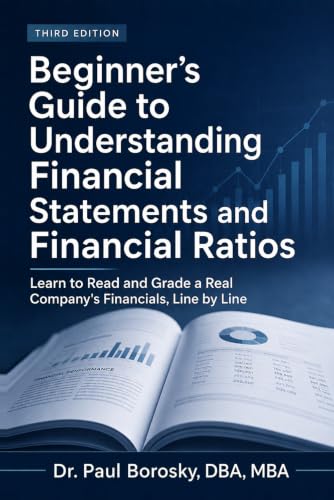
Formulas stick when you see them on real financial statements.
Dr. Paul's Beginner's Guide to Understanding Financial Statements and Financial Ratios walks through statements and ratios using Apple's actual 10-K, in plain English, so the numbers behind these formulas finally make sense.
Written by Dr. Paul Borosky, DBA, MBA, current college professor, business consultant, and author with 14+ years and 1,000+ businesses served.
This page is for general educational purposes only. It is not financial, investment, legal, or tax advice.