
Dr. Paul Borosky, DBA, MBA
College Professor · Business Consultant
How to Calculate the Beta of a Portfolio By Hand and in Excel
Portfolio beta is the weighted average of the betas of the stocks you own. It tells you how much your portfolio tends to move when the market moves. Watch Dr. Paul build it in Excel, then follow the same example below.
Last Updated: 10/30/2026 · Written by Dr. Paul Borosky, DBA, MBA
Watch First
Watch: How to Calculate the Beta of a Portfolio in Excel
The Short Answer
What Is Portfolio Beta and How Do You Calculate It?
Beta measures how much a stock moves compared with the overall market. A beta of 1.0 moves with the market. Above 1.0 swings harder. Below 1.0 swings less. Portfolio beta is each stock's beta multiplied by its weight in the portfolio, then added together.
βp = (w1 × β1) + (w2 × β2) + … + (wn × βn)
- βp
- Beta of the whole portfolio
- w
- Weight of each stock: its value divided by total portfolio value
- β
- Beta of each individual stock
How Much Risk Are You Carrying?
Step by Step
How Do You Calculate Portfolio Beta by Hand?
You own four stocks worth $50,000 in total. Here are the values and betas.
| Stock | Value | Beta |
|---|---|---|
| A | $20,000 | 1.20 |
| B | $15,000 | 0.80 |
| C | $10,000 | 1.50 |
| D | $5,000 | 0.60 |
- 1
Add up the portfolio
$20,000 + $15,000 + $10,000 + $5,000 = $50,000.
- 2
Find each weight
A: $20,000 ÷ $50,000 = 0.40. B: 0.30. C: 0.20. D: 0.10. They add to 1.00.
- 3
Multiply each weight by its beta
A: 0.40 × 1.20 = 0.48. B: 0.30 × 0.80 = 0.24. C: 0.20 × 1.50 = 0.30. D: 0.10 × 0.60 = 0.06.
- 4
Add the results
0.48 + 0.24 + 0.30 + 0.06 = 1.08. That is your portfolio beta.
- 5
Read what it means
A beta of 1.08 means the portfolio tends to move about 8% more than the market. If the market rises 10%, expect roughly 10.8%. If it falls 10%, expect roughly −10.8%.
Stock C has the highest beta, but Stock A drives this portfolio's risk. A is 40% of the money, so it contributes 0.48 of the 1.08. If you want to lower risk, look at the biggest weight times beta, not just the scariest beta.
In Excel
How Do You Calculate Portfolio Beta in Excel?
Put stock names in column A, values in B2:B5, and betas in C2:C5. You can build it with a weight column or skip straight to one formula with SUMPRODUCT.
| Step | Excel formula | Result |
|---|---|---|
| Total value (B6) | =SUM(B2:B5) | $50,000 |
| Weight of Stock A (D2, fill down) | =B2/$B$6 | 40.00% |
| Weighted beta of A (E2, fill down) | =D2*C2 | 0.48 |
| Portfolio beta from the columns | =SUM(E2:E5) | 1.08 |
| Portfolio beta in one formula | =SUMPRODUCT(B2:B5,C2:C5)/SUM(B2:B5) | 1.08 |
| Using the weight column | =SUMPRODUCT(D2:D5,C2:C5) | 1.08 |
The one formula version multiplies each value by its beta, adds them, then divides by the total. It skips the weight column entirely and gives the same 1.08.
Avoid These
What Are the Most Common Portfolio Beta Mistakes?
- Averaging the betas without weights. (1.20 + 0.80 + 1.50 + 0.60) ÷ 4 = 1.025. That treats a $5,000 holding like a $20,000 one. The right answer is 1.08.
- Weights that do not add to 100%. Check with
=SUM(D2:D5). If it is off, the total cell is probably not locked. - Using shares instead of dollar value. Weights come from market value, shares times price, not share count.
- Reading beta as total risk. Beta only measures market risk. A single stock can have a low beta and still be risky for company reasons.
- Treating beta as fixed. Beta comes from past price data and changes over time. Use it as a guide, not a guarantee.
Real World Use
How a Student Uses Portfolio Beta
Rebalancing a class portfolio to match the market
Your portfolio management class hands you a $20,000 portfolio: $6,000 in X (beta 1.40), $9,000 in Y (beta 0.90), $3,000 in Z (beta 1.10), and $2,000 in W (beta 0.50). The assignment asks for the portfolio beta.
Weights: 0.30, 0.45, 0.15, 0.10. Weighted betas: 0.42 + 0.405 + 0.165 + 0.05 = 1.04. In Excel, =SUMPRODUCT({6000,9000,3000,2000},{1.4,0.9,1.1,0.5})/20000 returns the same 1.04.
Interpret it: if the market rises 10%, this portfolio would be expected to rise about 10.4%. It is close to the market, slightly more aggressive. Stock X, at 30% of the money, adds the most risk, so that is the holding to trim if the goal is a beta of exactly 1.00.
Keep Going
More Videos in This Series
Using Excel to Calculate Gain or Loss and Weight of Stocks in a Portfolio
Dr. Paul builds the portfolio weights you need before you can find beta. (13:41)
Expected Rate of Return
Dr. Paul shows the return side of the same weighted average idea. (3:03)
Holding Period Return Calculations
Dr. Paul measures what a holding actually earned, dividends included. (3:51)
Questions
Portfolio Beta Questions Students Ask
How do you calculate the beta of a portfolio?
What does a beta of 1 mean?
How do I calculate portfolio beta in Excel?
=SUMPRODUCT(B2:B5,C2:C5)/SUM(B2:B5). If you already have a weight column in D, =SUMPRODUCT(D2:D5,C2:C5) gives the same answer.Can a portfolio have a beta less than 1?
Is a higher beta good or bad?
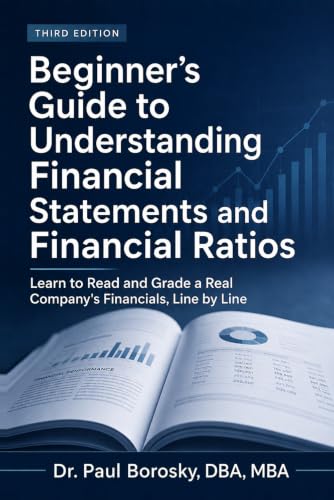
Beta tells you the swing. The statements tell you the business.
Dr. Paul's Beginner's Guide to Understanding Financial Statements and Financial Ratios uses Apple's actual 10-K to show the company behind the stock, so you understand what drives the risk you are measuring.
Written by Dr. Paul Borosky, DBA, MBA, current college professor, business consultant, and author with 14+ years and 1,000+ businesses served.
This page is for general educational purposes only. It is not financial, investment, legal, or tax advice.