
Dr. Paul Borosky, DBA, MBA
Business Plan Writer · Accounting and Finance Glossary
Fixed vs Variable Costs: Examples for Small Businesses
Some costs stay put. Others move with every sale. Knowing which is which is the base of any forecast or break-even point. As a business plan writer, Dr. Paul Borosky, DBA, MBA, builds projections on that split every week. This guide explains fixed and variable costs, shows a landscaping example, and covers the costs that fall in between.
Questions? Call or text (321) 948-9588. Dr. Paul answers personally.
Last Updated: 11/07/2026 · Written by Dr. Paul Borosky, DBA, MBA
The Short Answer
What Are Fixed and Variable Costs?
Do Your Projections Know Which Costs Move?
In Plain English
Costs That Stay vs Costs That Move
Fixed costs stay the same every month. Variable costs go up and down with how much you sell.
Rent shows up whether you sell anything or not. Fuel shows up with every job. Knowing which is which tells you how the business behaves in a slow month.
Watch: Fixed and Variable Costs
Watch Dr. Paul Put These Costs to Work
Monthly Fixed Costs in Pro Forma Projections
How Dr. Paul lists the fixed costs that show up every month, sales or not. (9:15)
Break-Even Point Formula
Fixed costs plus the variable cost of each sale give you break-even. Here is the formula. (2:14)
A Real-World Example
The Landscaping Company in a Slow Month
A landscaping company in Tampa, Florida has fixed costs of $4,200 a month: insurance, software, storage, truck depreciation, and loan interest. Its truck loan payment is $1,100 a month in cash, but only the interest part is an expense. The principal pays down the loan.
Fuel, mulch, and crew hours rise with each job. In a busy month, the business looks great. In a slow month, the fixed costs eat the profit. The owner sets a monthly sales floor from the split and books maintenance contracts to cover it. Every lawn care business should know that number.
From Dr. Paul’s Fabled Forest
Sunny the Sea Otter and the Busy Cart
Doctor Owl was at the woodworker’s stall, haggling over a hand-carved pen, when Sunny the Sea Otter drifted up, belly-up on the tide with her cart in tow.
“My cart is the busiest on the kelp coast,” Sunny said, “and the cheapest. And I’m still broke.” She patted her heart. “Feel it… it’s real.”
“What does each trinket cost you to make?” Doctor Owl asked.
Sunny knew her cart rent to the coin. She had no idea what each shell bead and ribbon cost her.
Doctor Owl drew two columns on a scroll. One for costs that never move: the cart rent and the stall fee. One for costs that come with every sale: beads, ribbon, and wrapping.
Sunny added up the second column for a single trinket. It was bigger than her price. She sold every trinket at a loss, and the busier she got, the faster the coins left.
The next morning, Sunny’s prices went up by three coins. The cart stayed busy.
This story is one of dozens told across Dr. Paul’s Fabled Forest Business School Series. You just read one from Book 2.
Dr. Paul’s Insight
Dr. Paul builds his projection models on this split, because it shapes how the business behaves in a slow month.
Put It to Work
Fixed vs Variable Costs, Side by Side
| Fixed | Variable | |
|---|---|---|
| Changes with sales? | No | Yes |
| Examples | Rent, insurance, salaries, depreciation, loan interest | Materials, fuel, shipping, card fees, commissions |
| Danger | Hurts most in slow months | Hurts most when the price is too low |
| Used for | Break-even point | Contribution margin per sale |
Cash vs expense: a loan payment is a fixed cash outflow, but only the interest is an expense. Plan cash and profit separately.
Gray area: semi-variable costs have both parts. A phone plan with a flat monthly fee and overage charges is one example.
Watch Out
Pitfalls When Sorting Fixed and Variable Costs
Your forecast will miss how fast costs climb in a busy month.
Principal reduces the loan. Only interest belongs in profit.
They come with every sale, so they belong in the variable column.
A second truck or a new hire is fixed once you add it, and it jumps at higher volume.
Why It Matters
Benefits of Knowing the Difference
- An accurate break-even point
- Better pricing floors
- Projections that hold up in slow months
- A clearer case for lenders
In Your Business Plan
How Fixed vs Variable Costs Shows Up in a Business Plan
Lenders test every plan against a slow month. A clear fixed and variable split, with break-even shown, answers that test.
Sample plan excerpt: Financial Plan, Assumptions
“Fixed expenses total $4,200 per month (insurance, software, storage, truck depreciation, and loan interest). Variable costs are projected at 42 percent of revenue, so break-even revenue is about $7,240 per month. The cash flow forecast separately includes the $1,100 monthly truck loan payment.”
FAQ
Questions Owners Ask About Fixed and Variable Costs
Is payroll a fixed or variable cost?
What is a semi-variable cost?
Why do lenders care about fixed costs?
More From the Series
Keep Building Your Business
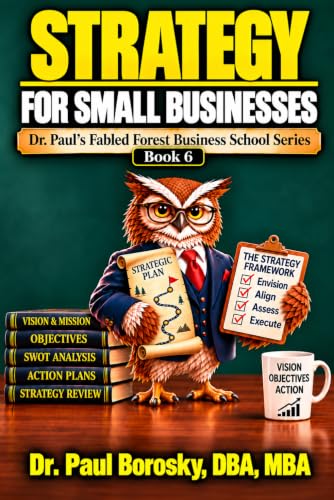
Every book in Dr. Paul’s Fabled Forest Business School Series teaches one subject through short stories, real terms, and one-page worksheets.


Dr. Paul Borosky, DBA, MBA
Dr. Paul is a business consultant and author with 14+ years of experience and 1,000+ written business plans. He works with owner-run small businesses on plans, financial projections, and the systems that let a business run without the owner doing everything. This page is part of the glossary for Accounting and Finance for Small Businesses, Book 2 of Dr. Paul’s Fabled Forest Business School Series.
This page is for general educational purposes only. It is not tax, legal, accounting, or other professional advice. For decisions about your own business, consult a qualified professional.